Ratepayer bill aimed at data center buildout blocked in Senate
Published in Political News
WASHINGTON — High-profile legislation amounting to lawmakers’ first real stab at addressing voter anger over data centers stalled in the Senate on Thursday after securing overwhelming support in the House a day earlier.
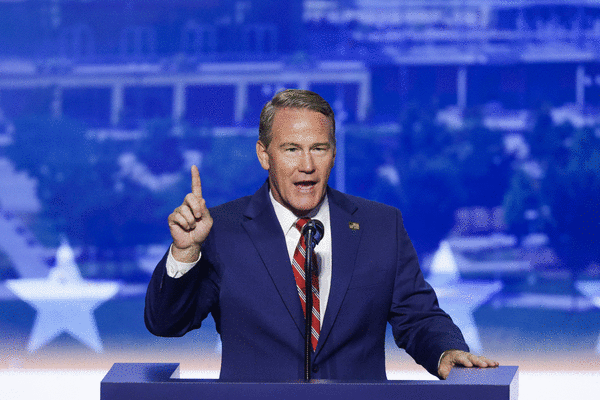
Senate Energy and Natural Resources ranking member Martin Heinrich objected to a unanimous consent request by Sen. Jon Husted, R-Ohio, to clear the bill, which would require state regulators to consider adopting standards to ensure large data centers pay for needed electric grid upgrades.
Heinrich, D-N.M., said the House-passed bill was insufficient because the new standards would be voluntary, and that his alternative legislation to force large industrial power users to shoulder the costs was the better option. Sen. Bernie Moreno, R-Ohio, in turn objected to Heinrich’s request.
The House bill, which Husted also introduced in the Senate, would require state utility commissions to evaluate rules to force data center operators who need massive amounts of power pay for the cost of infrastructure upgrades such as new power generation or transmission lines.
The bill would codify portions of President Donald Trump’s “Ratepayer Protection Pledge,” a voluntary agreement signed by over 300 utilities, electric cooperatives, hyperscalers and others.
The idea behind the push is to avoid those costs getting passed through to residential consumers in the form of higher electricity rates — a dicey issue on the campaign trail, including in Husted’s race against ex-Sen. Sherrod Brown, D-Ohio, whom Moreno defeated in 2024.
Speaking on the Senate floor, Husted said that data centers support “almost every aspect of modern life,” yet said that companies should be required to foot the bill for this expansion.
Failure to act, he added, would cause opposition to grow stronger. “Americans are understandably concerned about rising electric bills, if they believe every new data center will make their monthly bills go up, public opposition will grow, communities will reject plans, construction will slow and China will gain ground,” Husted said.
The bill, sponsored by Rep. Gabe Evans, R-Colo., in the House, does not require the states to adopt any standard, however — only that they begin the process of considering new rules within one year of enactment and close out the docket within two years.
In objecting to swift passage, Heinrich said the bill “falls short of what we need to do to respond.”
“If hyperscalers and other Big Tech developers need expensive new facilities and more energy, they should pay for it,” said Heinrich. “It’s not enough for us to tell states to consider making data centers pay for grid updates. Rather than voluntary pledges or suggestions to states, Congress needs to pass real legislation, with real teeth.”
Heinrich added that Congress should do more to force data center developers to engage with communities, conserve water and force the adoption of clean energy and battery storage.
Heinrich’s bill would require artificial intelligence “hyperscalers” and other large-load customers to finance the electric grid infrastructure they need, while allowing the companies to fund grid upgrades and receive reliable transmission service in exchange.
Moreno said Heinrich’s actions amounted to “Democrat obstruction.”
Husted and Evans are two of their respective chambers’ most vulnerable GOP incumbents in the November midterms. Inside Elections with Nathan L. Gonzales rates both their races Toss-ups.
After Thursday’s dueling objections, Senate Majority Leader John Thune, R-S.D., said whether the chamber revisits the ratepayer bill depends on how quickly lawmakers get through other business, including a potential deal on an energy infrastructure permitting overhaul measure.
—Aris Folley contributed to this report.
©2026 CQ-Roll Call, Inc., All Rights Reserved. Visit cqrollcall.com. Distributed by Tribune Content Agency, LLC.































Comments