Bill aimed at voter anger over data centers passes House
Published in Political News
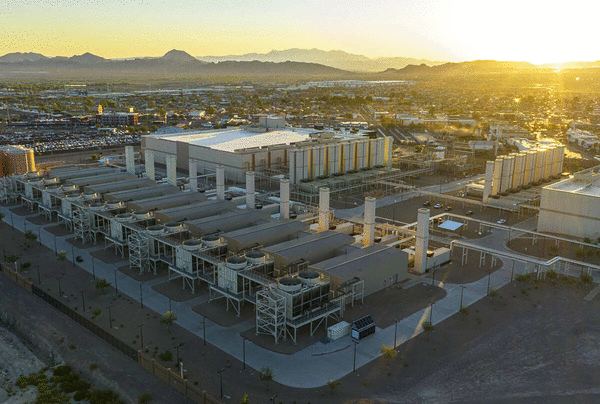
The House passed legislation Wednesday that would direct states to consider adopting federal standards for large-scale industrial power users, an attempt to address growing voter anger over the speed and scale of data center development.
The bill passed 417-3 under suspension of the rules, a procedure that requires support from two-thirds of members present and voting. It was introduced by Rep. Gabe Evans, R-Colo., with Rep. Kathy Castor, D-Fla. — two of their respective parties’ most vulnerable incumbents this November.
The bill would amend the 1978 law known as the Public Utility Regulatory Policies Act to require states to consider adopting federal standards for ratepayers that would ensure data centers and other large-load customers cover the costs of necessary grid upgrades. That’s intended to prevent costs from being passed on to other energy consumers.
Speaking on the House floor Tuesday, Evans said that the buildout of data centers is necessary to ensure the U.S. remains competitive with China in the growth of artificial intelligence.
“But with that growth our demand for energy is also skyrocketing, and some people have very understandable reservations and questions about data centers,” said Evans. “We cannot accelerate this growth on the back of Americans working hard to pay for electric bills at the end of the month.”
The three “no” votes came from Democrats: Summer Lee of Pennsylvania, Rashida Tlaib of Minnesota and Delia Ramirez of Illinois.
Senate Majority Leader John Thune, R-S.D., has said it was possible the House bill could clear the Senate before the elections, though that would likely require unanimous consent given a full floor agenda this month.
It would certainly help out Sen. Jon Husted, R-Ohio, the lead sponsor of that chamber’s version of the House bill. Husted is facing a tough race against ex-Sen. Sherrod Brown, D-Ohio, who has been targeting Husted’s past support for data centers when he was the state’s lieutenant governor.
The top Senate Democrat on energy policy suggested the lack of an enforcement provision in the legislation means that it will not address the concerns many voters have about strain on the grid and the wider impact on their utility bills.
The House bill “does nothing to meaningfully address the rising costs of AI data center development,” Senate Energy and Natural Resources ranking member Martin Heinrich, D-N.M., said in a statement. Instead, he said that chamber should focus on “legislation that makes AI data centers pay their fair share and actually protects families.”
Heinrich introduced a bill over the summer that would require artificial intelligence “hyperscalers” and other large-load customers to finance the electric grid infrastructure they need, while allowing the companies to fund grid upgrades and receive reliable transmission service in exchange.
‘Ratepayer Protection Pledge’
The House bill would codify portions of the White House’s “Ratepayer Protection Pledge,” a voluntary agreement signed by over 300 utilities, electric cooperatives, hyperscalers and others to sign.
PURPA itself has its origin in the energy crises of the 1970s and was designed to push states to consider other actions that would reduce costs. However, the bill would not require states to adopt any final regulations.
The House Energy and Commerce Committee approved the bill in June by a vote of 52-0. During the markup, the committee adopted an amendment that limited the definition of a large-load customer to facilities that require energy primarily “to operate information technology infrastructure and related systems pertaining to data storage and computational applications and services.”
The definition more explicitly targeted data centers as opposed to the legislation as introduced, which was based on peak electric demand. After the change, groups representing other large-load users, including the American Iron and Steel Institute, dropped their objections to the bill.
Energy and Commerce leaders, including the panel’s chairman, Brett Guthrie, R-Ky., pushed for the full House to take the bill up during the September work period and before the chamber leaves for the final midterm campaign stretch.
Voting on the measure would acknowledge that many members have constituents who’ve expressed concerns about the effect of data center development on consumer energy costs, he said.
Negative sentiment
Polls have found that large portions of the electorate oppose data center development near their homes.
A survey of 1,000 people conducted by the University of Massachusetts at Amherst in late August found that 65% would oppose an AI data center in their local community. That includes 52% of Republicans, 71% of independents and 76% of Democrats polled.
Both of the bill’s lead backers are in competitive elections this fall; Evans’ district is rated Toss-up by Inside Elections with Nathan L. Gonzales, while Castor’s is rated Tilt Republican after Florida’s redistricting.
The bill has 35 Republican and seven Democratic co-sponsors. Many of the Republicans are in competitive races, including Reps. Jen Kiggans, R-Va., Tom Barrett, R-Mich., and Ryan Mackenzie, R-Pa.
Allison Clements, a Federal Energy Regulatory Commission commissioner from 2020 to 2024, said that the bill comes at a time when data center developers have been moving quickly, drawing criticism and calls for moratoriums from lawmakers at all levels of government.
“The ratepayer bill is useful in that it is a presumably bipartisan expression of support for the momentum that has been building at the state and local level,” said Clements. “But from an impact perspective, I think the actual change that occurs directly as a line from this bill is more limited.”
FERC and state agencies have also considered their own regulations. In June FERC issued six “show cause orders” to the regional transmission organizations under its jurisdiction to propose changes to address large-load interconnection. That came after direction from the Energy Department in October 2025.
_____
(Jackie Wang contributed to this report.)
_____
©2026 CQ-Roll Call, Inc., All Rights Reserved. Visit cqrollcall.com. Distributed by Tribune Content Agency, LLC.
















































Comments