Stores, financial institutions come up short as penny production stops
Published in Business News
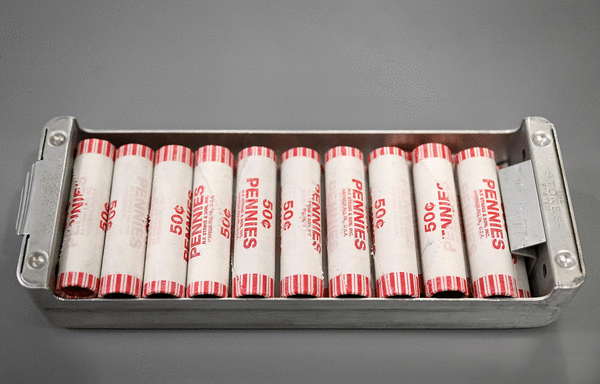
DETROIT — Marie Shoulders of Detroit has a penny purse, a penny jar and a small penny pouch.
As a self-confessed penny hoarder, she wasn't surprised to hear about the scarcity of the reddish-brown copper-and-zinc coins.
"The pennies are short because people have them at home in they drawers, purses and everywhere. I keep them. ... There's not a shortage, they're out there, we have them," Shoulders, 66, said. "We are penny hoarders."
Shoulders used a coin kiosk machine for the first time Wednesday afternoon at Diversified Members Credit Union in downtown Detroit, donating 35 cents from her stash to the financial institution, which posted a sign in its lobby saying that "pennies may be limited and/or unavailable upon request."
The Detroit credit union is not the only establishment worried about running short of the coins emblazoned with Abraham Lincoln's profile.
National and local retailers have been asking customers for exact change or to check out digitally during transactions as a federal decision to cease penny production has reduced circulation of the 1-cent coin even further.
President Donald Trump ordered the U.S. Mint in February to stop making pennies, saying it cost more to produce them — nearly 4 cents — than they were worth. The mint in Philadelphia struck the last pennies Nov. 12, ending production that began in 1793. The government is expected to save $56 million per year as a result of the decision, according to the mint.
Last year, the U.S. Mint struck about 3.2 billion pennies, which typically have a 30-year life span.
Banks and businesses will continue to take the coins during transactions but distribution back to consumers has been especially challenging since production stopped. For every 10 pennies produced, only three recirculate, while the others end up in coin jars or other random places, according to Jeff Lenard, spokesperson for NACS, an association of convenience and fuel retailers.
The Retail Industry Leaders Association said in a release that Federal Reserve locations began reporting depleted supplies as early as the summer. By mid-November, more than 100 of the 165 coin distribution sites across the country were penny-less.
Retailers struggle to adjust
Lenard said convenience stores have three "bad options" to deal with insufficient penny supplies: rounding down in the customer's favor, which would cost an estimated $1.25 million daily; round up or down to the nearest nickel, which based on various state and federal regulations, could subject Michigan retailers to possible fines or lawsuits; or lastly, encourage customers to pay with credit cards, which incurs swipe fees.
Hussein Nassar, who owns a Marathon gas station in Allen Park, said about a third of his customers use cash and are confused by rounding up or down to the nearest nickel.
"Let's say the total is $1.92, I'll put it at $1.90. It depends. If it's $1.94, I round it to $1.95," Nassar said. "Many people do complain and most of them, they don't really know what the issue is."
The issue: Nassar hasn't been able to get pennies from the bank for multiple weeks.
"If you go to the bank, they tell you they don't have it and they have to put in an order for you ... (or) it's not at all available. I was able to get a few, like a half box, but now, lately, they've been saying they're out."
On Monday, the state issued a notice regarding the phase-out of pennies in reference to Michigan's 6% sales tax. It said retailers may round the amount due from customers up or down, based on their own discretion, to the nearest nickel. The General Sales Tax Act and Use Tax Act requires rounding based off the third decimal place of the sales tax and that retailers round up to whole cents when the third decimal place is greater than four or round down to a whole cent when the third decimal place is four or less.
Convenience stores started noticing issues in June as penny production was being phased out, Lenard said.
"Pennies are the coin that needs to be circulated more than any other coin," he said. "It is the least loved. Whether it's in ashtrays or cars, they tend to pile up and not get used."
Lenard noted that the association wrote to Congress in October, asking federal lawmakers to pass legislation allowing businesses to round transactions to the nearest nickel. He added that customers are taking to social media expressing discontent with retailers rounding up in some stores and down in others.
"Anytime somebody doesn't feel good about coming to your store, you could possibly lose them for good," Leland said. "And it's something simple, you're trying to do the right thing with this penny shortage and you lose a customer because of a misunderstanding.
"We just need resolution. This transition has been successfully done in other countries like Canada and Australia, but when it was done in those countries, it was a process in place. ... We need Congress to act and say 'These are the things that we can do,' so that retailers have a path forward," Lenard said.
'Not a crisis, just a transition'
Coin collector Mike Dallas of Grand Rapids teaches 40 students in Grand Rapids Public Schools how to analyze pennies as a use of copper and their importance in history. He also uses them for business classes, starting a student off with a roll of pennies and challenging them to grow that 50 cents into dollar bills.
"My favorites are pennies from the '50s or '60s because of the way it feels and looks," Dallas, 44, said.
"I'd order a box of pennies but now I can't order those boxes anymore, so when I go in, I'd tell them I want $10, or 20 rolls, and pretty much they'll give me what they can or tell me that I can't have any pennies," he said. "I've been cut off."
Local banks like Fifth Third and Huntington have told Dallas to look elsewhere for pennies this month as they prioritize businesses. And Mark Evenson, CFO at Diversified Members Credit Union, said the institution would be following similar protocols.
Evenson, who has been in the industry since 1996, said although the credit union currently has a stockpile of pennies, it will prioritize small businesses that need coins for their operations.
"We've been through coin shortages before," he said. "It's not the first time. It's just the first time that they're going to be going away forever, so it's going to be educating our members, the retailers educating their customers and there'll be some short-term pains, lack of understanding. However, we'll get through it. It is not a crisis, just a transition."
Businesses, especially those that are cash-intensive, are most at risk being affected by a shortage, he said.
"They can't walk into Diversify and order 50 rolls of pennies for their daily operating. Retailers are going to have to make a decision on what they do from their perspective," Evenson said. "It really averages out. You might pay an extra 1 cent for your purchase today but your purchase tomorrow, you might have saved a penny."
©2025 www.detroitnews.com. Visit at detroitnews.com. Distributed by Tribune Content Agency, LLC.








Comments