Commentary: What Trump's 'triumphal arch' really means for America
Published in Political News
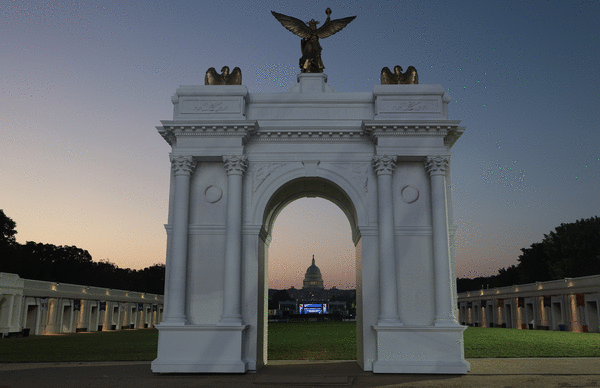
President Donald Trump’s planned 250-foot-high triumphal arch at the foot of Arlington National Cemetery, which he has proposed outfitting with armed drones and manning with snipers, is easy to shrug off as nothing more than a malignant daydream. The absurd whim of a mad king. But to indulge that temptation would be a mistake.
The arch has to be taken seriously as a concrete manifestation of Trump’s conception of American politics and his self-appointed role as America’s savior, asserted in his 2017 inaugural address portraying “American carnage.” The arch flows logically from his worldview, which is one of militarized autocracy that undermines the democratic process, unambiguously demonstrated on Jan. 6 and ever since in his arrogation of power in the economic, civil and military realms of government and his obvious and substantive enmity toward all left-of-center Americans.
The pretext of “national security” for the arch, as well as the massive ballroom Trump plans to build on White House grounds, raises questions about just what sort of threat the president actually envisions, whom he contemplates the sniper fire and battlefield drones will target and why he thinks this obscure threat is directed at him.
The rambling speech Trump gave a year ago to some 800 flag and general officers whom Secretary of Defense Pete Hegseth spontaneously summoned from all points to Quantico, Virginia, provides troubling clues about the real targets.
Trump told those in attendance, “we’re under invasion from within, no different than a foreign enemy.” Here he seemed to be referring to undocumented immigrants. Then he bragged of signing “an executive order to provide training for a quick reaction force that can help quell civil disturbances,” and mused that “our history is filled with military heroes who took on all enemies, foreign and domestic.” The next segue in this unruly weave was to “insurrectionists” Trump claimed were “paid by the radical left,” followed by self-congratulation for deploying the military “to secure the nation’s capital.”
As to the precise identification of the enemy, Trump’s September 2025 National Security Memorandum named antifa — an amorphous, decentralized leftist movement — as a “domestic terrorist organization.” He claims antifa is guilty of anti-Americanism, anti-capitalism, anti-Christianity, extremism on migration, race and gender, and of hostility toward traditional American views on family, religion and morality. No other federal instrument accords antifa this august status.
Trump’s 2026 counterterrorism strategy dwelled on “politically motivated killings of Christians and conservatives” and specified hatred of Christianity as an indicator of violent extremism. Add up all these qualifications, and it’s clear that the enemies Trump has chiefly in mind are not Chinese, Russians, Iranians or jihadists, but the Americans who politically oppose him. The weapons in the arch would be fired on them.
From this perspective, the triumphal arch looks like a baldly coercive tool of regime security and the ultra-secure ballroom like an impregnable command bunker.
Trump has claimed that he’s building the arch at the military’s request. Although this is almost certainly untrue, neither Chairman of the Joint Chiefs of Staff Gen. Dan Caine nor any other authoritative military spokesman has denied it. The notion that the civilian leadership, which under Hegseth has purged the Pentagon of praetorian critics, would object is fanciful.
The military has so far done whatever Trump has asked of it — including committing probable war crimes in killing suspected Venezuelan drug traffickers without attempting to apprehend them. The sole active dissenter to come to light, Adm. Alvin Holsey, was fired, while the top ranks of the military have been purged for reasons that have not been revealed, even to the House and Senate Armed Services committees.
The arch is also in line with significant changes in the United States’ homeland security approach that ominously project the wholesale militarization of domestic law and order. In particular, the Trump administration has established the U.S. Army Western Hemisphere Command, activated in December 2025. The express purposes of this new command — now the Army’s largest — include integrating its “domestic-response capabilities” with its traditional expeditionary functions and providing “defense support” to American civilian agencies.
At least sporadically, integration has already begun. The Trump administration has deployed the National Guard for garden-variety law enforcement and purposely blurred the line between military action and civilian policing by means of his paramilitary group of immigration and customs agents with an extra-constitutional mandate whose officers have killed American citizens with impunity. At times, Trump has positioned active-duty military units to support ICE. On this record, a compliant Hegseth-purged military should not be expected to refuse deployment to the arch in anticipation of orders to fire on fellow U.S. citizens.
Trump’s focus on coercively subverting American democracy poses strategic as well as civic problems. His diversion of presidential effort to chimerical domestic threats inevitably distracts the administration from external ones. Indeed, Trump’s preoccupation with the arch and the ballroom against an international backdrop of instability and privation stemming from his ill-informed and recklessly conducted war of choice has been conspicuous and alarming.
The president’s seeming apathy about the state of the world that he’s leaving in his wake suggests that for Trump there are no external adversaries as such, just outside sources of personal enrichment or personalized antagonism. For the rest of us, his strategic obliviousness and potentially lethal contempt for more than half of his own electorate are matters of national security.
Constitutional remedies — including impeachment and conviction under Article II and removal under Section 4 of the 25th Amendment — each require strong congressional consensus. Too many Republican senators remain inclined to dismiss Trump’s autocratic designs as evidence of merely decorative egomania to dislodge him under these provisions.
In 2021, all Trump supporters had in their bid to overturn an election was a crowd-sourced far-right rabble. In 2029, the president could have his state-of-the-art gun turret and a U.S. military mobilized to suppress political opposition. If there’s a silver lining in what would amount to state terror, it is that the prospect reveals so clearly Trump’s malign intent and unstable state of mind and provides strategic warning.
The steep decline in Trump’s approval ratings means that the target set for his weaponized arch has significantly expanded. With more than two years left in his final term, American voters could choose to limit his room for maneuver at the ballot box in November’s midterm elections. At the very least, this might yield urgent bipartisan engagement on the clear and present danger of his presidency.
____
Steven Simon is a visiting lecturer at Dartmouth College. Jonathan Stevenson is a senior fellow at the International Institute for Strategic Studies. Both served on the U.S. National Security Council.
_____
©2026 Los Angeles Times. Visit at latimes.com. Distributed by Tribune Content Agency, LLC.












































Comments