5 Republicans join as Senate Democrats move to curb Trump military actions in Venezuela
Published in Political News
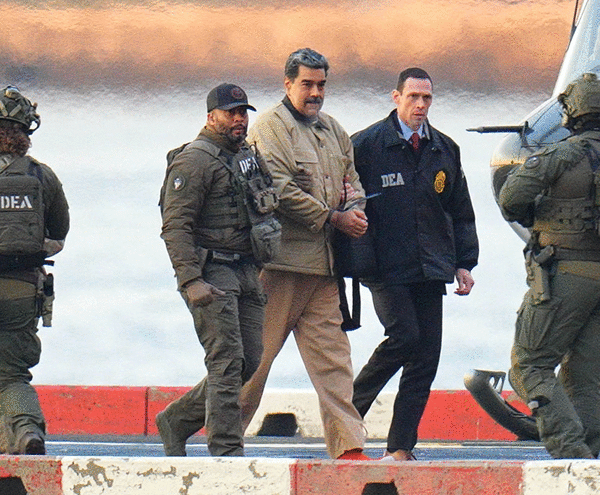
WASHINGTON — The Senate on Thursday delivered a stinging rebuke to President Donald Trump’s Venezuela action, moving ahead with a bid by Sen. Adam Schiff and his colleagues to bar the use of U.S. military forces to act in or against Venezuela unless Congress gives its consent.
The 52-47 vote came after often angry and puzzled lawmakers got briefings from top Trump administration officials on the Saturday strike that captured Venezuelan President Nicolás Maduro and his wife. They are now in New York awaiting trial on drug-related charges.
Five Republicans joined Democrats to push the measure forward. A final vote is expected later Thursday or Friday.
Schiff, D-Calif., and his allies have tried twice in recent months to force President Donald Trump to get congressional authorization before engaging militarily in Venezuela. Both efforts failed along party lines.
Democrats warned that the vote could send Trump a strong message that he needs to consult Congress before taking military action. Trump and his allies have suggested more U.S. activity in other countries, notably Colombia, Greenland and Cuba.
“If there was ever a moment for the Senate to find its voice, it is now. The Senate must act to stop Donald Trump’s folly,” Senate Minority Leader Chuck Schumer, D-N.Y., told colleagues just before the vote.
Republican leaders said the legislation’s purpose was political.
“The effect of this is to slap the president of the United States in the face, That is the only effect that this vote can have. It can have no practical effect,” said Senate Foreign Relations Committee Chairman Jim Risch, R-Idaho.
Schiff wants to invoke the 1973 War Powers Resolution. The Vietnam War-era measure permits a president to launch military action in an emergency and then notify Congress within 48 hours. That action can last 60 days plus a 30-day withdrawal period unless Congress says otherwise.
The president could strike in an emergency and notify Congress within 48 hours. He can proceed with the military action for 60 days, plus a 30-day withdrawal period, unless Congress agrees otherwise.
Schiff and Democrats vs. Trump
After the strike, Secretary of State Marco Rubio said it was a law enforcement operation and, as a result, did not need congressional consent.
Risch insisted Thursday the legislation was unnecessary.
“If the resolution were drawn to say, president, you can’t do this anymore, that would actually have some affect, or attempt to have some effect,” he said, though he added that would be unconstitutional and unenforceable.
Look at it this way, said Sen. Mitch McConnell, R-Ky.
“The president was well within this authority in his decision to bring Nicolás Maduro to justice. How do we know? A number of ways,” he said. ““First, plain statute: Notification of Congress within 48? Check. Withdrawal within 60 days? Try 60 minutes!”
But not only were Schiff and his allies outraged over the Venezuela attack, but were concerned it could be repeated elsewhere.
“If Congress does not exercise its constitutional war powers now, there’s no telling where Donald Trump will send our military next.” Schiff said.
Democrats also protested what they said was a lack of a solid plan what to do next in Venezuela.
“Donald Trump seems content to drag our country and American families into an endless war with no plan, no transparency, and nothing but wishful thinking. But Congress can stop this,” Schumer said.
_____
©2026 McClatchy Washington Bureau. Visit at mcclatchydc.com. Distributed by Tribune Content Agency, LLC.

















































Comments