Amid deep freeze, oil powers New England grid
Published in Weather News
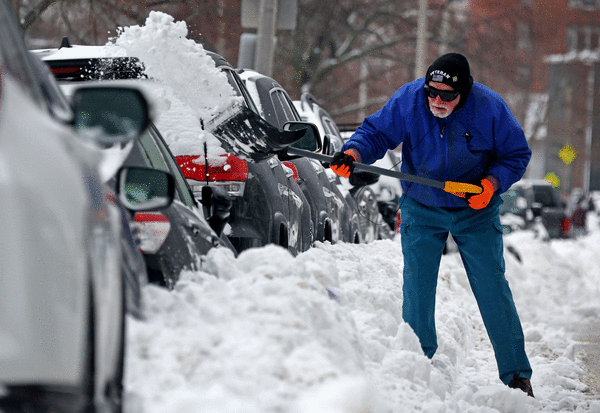
BOSTON — During the largest winter storm of the season, which saw up to 2 feet of snow blanket New England as a deep freeze sent temperatures plummeting into the single-digits, the regional grid reported that oil was heavily relied on while renewable energy sources provided negligible electrical power.
Oil-fired power plants have been the primary source of electricity for New England states over the frigid past few days, accounting for over 40% of electricity for the region during peak periods, according to the Independent System Operator (ISO) New England. On Sunday, where temperatures reached as low as just seven degrees in Massachusetts, oil-fired plants accounted for 43% of electricity on the ISO-New England grid.
As of the latest update Tuesday night, ISO-New England reported that oil was again the main provider of electricity to the grid, accounting for 32%, followed by natural gas at 27% and nuclear at 17%. Renewable sources combined to provide just 6% of the grid’s electricity.
Executive Director of the Massachusetts Fiscal Alliance Paul Craney says the heavy dependence on oil paired with minimal contribution from renewables displayed an “utter failure” by green energy resources.
“During the last few days, the primary source of energy has been oil. When you look at oil, natural gas, and nuclear, it is by far the vast majority of how we’re powering our grid. So, the test of whether solar, wind, and hydro be able to keep up with peak demand was just nothing short of an utter failure,” Craney told the Herald.
“And you layer that on when you have people like Governor Maura Healey and Environmental Secretary (Rebecca) Tepper, who are demanding to build out more of these renewables with ratepayer money. It’s billions upon billions of dollars now we’re spending, and when it was put to the test, it was just an utter failure,” he said.
At the same time Sunday, renewable energy sources like offshore wind, solar and battery storage provided just 8% of electrical power to the grid. Wind power generated more than half of the combined power from renewable sources, followed by wood, refuse, landfill gas and solar – which brought in less than 1% of that combined renewable power.
When it comes to the cleaner natural gas, typically the foundation of the system, it produced a surprisingly low 24% of electrical power to the grid. Craney says that’s because it was constrained by limited pipeline capacity – an issue he points to Gov, Maura Healey and her stoppage of two natural gas pipelines to Massachusetts as attorney general for contributing to.
Healey has gone back and forth over whether she stopped the two pipelines, deflecting blame for soaring energy costs in Massachusetts and telling the Herald she “didn’t do that” when pressed on the issue in November, before later acknowledging that she stopped them while claiming she got ratepayers “out of a bad deal.”
MassFiscal says the priority by five of the six New England states to implement the use of renewable energy sources is ideologically driven and does not take into account the extreme expenses in building out infrastructure paired with minimal output. The organization is calling on state lawmakers and Gov. Healey to repeal the Net Zero Emissions by 2050 climate mandate and instead adopt energy policies focused on reliability and affordability.
“Governor Healey needs to put her pride aside and repeal this law. Legislative leaders need to do the same. You can’t continue down this path of throwing billions of dollars to something that doesn’t work and expect a different result,” Craney added. “We think it’s time these legislators, legislative leaders, governors in England, repeal the net zero mandate. It’s not realistic. It was just put to a stress test. And anyone that looks at this objectively knows this is not how you build an energy infrastructure for New England. It just does not work. They need to reverse course.”
The newly connected hydro power coming in from Canada also provided negligible results, accounting for just 3% of electrical power to the grid on Sunday. This comes just over a week after Gov. Healey flipped a large promotional light switch in front of the media signifying the start of the power source coming to Massachusetts.
“All this fanfare of hydro, after years of developing the extension cord in Canada, and what happens when it gets really cold in the region? Canada needs that energy and it was cut off. So, you can make the case that some of these energy sources can be used from time to time when the weather is mild, but this is New England,” Craney said. “We have cold winters. We have to have a grid that can sustain us. This was a test, and it just does not work. Net zero does not work. It’s not realistic.”
_____
©2026 MediaNews Group, Inc. Visit at bostonherald.com. Distributed by Tribune Content Agency, LLC.




Comments