Noise canceling's nemesis: Sony's new LinkBuds let everything in
Published in Science & Technology News

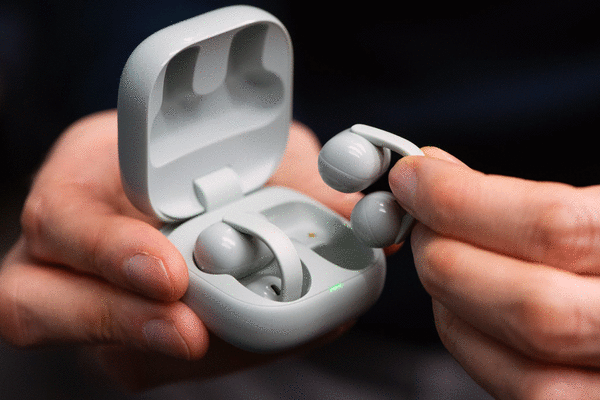







TOKYO — Sony’s new LinkBuds Clip may not be the best-sounding earbuds in the world, and their little case could be mistaken for a ring box, but there are at least two things that make them stand out from the crowded market of earbuds.
Unlike most earbuds and headphones these days, they're not pretending to let you keep the world out. In fact, they want you to do exactly the opposite: the earbuds don't block your ear canal, meaning you hear the world as you normally would, with your audio as a kind of background soundtrack.
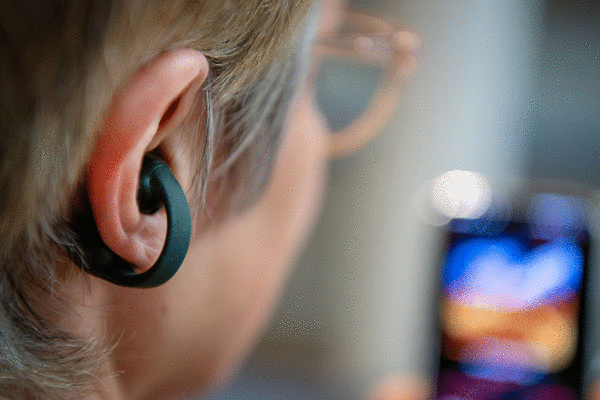
The second stand-out feature is the design and overall look. Instead of jamming something into your ear canal, you're clipping what looks like an oversized fake earring onto the area just above your earlobe.
Like Motorola’s Moto Buds Loop, the LinkBuds Clip consist of a small round speaker you put in your ear just in front of (and not on top of) your ear canal. This is attached to a flexible band that loops around to a battery capsule behind your ear.
It looks unusual at first, but proves quite comfortable to fit onto the ear.
Ideal for staying alert to surroundings
Essentially what the LinkBuds do is make your audio the dominant sound in a general soundscape of other sounds.
The benefit is that you remain aware of your surroundings, which is practical on the street, allowing you to stay alert and avoid surprises.
People who use noise-canceling earbuds from Samsung, Apple and Sennheiser might say "so what? I can always turn on 'transparency' mode on my earbuds and hear the world if I want to!"
But not like this. There is no artificial hiss and tinny sound of the real world being fed back to you through microphones. You use your ears to hear the world naturally, without digital processing.
It also makes sense in the office, since you are not completely isolated acoustically.
Battery life is 4 to 9 hours depending on use. The case holds power for up to four additional charges. You can pair the buds with an Android or iOS smartphone via Bluetooth. You will miss a wealth of settings such as an equalizer, sound modes and multi-device connectivity unless you use the Sound Connect app.
A look at the privacy terms is advisable. Depending on the level of personalized services chosen, a lot of personal data may be sent around the world.
In the app you can select modes such as:
•Standard: For listening to music and podcasts, and taking calls as expected.
•Voice boost: Amplifies voices, particularly useful in noisy environments.
•Sound leakage reduction: Reduces outward leakage so people around you hear less of what the LinkBuds are playing.
•Background mode: This is genuinely impressive. Music and podcasts sound as if they are not being played into your ears, but more like audio coming from a distant speaker somewhere in the room. Whatever you listen to blends into the ambience of the café or office. Three settings are available, from small room to living room to café.
•Plus sound optimizations and spatial sound.
In daily use the LinkBuds are controlled by tapping the flexible connector. It takes a bit of learning before you get the hang of the tap sequences.
Beyond media controls, you can adjust the volume and other functions by tapping, and you can configure this in the app.
At least good enough — surprisingly decent for music
The sound is not as bombastic as from sealed earbuds like AirPods or Sony’s own WH1000-MX6, but it is usually good enough and often really good.
On calls, AI combined with multiple microphones is meant to deliver good voice quality. We found this to be okay, but not impressive, even after a software update.
They are much better for music, where the LinkBuds offer a pleasing sound and a surprisingly good bass for this form factor.
Thanks to the many settings, the LinkBuds also stand out for podcasts and as a computer headset in the office. The background mode is also a real plus, at least for some.
There downsides? There are few. People with large ears may struggle to get them to sit firmly.
Compared with Bose’s comfortable Ultra Open Buds or Motorola’s Moto Buds Loop, they are more noticeable in this tester’s ear. They are not quite uncomfortable, but you can feel something is clipped onto your ear.
The many settings are a plus
Noise canceling is not on the spec sheet for these new earbuds, which is fine because open designs cannot do that.
They combine very decent sound with a more inclusive approach to environmental noise. It's an interesting concept, implemented by Sony with many configuration options and a stand-out design in four colors.
Similar models are available not only from Motorola but also from Anker and Bose, mostly a bit cheaper. If you like Sony and the design, and value the app’s feature, it's a good choice. Prices will likely fall significantly in the coming weeks and months, so it may be worth waiting.
©2026 dpa GmbH. Distributed by Tribune Content Agency, LLC.






Comments