Robots are teaching autistic children social skills -- and it's actually working
Published in Health & Fitness
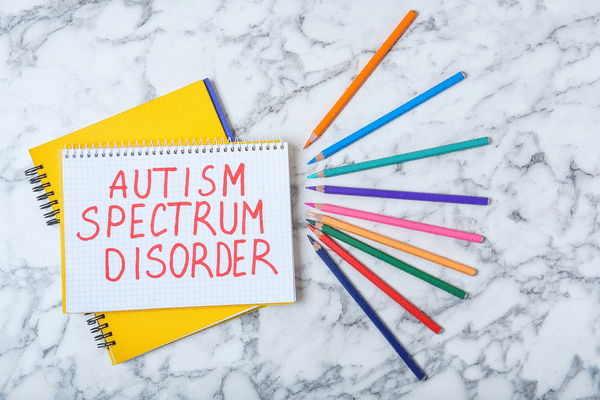
Adding robots to therapy can help autistic children develop foundational social skills like taking turns, making eye contact, and paying attention.
Researchers in Europe added a learning robot to one-on-one therapy sessions and to simpler setups, such as school or home settings. While treating autism spectrum disorders with robot-assisted therapy dates back to the early 2000s, the new study aims to better integrate robot-assisted activities into the therapeutic process and track long-term outcomes.
“Most previous studies on [robot-assisted therapy] for children with [autism] are proof-of-concept studies, clinical cases/single-case experiments, exploratory studies with small samples, experimental rather than clinical interventions, and often not guided by the evidence-based psychotherapy framework targeting established key mechanisms, such as joint attention, attention, and turn-taking,” the authors wrote.
Autism Spectrum Disorder is a developmental condition marked by complex, persistent challenges with social communication as well as restricted interests and repetitive behavior, according to the American Psychiatric Association. It affects an estimated one in 36 children and is considered a lifelong disorder, though individual needs for services and supports can vary greatly among individuals with autism.
In one trial, 69 children attended 12 biweekly sessions in a clinical setting. Those meeting with a robot and a human mediator achieved improvements similar to those of traditional human therapy, but with a significant increase in engagement, as measured by smiling and making eye contact.
A second trial treated 63 children with five sessions in a more casual setting and achieved similar outcomes. The second group showed greater imitation abilities when facing a robot rather than a human.
The researchers, based in Romania and Sweden, published their work in the journal Science Robotics in December.
The authors cautioned that their work did not include a control group in which children received no therapy and said they would like to see that in a future study.
“Overall, the results contribute to an understanding of the relevance of technological solutions in treating children with [autism spectrum disorder] and reducing the human workload that traditional therapies impose,” they concluded.
©2026 The Baltimore Sun. Visit at baltimoresun.com. Distributed by Tribune Content Agency, LLC.






Comments