Support dwindles for wealth tax, voter ID ballot measures, new poll shows
Published in News & Features
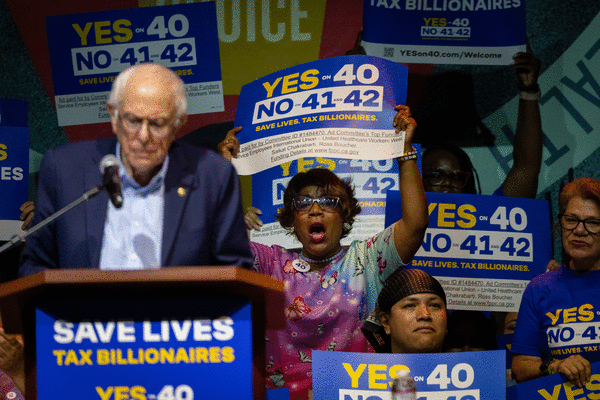
LOS ANGELES — California voters are souring on a Nov. 3 ballot measure to impose a one-time tax on billionaires to help fund healthcare programs, a proposal that has triggered one of the most expensive political battles in state history.
Half of likely voters plan to vote against Proposition 40, the proposed wealth tax on billionaires' assets, while 42% support it, according to a new poll by UC Berkeley's Institute of Governmental Studies that was co-sponsored by the Los Angeles Times. The findings mark a significant decline in support of the measure, which was crafted by an influential California healthcare union to compensate for an estimated $100 billion in federal healthcare cuts approved by President Donald Trump and congressional Republicans.
The survey also found that a solid majority of likely voters opposed Proposition 39, which would require Californians to provide identification when voting and election officials to verify registered voters are U.S. citizens. The findings come as the Trump administration continues to attack California as a haven for voter fraud, including unfounded allegations of rampant illegal voting by undocumented immigrants.
Mark DiCamillo, the poll's director, said previous surveys showed support for Proposition 40 has been fragile, and the most recent shows its prospects have dimmed as election day approaches.
The increase in opposition to Proposition 40 is "broad-based and spans virtually all major segments of the electorate," DiCamillio said. The ballot measure was leading in a Berkeley poll conducted just six weeks ago, albeit by a slim margin, so its reversal of fortune is significant, he said.
The declining support comes after an onslaught of money spent opposing Proposition 40, including a torrent of television and social media ads airing everywhere from NFL games to "Everybody Loves Raymond" reruns. Nearly $368 million has been contributed to efforts opposing the billionaire tax, while $36 million has been donated to support the proposed levy.
Proposition 40 would impose a one-time 5% tax on the assets of billionaires who resided in California as of Jan. 1, with some exceptions. Democrats and their allies are splintered over the proposal. Some, including Gov. Gavin Newsom, argue it will prompt the wealthy to flee California, further harming its volatile budget, which is dependent on the state's richest residents. The California Democratic Party and leading progressives support the measure, with Sen. Bernie Sanders, I-Vt., calling it a modest tax necessary to help Californians struggling because of cuts imposed by Republicans to pay for tax breaks for the wealthy.
While Republican voters overwhelmingly oppose Proposition 40, nearly two-thirds of Democrats support it and more than a quarter opposing it. There is also a generational divide, with 6 out of 10 voters 65 years old or older opposing the measure, while more than two-thirds of those under 30 supporting it, according to the poll.
The findings are similar to a Public Policy Institute of California poll released Tuesday, which found 52% of likely voters would vote against Proposition 40, while 46% supported it.
The campaign against the wealth tax, funded by some of California's richest tech moguls, is centered on three intertwined ballot initiatives: Proposition 40 and Propositions 41 and 42, both of which would undercut Proposition 40 through a series of changes to state tax laws and spending restrictions.
Proposition 41 would cut wasteful government spending by requiring audits of new state special taxes and would bar new state taxes that are exempt from a state spending limit. Proposition 42 would prohibit new taxes on retirement holdings, individually owned assets and other personal savings. Both Propositions 41 and 42 would nullify the billionaire tax if it passes, provided either measure receives more votes.
A plurality of voters oppose Propositions 41 and 42, a reversal from just six week ago, according to the poll.
In mid-September, voters were closely divided about Proposition 41 — 37% in favor and 33% opposed — with a large number of undecided. In the current poll, 38% of likely voters favor the measure and 47% oppose it. Proposition 42 led by 9 percentage points in the Berkeley/L.A. Times poll in September — 43% in favor and 34% opposed. Now, 43% of likely voters support it and 45% oppose it.
DiCamillo said backers of a ballot measure also should be concerned any time support registers below 50%, since voters who are undecided or unsure tend to vote no.
"It's below 50%, and it's trending down. Both of those are ominous signs," DiCamillo said. Proposition 42 is "still very close. I'm not saying it's definitely going down, but it's moving in the wrong direction late in the campaign, and usually movement in a late poll is even more significant than the actual numbers themselves,"
He added that while many voters were unaware the two proposed ballot measures were designed as poison pills to kill the billionaire tax, among those who knew, the opposition was significantly greater.
If all three measures fail, that still would be a victory for the billionaires who spent aggressively to tank the wealth tax.
Another notable finding was voters' support of Proposition 3, which would make permanent a higher income tax rate on the wealthy that funds education. A majority of voters — 54% — support continuing the levy, while 37% oppose it, according to the poll. DiCamillo says the disparity in support of the proposed billionaire tax and the extension of the existing wealth tax has been consistent in IGS's polls, and is likely because of the differing foundations of the levies.
"Proposition 3 is already in place, and if you read the fiscal impact, if this were to pass, it maintains $5 billion to $15 billion of annual funding," he said, "It's a big revenue generator, and I think that is something that's already in place."
"Voters kind of understand the progressive nature of California's tax system, and they kind of support that, but they don't support nearly as much the idea of some new kind of tax, the wealth tax, which is taxing assets rather than income," he said. "So that's the distinction."
These ballot measures are among 14 that voters will decide on Nov. 3, as well as statewide, congressional, local and judicial elections.
Among the other controversial measures is Proposition 39, a measure pushed by Republicans that would require all voters in future elections to show government-issued identification every time they vote in person or provide a special PIN or the last four digits of their Social Security number when submitting mail-in ballots.
The measure also would require the California secretary of state and county election officials to verify that registered voters are U.S. citizens by "using government data," which according to supporters could include information in the federal Social Security Administration database, jury summons information and other government records.
Nearly 6 in 10 likely voters oppose the effort, while more than a third support it, split largely along party lines. More than half of voters who are registered as "no party preference" or with a smaller political party oppose the proposal, which DiCamillo said was an indication of trouble for the proposition given the state's Democratic majority electorate and the proximity of the election.
"It's hard for Republicans to push something over the finish line by themselves," he said.
Other prominent ballot measures:
•Proposition 43, which would prohibit local governments from imposing certain new special taxes unless two-thirds of voters approve the proposal. Such proposals need a simple majority vote to be approved. While 46% of likely voters oppose the proposal, 36% support it, challenging numbers this close to election day, DiCamillo said. "It needs to get to 50," he said. "We'll see how you do that this late in the campaign."
•Proposition 4, which would repeal a prohibition of public financing of campaigns, allowing state and local governments to support candidates if they abide by several rules. Likely voters are evenly split about the proposal, with 41% supporting it and opposing it, and 18% undecided. "It's close, but it's still below 50%. Most voters tend to vote no in the late going if they're not convinced," DiCamillo said, adding that he viewed the lack of support among voters who do not affiliate with a political party as a signal of potential failure.
The poll of 2,787 registered California voters was conducted online in English and Spanish Oct. 19-25 and has a margin of error of about 3 percentage points in either direction.
©2026 Los Angeles Times. Visit at latimes.com. Distributed by Tribune Content Agency, LLC.




Comments