Israel's election deadlock opens up four possible scenarios
Published in News & Features
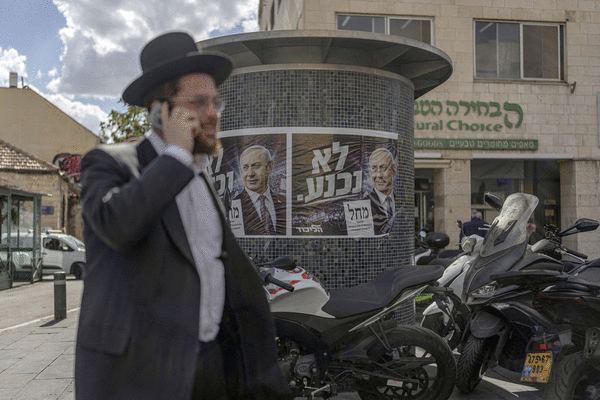
Israel’s election deadlock has set the stage for weeks or months of political horse-trading, with every path to a government likely to demand difficult compromises and broken campaign promises.
Prime Minister Benjamin Netanyahu and his right-wing religious allies are projected to secure 53 seats in Israel’s 120-member parliament, ahead of the opposition bloc’s 48 but short of a majority allowing them to rule without further backing.
The two Israel-Arab parties are set to occupy 19 seats, nearly doubling their parliamentary representation after frustration over rampant violence in their communities drove record turnout. On paper, they could support the opposition under former general Gadi Eisenkot.
President Isaac Herzog must now choose who will get the first shot at forming a coalition with enough support to ensure stable governance. If neither Netanyahu or Eisenkot are ultimately able to cross the 61-seat threshold, another election is possible next year.
“We must do everything to avoid another round of elections. I expect everyone who comes here to arrive with an open mind,” Herzog said Wednesday.
Here are the main scenarios in Israel’s coalition-building efforts:
Unity government
The clearest path to a majority government would be for Netanyahu, Eisenkot and other Jewish parties to reach a power-sharing deal.
While mathematically straightforward, the deal would amount to a reeversal of Eisenkot’s pledges to not serve under Netanyahu, whose Likud gathered more votes than any other individual party. The former general’s campaign leaned heavily on Netanyahu’s perceived security failures and saught to blame him for allowing the October 2023 Hamas attack.
Hours after the first exit polls were published, Eisenkot took to the stage and called for the prime minister to step away from political life.
An accord between Netanyahu and his main rival would likely force him to abandon longstanding allies, including ultra-Orthodox parties with whom Eisenkot strongly disagrees over their exemption from military service. Itamar Ben Gvir, whose nationalist, anti-Arab policies have drawn widespread international condemnation, would likely also prove unpalatable for a government including Eisenkot.
Those would be difficult concessions to stomach for Netanyahu, who has relied on those alliances for his political survival.
A unity government would potentially need to agree on who serves first as prime minister under a rotation arrangement, with Netanyahu likely to take the lead. But partners would likely distrust his willingness to relinquish power after a 2020 power-sharing agreement collapsed before the change in leadership took place.
Inter-bloc defections
Netanyahu may seek to lure one of the parties in the opposition bloc to join him, or peel off individual Knesset members outside his camp to secure a majority.
With roughly eight seats to find to cross the critical 61-strong threshold, Netanyahu may try to exploit ideological divisions within a grouping primarily united by their opposition to him. The anti-Netanyahu camp spans conservative to liberal factions and, if he can overcome personal resistance, he could find potential partners with compatible politics.
Netanyahu has pulled off similar maneuvers before — most notably in 2022, when he enticed key lawmakers to defect from then-Prime Minister Naftali Bennett’s Yamina party to side with Likud.
Minority government
Eisenkot may attempt to lead a minority government supported by Arab parties from outside the coalition, a delicate scenario made more precarious on Thursday by the announcement of a probe into alleged vote irregularities.
Israel’s election monitor called on the Shin Bet — Israel’s domestic intelligence agency — to investigate possible foreign involvement in helping to increase the Arab vote, according to a copy of a letter seen by Bloomberg. The request follows Netanyahu and some far-right allies decrying the high turnout among Arab citizens.
Shin Bet declined to comment on whether it would start an investigation.
In any case, an alliance with Arab parties would likely result in a fragile government, since the opposition bloc is smaller than Netanyahu’s. Arab lawmakers would need to actively support the government rather than merely abstain, potentially alienating right-leaning opposition parties reluctant to depend on their votes.
Since 2023, Arab parties have become increasingly isolated politically, rejected by Netanyahu and other right-wing parties over their support for Palestinian statehood and refusal to denounce Hamas. Opposition leaders have distanced themselves in order not to alienate right-leaning voters.
Another election
If no candidate is able to form a government, Israelis would be sent back to the polls in spring 2027.
That raises the specter of a protracted period under a caretaker government, or an election cycle similar to the one that preceded Netanyahu’s return to office after a brief interregnum. Five voting rounds took place before a stable government was formed.
—With assistance from Tom Fevrier.
©2026 Bloomberg L.P. Visit bloomberg.com. Distributed by Tribune Content Agency, LLC.



Comments