US-China blame game over global economy tilts in Beijing's favor
Published in News & Features
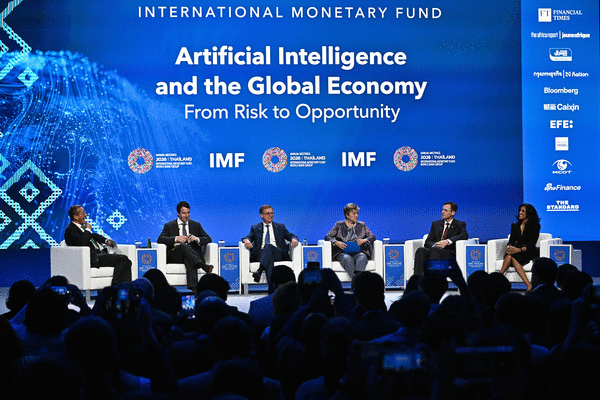
At the last major summit, Scott Bessent worked hard to tag China as the cause of dangerous fault lines in the world economy. With the U.S. Treasury chief absent from Bangkok this week, it was America and its allies in the spotlight.
Steep borrowing costs were top of mind for government and business leaders at the International Monetary Fund and World Bank’s meetings in the Thai capital. The climb began in the U.S. and other advanced economies, the bloc accusing China of fueling a giant export surplus that’s damaging everyone else.
That threat hasn’t gone away, and may even be growing. Beijing posted new trade numbers during the meetings that point to another record-busting year. But at the panels and cocktail parties across the congested Southeast Asian metropolis, conversations focused on the surge in debt costs and questions around the policies of U.S. President Donald Trump – a shift that bolsters China’s side of the great global imbalances debate.
“Bond yields, bond yields, bond yields,” is how Frederic Neumann, chief Asia economist at HSBC Holdings Plc, summed up the Bangkok chatter. What everyone wants to know, he said, is when and where they’ll start to bite: “If they keep climbing at this pace, the global growth resilience over the past year will quickly start to fray.”
In the six weeks since Group of 20 finance chiefs met in Asheville, North Carolina, borrowing costs in the U.S., France and Japan have hit multi-decade highs. Yields have eased in the past week or so, but remain far above levels the world had gotten used to.
Trump’s war on Iran has been the main driver of higher inflation and interest rates this year. Many Bangkok participants including IMF chief Kristalina Georgieva argued that large budget deficits and debts fan the flames. She called advanced economies the “worst offenders” and urged them to fix their finances.
That message appeared particularly directed at the U.S., which in Asheville led the charge to condemn China’s flood of exports. Georgieva suggested Bessent’s plan for America to grow its way out of debt and deficit trouble likely won’t work — posing a problem for the rest of the world.
Debt woes
While the bond rout hasn’t hit emerging markets as badly, it’s still left them paying more to borrow and worrying if the contagion from rich countries could get worse.
“We do call out to all economies in the world, especially the advanced economies, to really look at the impact,” said Indonesian Finance Minister Suahasil Nazara, whose nation saw its stocks drop Friday by the most in 28 years on a downgrade warning from MSCI Inc. “The impact is to the local people, the people on the street, the people in the villages, that they will have to endure higher borrowing costs.”
In the long-running U.S.-China row about global imbalances, the views of onlookers matter because both sides typically play to the gallery. They argue their adversary’s misdeeds are hurting everyone else.
China’s stock response to attacks on its trade surplus is to point the finger at structural problems in the U.S. and Europe, particularly profligate budget spending — an old argument, but one that could get new traction in a bond selloff.
In Asheville, Bessent orchestrated what the U.S. portrayed as a 19-1 vote against China. He said that everyone except Beijing, the obvious target, agreed with the idea that “non-market-based economies pushing out a never-ending stream of cheap exports is not sustainable.”
After G20 finance chiefs met in Bangkok on Thursday, People’s Bank of China Governor Pan Gongsheng published a statement saying “sharp swings in some countries’ government bond markets” are adding to financial fragility.
Fiscal failings
In a report published on the eve of the IMF meetings, the PBOC said the U.S. had lost trade competitiveness because of its own failings, including excessive fiscal spending, and shouldn’t pin all the blame on Chinese trade.
Imbalances “are not caused by surplus countries or deficit countries acting alone,” it wrote. “Each country should do its homework.”
Japanese officials in Bangkok sought to play down any sense of tensions between developed and emerging economies over the impact of yields. Finance Minister Satsuki Katayama said international institutions had flagged potential spillover risks, but there’d been no call for specific action.
Katayama also scolded Japan’s Nikkei newspaper for reporting an alleged clash with China during a pre-G20 meeting, with her denial going viral. She said finance ministers from the Group of Seven advanced economies discussed global imbalances, an issue on which “China was effectively called out” in Asheville.
The G20 didn’t try to draft a statement this week, or even hold a press conference. Bessent’s absence made it more important for allies like Europe or Canada to make their presence felt in Bangkok and prevent China from filling any gap, according to one senior government official.
Erin Browne, Treasury undersecretary for international affairs, said at a press briefing in Bangkok Friday that the U.S. continues to press the IMF during discussions this week over its “responsibility to address global imbalances and exchange rate policies” — coded language for what Washington sees as Beijing’s impacts.
“The fund must be more assertive in identifying these distortions and addressing the beggar-thy-neighbor policies that contribute to them,” Browne said.
Concern about China’s trade threat isn’t confined to developed economies like the U.S. and Japan — or Europe, which this week scored a rare concession from Beijing with a deal to cap exports of hybrid autos. It’s evident in Latin American and Africa too.
But in such countries the new debt risks were top of mind this week.
Kenya’s central bank governor Kamau Thugge said in an interview that he’d watched his country’s dollar-bond yields rise by about 100 basis points over three weeks.
The African nation plans to raise $5.4 billion, and three weeks ago “we’d have said that the market is ready for us to go,” he said. “But the conditions are changing so fast.”
The main risk is coming from war in the Middle East, he said, adding that “oil prices can go to $130. Who knows?”
Brink of default
Elsewhere in Africa, the rise in yields threatens several countries that “don’t really have capacity for shocks,” according to Luvuyo Masinda, head of commercial and investment banking at Standard Bank Group, Africa’s biggest lender by assets. He listed several nations that are either “teetering” on the brink of default or could find themselves there.
As governments weighed up the risk to their budgets, many bankers in Bangkok for this week’s meetings were worrying about what higher yields will do to balance sheets. JPMorgan Chase & Co. and Deutsche Bank AG were among several big financial institutions to set up shop in the Thai capital and host receptions at its fanciest hotels. Gulf International Bank’s delegation at the Four Seasons had its own fleet of at least six BMWs.
“Sovereign risk was raised in almost every conversation,” said Andreas Lindh, a vice chairman at JPMorgan’s EMEA unit. “The combination of high sovereign indebtedness, large budget deficits, surging government bond yields and no clear signs of fiscal consolidation in several major countries is cause for concern.”
The IMF itself has been striking a similar note on several occasions this week.
Asked directly about the roots and cures of global imbalances at her Wednesday press conference, fund chief Georgieva took refuge in a neutral formula. “China needs to spend more, the U.S. has to save more, and Europe has to invest more,” she said.
But in her curtain-raising speech last week, Georgieva cited rising debt and borrowing costs as one of the three big challenges she wanted to see addressed in Bangkok. AI and the energy crunch made the list too, but trade imbalances did not. And on Tuesday the IMF’s financial stability report said the yield surge has emerged as the biggest risk.
Watching the market
That chimes with the audience mood at many of this week’s events. One London-based manager of an emerging-market fund said it’s been hard for people to concentrate during investor presentations because they have to keep checking their phones to see what bond yields are up to.
To French Finance Minister Roland Lescure, whose nation has seen borrowing costs soar to levels unseen since the euro-area debt crisis, that’s not a bad thing. The higher yields are forcing everyone to see the need for fiscal prudence, he told Bloomberg Television on Friday.
“At the end of the day, the bond market is doing its job,” he said. “The vigilantes are being very vigilant, and we have to get it — and we have to make sure we do our part of the job.”
—With assistance from Alexander Weber, Ambereen Choudhury, Avril Hong, Christine Hah, Denise Wee, Emma Clark, Jana Randow, Jing Zhao, Kamil Kowalcze, Lauren Faith Lau, Lisa Abramowicz, Manuela Tobias, Mirette Magdy, Patpicha Tanakasempipat, Philip Aldrick, Ramsey Al-Rikabi, Satid Sutipanya, Srinidhi Ragavendran and Yash Roy.
©2026 Bloomberg L.P. Visit bloomberg.com. Distributed by Tribune Content Agency, LLC.





Comments