University of Minnesota offers online classes for students who feel unsafe amid ICE surge
Published in News & Features
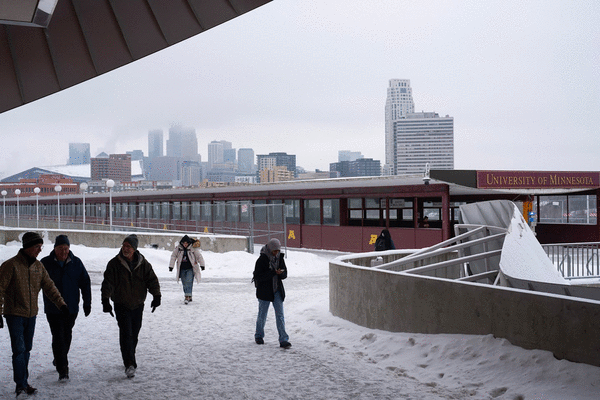
MINNEAPOLIS — The University of Minnesota’s Twin Cities campus is offering online learning options to students who feel unsafe coming to class amid concerns about Immigration and Customs Enforcement agents’ presence in the Twin Cities.
The decision was shared with faculty, instructors and administrators Jan. 15. Specific accommodations will be decided by each school or college, and students will receive more information about procedures from the dean’s office at their school by Jan. 16.
It comes after several K-12 school districts, including Minneapolis and St. Paul, announced they’d offer online classes to students who are too scared to go to school.
At the University of Minnesota, classes at the Twin Cities campuses begin Jan. 20.
“Our goal here is to make sure that we’re meeting the needs of all the students,” said U Provost Gretchen Ritter in an interview with the Minnesota Star Tribune. “And for some students, being able to keep up with their classes without their being there in person is going to be valuable.”
For other students, attending classes in person will be important, she said.
“Often that looks like a hybrid accommodation,” she said, adding that by “hybrid,” she means some students will be in class while others join remotely. “It may mean, for something like a lab, doing a makeup later.”
It’s not clear how long the arrangements will last, but “I don’t imagine that we are going to extend this initially for very long,” she said.
The U’s general preference is to offer classes in the format they were initially planned.
In St. Paul, St. Catherine University has also offered to work with students who feel unsafe coming to class to find “appropriate temporary options,” said spokesperson Sarah Voigt.
Those could include short-term flexibility with attendance and online options when feasible, she said.
For staff, their supervisors can find flexible arrangements, too. And faculty “has the agency to make decisions for their own safety” and what’s best for their program or class, she said.
“We want to assure our students, faculty and staff that they belong here and we will get through this together,” Voigt wrote in an email.
Safety has been top of mind for universities lately, as at least two other Twin Cities schools, St. Kate’s and Augsburg University, received bomb threats via email on Jan. 16. St. Paul and Minneapolis police went in and did a sweep of the areas mentioned in the threats and found no bombs, according to spokespeople from each school.
Augsburg’s Lindell Library was closed for the rest of the day as a precaution, said Rachel Farris, Augsburg University’s spokesperson.
St. Kate’s students started classes Jan. 12 while Augsburg students won’t be on campus until Jan. 20.
At the U, the accommodations don’t extend broadly to faculty or instructors at this point, Ritter said. If they feel uncomfortable coming to campus to teach, the U will work with them to try to make them feel safe. In some individual cases, the U might arrange for other options “through our normal accommodation policies.”
In terms of students’ reactions, she said, “We’ve gotten some expressions of student concern as well as a lot of people feeling grateful for the messaging and the measures we’re taking.”
The U is also switching to badge-only access for most buildings when students return, meaning students will use their U Card to get in.
“For the majority, I would say, of our students, that’s going to feel familiar,” she said.
Dorms and some academic buildings already require a U Card to enter, she said. But student unions, museums and spaces like the veterinary school will stay open to the public.
“We’re working to make sure that we can take care of and support all of the members of our community in a way that allows them to continue to get a great education and to participate in society,” she said.
_____
©2026 The Minnesota Star Tribune. Visit startribune.com. Distributed by Tribune Content Agency, LLC






Comments