Florida Keys migrant crisis strained Coast Guard. Agency reports record drug seizures
Published in News & Features
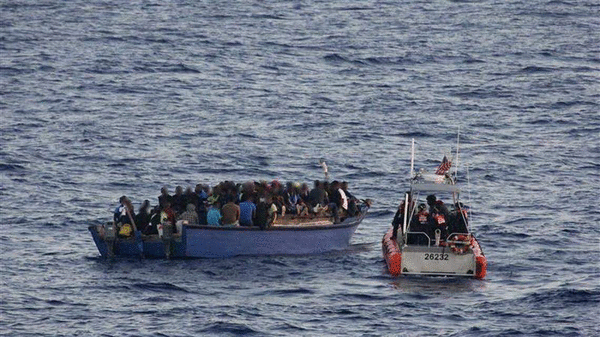
The U.S. Coast Guard said this week that its crews intercepted more cocaine loads at sea than at any time in the service’s history — a record high of over half-a-million pounds of narcotics in a single year.
The announcement comes the same week federal auditors in the U.S. Government Accountability Office released a report concluding the Coast Guard’s focus on stopping maritime migration in the Florida Keys from the end of 2022 through 2024 hampered its anti-drug smuggling mission.
But the Coast Guard said overhauls it began implementing last year included new efforts to combat drug smuggling, mainly cocaine, in the Caribbean, while at the same time stopping illegal migration through increased patrols off the California coast and along the Rio Grande.
“The Service is better positioned than it was in January 2025 to effectively control, secure and defend the U.S. borders and maritime approaches, facilitate the uninterrupted flow of commerce, and rapidly respond to contingencies,” Adm. Kevin Lundy, who was sworn in as the Coast Guard’s 28th commandant this week, said in a statement.
The accomplishments on both drug and migrant fronts are part of the agency’s “Force Design 2028” initiative that aims at aligning the agency, which is under the Department of Homeland Security umbrella, with Department of Defense goals.
This includes the recruitment of an addition of 15,000 military members to the Coast Guard by 2028. The service now has around 41,000 active duty members. The GAO report states that while the agency exceeded recruitment goals in 2024, it fell short from 2019 to 2023.
“Force Design 2028 is already improving operational outcomes while establishing the foundation for even greater achievements in the future,” Lundy said.
The Coast Guard said in a press release Thursday that from Oct. 1, 2024, to the end of September 2025, crews intercepted more than 510,000 pounds of cocaine, which is an agency record. And, its crews serving tours in the eastern Pacific off South America are seizing an average of 1,600 pounds of cocaine daily, the agency said.
From 2021 through 2023, at-sea drug seizures dropped significantly — from around 315,000 pounds to about 242,000 pounds, according to the GAO report. Auditors say this was because the Coast Guard directed more personnel and assets to stopping people, mainly from Cuba and Haiti, from reaching U.S. shores in South Florida.
Between 2022 and 2024, the federal government says almost 70,000 people from Cuba and Haiti tried crossing the Caribbean and the Florida Straits attempting to reach Florida, according to the GAO report. It was the highest maritime migration to the U.S. in more than three decades.
Florida Keys overwhelmed
In the fall of 2022, Monroe County sheriff’s deputies were spending much of their shifts on the roadside and under the hot sun guarding newly arrived migrants — instead of patrolling, preventing and investigating crime in the Florida Keys.
Unrest in Cuba and Haiti forced a maritime exodus that resulted in a tsunami of landings in the Keys, historically a destination for migrants from both countries. It strained local resources, with deputies and firefighters often acting as first points of contact for the new arrivals until stretched U.S. Border Patrol agents could come pick them up. Sometimes, there were so many simultaneous landings that it would take hours for federal agents to arrive.
The situation hit its boiling point when nearly 500 Cubans disembarked in the Dry Tortugas National Park, a group of remote islands about 70 miles west of Key West, over the December 2022 New Year’s weekend. The skeleton crew of park rangers there were overwhelmed, prompting the federal government to make the unprecedented move of closing a national park to the public for reasons other than a national disaster like a hurricane.
Sheriff Rick Ramsay, who remains the head of the Monroe County Sheriff’s Office, demanded help from the state and federal government.
“Each landing requires resources being diverted from other critical missions and sometimes requires many officers,” he told the Miami Herald in December 2022.
Both Florida Gov. Ron DeSantis and then-President Joe Biden responded to the influx, sending personnel and assets to patrol the surrounding waters and airways of the archipelago. For the state, this meant more Florida Highway Patrol troopers and Florida Fish and Wildlife Conservation Commission officer, as well as boats and aircraft.
The U.S. Department of Homeland Security surged South Florida with more Coast Guard personnel, cutters, airplanes and helicopters, which were diverted from other areas of the country and away from other critical missions, according to the GAO.
The combined effort worked, and the influx slowed dramatically. While there were anywhere from three to 10 arrivals back then, the Keys now go months without a group of arrivals making landfall.
Yet the massive Coast Guard operation to prevent Cubans, who usually arrive on homemade boats and rafts, and Haitians, usually arriving on overloaded sailboats and rustic freighters, from landing continued. And it took its toll on the maritime service’s other primary missions — stopping drug smugglers and protecting marine natural resources, the GAO said in its report.
Stretched thin
The GAO said in its report, released to Congress this week, that the enhanced interdiction mission that began in 2022 “exacerbated (the agency’s) inability to meet its drug interdiction mission.”
“According to Coast Guard officials, the drug interdiction mission sustained the most significant impacts from redirecting many of its resources to migrant interdiction,” says the report, which included information from in-person visits to Coast Guard facilities in Miami and San Diego, as well as interviews with agency officials.
The amount of at-sea stops that resulted in the seizures declined from 218 in 2021 to 112 in 2023, the GAO said.
“Both the number of seizures and amount of drugs the Coast Guard seized annually decreased considerably during the migrant surge, after varying over time,” the report states.
The report notes that the Coast Guard is already stretched thin in both personnel and assets, making it more difficult to divert efforts from one mission to another. GAO concluded that the service needs more cutters, airplanes and helicopters, as well as more funding to maintain and repair its existing assets.
The Coast Guard deems migrant interdictions to be high-priority, life-saving missions, since many of the boats people use to travel to the U.S. are not seaworthy and at risk of capsizing or coming apart in the middle of the ocean. They are also often captained by traffickers who do not care whether people on the journeys live or die.
The GAO found that the Coast Guard does not have appropriate performance metrics for migrant interdiction and should create new measures. It also urged the Department of Homeland Security to share what the task force had learned with other federal agencies.
“Headquarters officials told us that they would not be able to increase mission activity without acquiring more assets, but acquisition delays have been a longstanding challenge for the service. Furthermore, according to officials, the acquisition process is lengthy, as it can take several years from initial request to final delivery of an asset,” the auditors stated.
Goals reached
But in the time between when the GAO completed its report and when it delivered it to Congress this week, the Coast Guard said it’s been busy addressing shortfalls and establishing new priorities. These efforts began last January, and the agency credits them with being able to increase narcotics interceptions and stop maritime migration.
The Coast Guard also said it’s been able to stay on top of its other vital role — saving lives on the nation’s waterways. The agency said since the end of 2024, crews have rescued nearly 5,000 people.
It’s also working on bolstering the number of service men and women.
Since the beginning of October 2024, the service has exceeded its active-duty recruiting goals, enlisting more than 5,200 new members, the agency said. This is the highest recruitment since 1991. It also met or exceeded Coast Guard Reserve enlistments and promoting active-duty officers, the agency said.
The service also created more leadership positions in the field while becoming less top heavy, winnowing senior administrative staff from more than 40 to 14 “to streamline decision-making and maximize efficiency,” the Coast Guard said this week.
_____
©2026 Miami Herald. Visit miamiherald.com. Distributed by Tribune Content Agency, LLC.





Comments