Many Pennsylvania communities are wary of data centers -- and some concerns are existential
Published in Business News
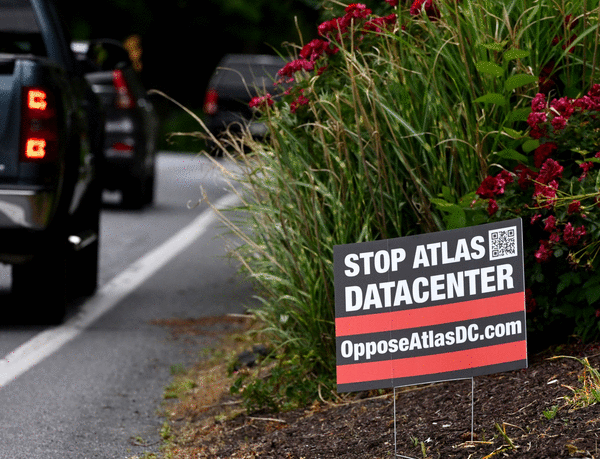
Even the really big, existential questions start with a zoning permit.
The question currently roiling municipalities across Pennsylvania is data centers — large buildings filled with computers. What all of those computers are calculating is not subject to municipal oversight, but it’s the current that runs through the long township meetings, the protests, the Facebook groups, and kitchen table discussions.
Developers and engineers should be able to answer questions such as how much water a data center will use and how loud its generators may be. But are those the only questions residents need to have answered?
“The real problem,” said Brian Regli, who represents Dynamo DC, the developer behind a proposed data center in Springdale, Pennsylvania, “is the fact that we have this extraordinary wealth disparity in the United States, and that the history of social media and the history of technology has not turned out very positively over the last 10 to 15 years.”
Regli was speaking on a panel about data centers at the Marcellus Shale Coalition’s annual conference in Erie in September. Data centers and their need for huge amounts of electricity have galvanized the natural gas industry.
Many data center projects come with their own natural gas-fueled power plants, meaning neighbors face a new source of pollution to feed computers that are doing … what, exactly?
He said he understands the unease.
“The internet was going to solve all the problems. We were all going to have a common understanding of the world, and democracy would reign — that's what I grew up thinking,” Regli said.
But his children think differently. He said they’re suspicious of the tech companies that have gotten so good at sucking attention and “squeezing every single dollar out of every single one of us for everything that we buy.”
So when he shows up in a place like Springdale “representing a $40 billion investment fund that’s working with some other billionaires and trillionaires out there, to (put) a data center in your backyard that’s going to take more money from you, control from you and, ‘Oh, you’re building the death robots back there, aren’t you?’ ”
It’s about the land use. But it’s about much more than that, he said.
“And this is where I think, ultimately, the anger that people feel needs to be recognized as valid.”
Inevitably, talking about data centers means talking about artificial intelligence, which, according to the companies developing the technology, may or may not wipe out human civilization. But it might also cure cancer.
The natural gas industry in Pennsylvania has been helping data center developers navigate the same political and social terrain that drillers walked through two decades ago, when Marcellus Shale development swept through southwestern and northeastern corners of the state and hundreds of municipalities dusted off their zoning ordinances to deal with it.
Back then, the existential issue was fossil fuel use and climate change that somehow had to be codified into setback requirements and noise restrictions.
Lawyers who once helped gas companies went on to repurpose their expertise for solar and battery storage developers, and are now doing the same for data centers.
For the public, the benefits of data centers are less clear, said Corey Young, director of the Center for Energy and the Built Environment at Washington & Jefferson College.
With shale gas, developers argued that more local energy production would reduce energy bills and make it more attractive for heavy industry to locate and grow here, for example. Many landowners received royalty payments, and local and state governments got impact fee funds.
“With data centers, you might get a narrative about competing with China, or healthcare applications, or even folksy explanations about their need for streaming services for entertainment. But there's no single overarching narrative that says, Investing in x will lead to y, which will make life meaningfully better,” Young said.
Washington & Jefferson commissioned a survey of Pennsylvanians’ attitudes toward data centers and AI, finding that while most respondents expected artificial intelligence to change society, more than 40% thought it would be for the worse.
What struck Young is the precarious position of local government officials who, according to the survey results, aren’t trusted or equipped to deal with data center developers and, at the same time, should be more involved with it.
Tracking public sentiment
The money behind data centers is big.
According to the Pittsburgh Regional Alliance, companies moving or expanding in the 10-county southwestern Pennsylvania region in 2024 accounted for a cumulative investment of $350 million. In 2025, it was $16 billion.
So far this year — $26 billion.
“Anyone want to guess why?” John Timney, a senior director with the PRA, asked an audience of local government officials and energy policy wonks at Washington & Jefferson’s annual energy conference in October.
It’s data centers.
The only thing that might rival how much money is being tossed around in what appears to be a digital gold rush is the intensity of the opposition to data centers.
To weed out places hostile to them and prepare developers going into a new area about what to expect, there’s an AI-powered cottage industry of websites that scrape and organize hours of public testimony, municipal meetings, social media conversations and local legislation to come up with a score.
A San Francisco-based tech firm called Hamlet tells clients “who spoke up for, who spoke against, and where each place lands against others its size.”
Spark, a data center developer tool, promises to screen hundreds of potential sites in minutes.
“Local opposition often starts online, so Spark also tracks data center posts in local Facebook groups and community pages before they reach a hearing,” the company’s website says.
It ranks Pennsylvania as third in the country in terms of a favorable environment for data centers, behind only Texas and Virginia. Some 72% of projects are approved in the Keystone State, according to its data.
Other services track sentiment on lots of issues. Hamlet can assess how communities feel about data centers, but also about backyard chickens.
Oregon-based Learnewable started in 2023 to help solar, wind and battery storage developers navigate through local permits and community concerns. Its founder, Jeremy Solomon, became interested in tracking public sentiment after he learned what kinds of concerns solar companies faced in communities.
He began tracking data centers in 2025, training his existing tools on the next big thing.
“The challenges that developers faced in renewable energy development are almost exactly the same but smaller,” he said of data centers.
But there’s one area where they diverged, Solomon has noticed. Opposition to renewable energy tends to decrease as more of it is installed. That’s not the case for data centers. Deteriorating public sentiment leads to more zoning and permitting restrictions, he said.
Looking at Learnewable’s data for Allegheny County, Pennsylvania, last month, Solomon described the data center environment as “bad and getting worse — if you’re a developer.”
Pittsburgh-based law firm Babst Calland has long tracked municipal ordinances for natural gas development, adding solar, then battery storage and now data centers.
In September 2025, the firm was tracking 35 pending or enacted ordinances that dealt with data centers, said Kate Cooper, a shareholder in the firm’s corporate and commercial and emerging technologies group.
“As of (last week), that number was 571,” she said.
Pennsylvania has more than 2,500 municipalities across its 67 counties. The same fragmentation that stumped natural gas developers and gave rise to legislative efforts to restrict local zoning of oil and gas infrastructure is now bedeviling another industry.
Babst Calland’s count shows Washington County leading the state with 35 adopted or proposed data center ordinances. Allegheny County municipalities have about 20 in various stages.
“They’re adding the kinds of protections you’d expect for large facilities near neighbors: buffers, noise limits and decommissioning requirements,” Cooper said. “A couple of newer trends are that some ordinances are now trying to cap building size, and many are requiring applicants to show how much power and water a project will use.”
Some residents would also like to know what kind of data will be stored and transmitted through these facilities, a question many developers don’t have the answer to as they plan to rent their space to clients.
“Data centers are immediately associated with AI. AI is associated with all kinds of different things — Flock cameras, everything you read about in the news that scares people, or they're uncertain how it's going to be used or what's done,” said Amy Gonzalez, who works for the developer Keel Infrastructure, which has proposed a data center project in Venango County, Pennsylvania.
“Even though we may not be the ones actually putting the compute in those buildings, we have to talk about that,” she said during the shale conference in Erie.
Max Junker, a shareholder at Babst Calland who spoke at the Washington & Jefferson College event last month, suggested a different approach.
“Trying to address the zeitgeist of AI — is it going to be your doom or is it going to be your savior? — is perhaps a losing battle, when we're dealing with local governments and a specific project.”
©2026 PG Publishing Co. Visit at post-gazette.com. Distributed by Tribune Content Agency, LLC.









Comments