More delays for Boeing's 777X, CEO Ortberg says
Published in Business News
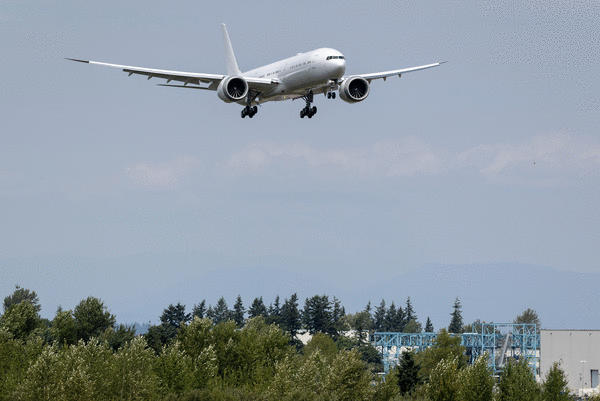
Boeing’s 777X certification could push into next year as the company continues to work through an issue with engine maker GE, Boeing CEO Kelly Ortberg said Wednesday.
Separately, the plane-maker’s wing shop in Renton, Washington, could slow Boeing’s efforts to increase its monthly Max production rate.
The wing shop has not kept up with Boeing's rate increases, Ortberg said, and could cause a snag for the company's next jump to 52 planes per month. That rate hike won’t come until next year, Ortberg said.
Both 777X certification and increased monthly Max production have been seen as key parts of Boeing’s recovery after several tumultuous years, starting with two fatal 737 Max crashes in 2018 and 2019, then the COVID-19 pandemic and, in 2024, a nearly catastrophic midair panel blowout.
Speaking at a Morgan Stanley conference Wednesday, Ortberg said 2026 had been a big year for Boeing, highlighting several positive developments. The Federal Aviation Administration last month certified the long-delayed 737 Max 7, the smallest Max variant, and Boeing is nearing certification for the Max 10, the largest variant, Ortberg said.
The FAA in July expanded Boeing’s authority to self-certify that its planes are safe to fly, an authority the regulator revoked after the fatal Max crashes and only partially restored last year.
On the defense side, Boeing has made progress on fixed-price contracts that were bleeding money. And, after taking a $280 million charge on the Air Force One program in the last quarter, Ortberg said he doesn’t expect any more major charges, though he cautioned there could be minor charges along the way.
After the midair panel blowout, the FAA capped Boeing’s monthly Max production at 38 planes per month. Since the FAA lifted that threshold last October, Boeing has increased monthly Max production in increments of five, with several months in between each rate hike.
It is now working to stabilize its Max production cadence at 47 planes per month, but “it’s taken us a little bit longer than what I had anticipated,” Ortberg said Wednesday.
The 737 Max supply chain is “in really good shape,” Ortberg continued, but the plane-maker is “constrained” in its wings production. Boeing builds all of its 737 Max wings in Renton.
“We have not seen the flow improvements we expected,” he said.
Boeing has “plans in place to address that” and feels it's in “pretty good shape to move to the next rate,” Ortberg said, without elaborating on the constraints or the planned resolution.
Separately, Ortberg cautioned that Boeing may have to finish some testing in 2027 to certify its 777X program with safety regulators in order to fly passengers.
The company is still working through an engine durability issue with GE, something the companies first identified in January and one of several concerns that have held up the 777X program since it was first introduced in 2013.
Until the engine issue is resolved, Boeing’s 777X won’t be authorized to fly over oceans or far from airports, part of the FAA’s ETOPS program, or Extended-range Twin-engine Operations Performance Standards.
“GE’s working that diligently,” Ortberg said. “I think they had to do more testing than what was originally planned.
“That’s probably going to cause us a little bit of a challenge between now and the end of the year,” he continued. “We may see some of the testing spill into next year.”
Boeing still expects to make its first 777X deliveries in 2027.
Ortberg also addressed controversy over airline customers who have said they may not want to take Boeing’s earliest-built 777X planes, because they will require so many changes to incorporate updates made throughout the lengthy certification process. Emirates CEO Tim Clark in July said those early planes would be better off turned into baked bean tins.
On Wednesday, Ortberg said Boeing has that “well understood and well contained.”
“I don’t want to negotiate publicly on who’s getting what airplane, but it's not a big issue for us,” he added.
He pointed to yet another potential snag for the delayed program: the possibility that Boeing’s engineering workforce could go on strike as soon as next month.
Boeing’s white-collar union, the Society of Professional Engineering Employees in Aerospace, rejected Boeing’s first contract offer last month and overwhelmingly authorized a strike if the union’s negotiation team calls for one. A strike would not begin until the contract expires on Oct. 6, and union members are set to vote next week on the company’s second offer.
“We’re working hard to try to avoid any kind of work stoppage,” Ortberg said. “That’s our key No. 1, 2, 3, 4 and 5 priority. That impact would be significant. If we did have a strike, essentially the 777X certification program shuts down until we get the engineers back.”
Boeing has put together a strike contingency plan, focused on maintaining some level of 737 production, Ortberg said. But Boeing would likely not be able to sustain its current rate of Max production if SPEEA did walk out, he added.
©2026 The Seattle Times. Visit seattletimes.com. Distributed by Tribune Content Agency, LLC.









Comments