Colorado's largest lumber mill shutting down, dealing a blow to a rural community
Published in Business News
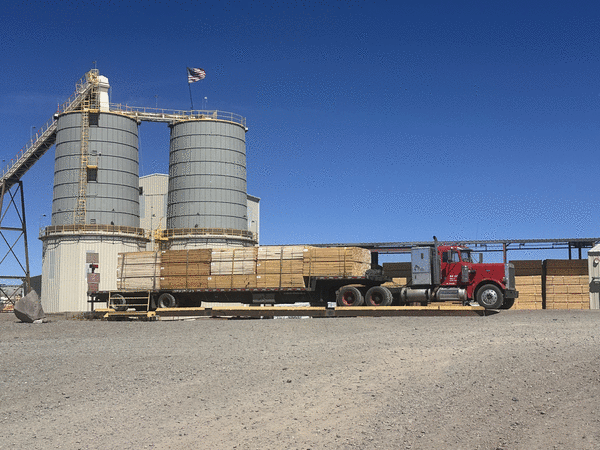
MONTROSE, Colorado — Efforts to revive the country’s domestic lumber industry may have come too late to save Montrose Forest Products, Colorado’s largest lumber mill.
Owner Neiman Enterprises informed the mill’s 90 employees on Tuesday that operations would wind down once its remaining timber supply runs out in the next few weeks.
“For months, we searched for a buyer who could continue operating the mill in Montrose, but we were unable to secure one,” Jim Neiman, president of Neiman Enterprises, said in a news release.
If a viable offer doesn’t emerge in the next 60 days, the mill is expected to wind down operations and sell off its equipment to the highest bidder.
The loss of the mill could impact the livelihoods of more than 400 rural workers who depend directly and indirectly on the mill, and remove nearly $75 million in payroll spending from the Montrose economy, according to a study conducted by the Montrose Economic Development Corp. (MEDC)
“The best scenario is that we get another operator in there after a pause of a month or two,” said Sandy Head, executive director of the MEDC. “We are working hard on that scenario.”
The potential layoffs are the largest the area has faced since Russell Stover Chocolates shut down its factory in 2020, putting roughly 400 workers out of a job.
Head notes that both the chocolate factory and the sawmill had employed multiple generations of Montrose residents. They were part of the economic fabric of the city of 21,000 residents.
“This is just the latest example of a struggling industry,” said Megan Maxwell, executive director of the Colorado Timber Industry Association. “Losing our biggest mill is going to have a ripple effect across the remaining industry.”
Montrose Forest Products was one of only three commercial-scale mills left in a state that has seen its count fall from 87 to 33, mostly small mills, since 1987, Maxwell said.
The two big players remaining are Colorado Timber Resources near Granby, which focuses on processing beetle-kill timber, and Blanca Forestry Products in Costilla County, a more traditional maker of construction-grade lumber.
Without a viable timber market, restoring forests at scale in Colorado could become much more expensive, Maxwell said.
Diseased and overcrowded forests in turn could elevate the risk of more intense fires and damage to area watersheds, including the one supplying Grand Junction.
Shrinking supplies, rising costs
Uncertain and shrinking timber supplies from nearby forests and rising operating costs, especially for fuel, which skyrocketed after the war with Iran began on Feb. 28, combined to push the struggling mill past the point of no return.
“One of the benefits of Montrose Forest Products is that we are surrounded by national forests. One of the downsides, however, is we are roughly 50 miles to the closest stick of wood,” said Sonja Neiman, community relations director and spokesperson for Neiman Enterprises.
Costs at the Montrose mill have increased about 30% since the pandemic, she said.
In that time, the dynamics of forest management have also shifted, she said, resulting in fewer trees to harvest within the Grand Mesa, Uncompahgre and Gunnison National Forests.
Almost all the wood processed in Colorado comes from public forests, and Montrose Forest Products accessed trees from a 250-mile radius.
The mill had the capacity to produce 80 million board feet of lumber at its peak, said general manager Jerod Stinson.
It needs a minimum of 40 million board feet to stay profitable and 30 million to stay open, according to the MEDC analysis.
Although the mill was on track to get 26 million board feet this year from federal forests, that number was expected to drop to 22 million the following year and then to 12 million to 15 million board feet three years out.
An uncertain supply situation complicated efforts to find a buyer by making lenders less willing to fund a purchase.
One solution would have been to pull timber from more distant forests, such as the White River and San Juan.
But with the average cost of a gallon of diesel up 72% this year following the conflict with Iran, hauling logs longer distances ceased being feasible.
A more limited supply of logs and higher fuel prices were a “killer,” Stinson said.
“Unfortunately, with just the uncertainty and the shift in the timber supply for the long-term, it’s just not viable for us. We’ve already lost money substantially over the last several years, and without a light at the end of the tunnel, it’s hard to justify those losses to continue,” Sonja Neiman said.
With its options dwindling, the company filed a notice with the Colorado Department of Labor and Employment on Tuesday under the Worker Adjustment and Retraining Notification Act, which requires 60 days’ notice before a business or plant closes.
Layoffs will occur between Sept. 8 and Nov. 6, according to a letter filed with the Colorado Department of Labor and Employment.
The Neiman family, which owns mills across the Rocky Mountain region, purchased the Montrose facility in 2012 and has invested more than $60 million in upgrades.
Much of that investment, Sonja Neiman said, was to allow the mill, which has historically handled spruce and fir trees, to process ponderosa pine from the San Juan National Forest in southern Colorado, which has been affected by beetle kill.
Dead ponderosa pine trees can become unusable for lumber within 18 months, creating a narrower window for harvesting than spruce trees, which hold up better.
Deep roots in the community
On Wednesday, Montrose Forest Products was operating as usual.
The sounds of machinery moving logs and milling lumber echoed from one of the warehouses on-site. Trucks entered the grounds with raw logs and left with milled boards, typically weighing in at more than 70,000 pounds each.
Glen Goodhue, owner of San Juan Gardens, a nursery and tree farm neighboring Montrose Forest Products, has lived next to the mill his entire life.
He grew up on the land where the nursery now resides. The hum of the sawmill turning timber into lumber has been a constant background noise.
He was shocked to learn about its impending closure, given that it’s been a staple of the Montrose community for decades.
One of the perks he was able to enjoy was having sawdust so close by to heel in the nursery’s trees each year, he recalled.
“If you think of all the truck drivers that haul logs, all the truck drivers that deliver woodchips from the sawmill, all the employees that work at the sawmill, it’s probably a pretty big impact, for sure,” Goodhue said.
The state and local community are bringing resources forward to help displaced workers, Head said.
One concern is that local forestry and logging expertise, built over decades, will be lost or relocate to other locations, in particular the Southeast and Pacific Northwest.
The Trump administration, as part of its larger push to rebuild the country’s manufacturing base, wants to restore the country’s capacity in lumber and building materials.
That effort has included putting high tariffs of 50% on Canadian wood product imports in August to provide U.S. producers breathing room.
Gov. Jared Polis has also prioritized clearing dead tree stands and finding economic uses for wood byproducts beyond conventional uses.
Colorado ranks sixth among U.S. states for its forest and woodland acreage, which stands at around 24 million acres or 36% of the state’s land.
Despite that, the state ranks in the bottom half of states when it comes to actual lumber production. Surrounded by a sea of trees, Montrose Forest Products has found itself sinking.
©2026 MediaNews Group, Inc. Visit at denverpost.com. Distributed by Tribune Content Agency, LLC.










Comments