From layoffs to changing inventory, inflation drives hard decisions for small firms
Published in Business News
The co-owner of Ingebretsen’s Scandinavian Gifts and Foods in Minneapolis stopped taking a salary for a nearly a year and cut her inventory of imported Norwegian sweaters after tariffs and other costs increased by more than she could afford.
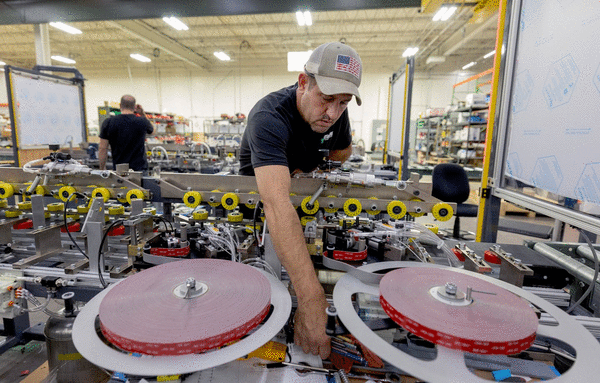
A New Hope, Minnesota, manufacturer laid off five workers when hit with higher costs of necessary items from fuel to health insurance.
A Minneapolis ad agency switched health plans and went into overdrive to find new clients to pay for added costs.
The same inflationary forces that have been hitting household budgets the past few years are causing an “affordability crisis” for small businesses, said Allie Palmer, senior strategist of the 3,000-member Main Street Alliance in Minnesota.
“They’re kind of at the epicenter,” Palmer said.
The Federal Reserve Bank of Minneapolis found steep increases in health care and insurance costs among inflationary challenges for small businesses, according to its six-month business conditions report released late last month.
“Small businesses are saying that price increases for their inputs have been a major and consistent issue,” Federal Reserve analyst Haley Chinander said.
Profits fell at more than half of the 905 businesses that responded to the Fed’s July survey.
Many of these consumer-facing businesses resist passing cost increases onto customers at the same pace as larger firms, so “their profits are taking a huge hit,” Chinander said. “We do see a few in every survey saying that they might be closing their doors soon if things don’t improve.”
Gov. Tim Walz and state economic development officials were on Lake Street in Minneapolis last month meeting with dozens of shopkeepers who are still on the edge of survival because of the federal immigration crackdown at the beginning of the year.
Many businesses saw revenue sharply decline or were forced to close their doors for days or weeks because customers and employees were staying home as Operation Metro Surge escalated.
Twin Cities mayors and other officials estimate Operation Metro Surge cost cities and businesses $700 million in lost wages, sales and tax revenue.
These businesses were dealing with inflationary costs on top of the added challenges from the crackdown, the state officials said.
The rural economy also has taken a hit, according to Creighton University’s surveys of businesses. Farm equipment sales have either declined or stayed flat for 36 straight months, for example.
With tariff disruptions and higher diesel costs from the U.S.-Israeli war against Iran, “producers are not as willing to purchase new farm equipment due to volatility, along with low and negative cash flows,” said Creighton economics professor Ernie Goss.
Besides cutting her own salary, Anna Bloomstrand — who co-owns 105-year-old Ingebretsen’s Scandinavian Gifts and Foods with her mother, Julie Ingebretsen — said she halted retirement savings and cut her import orders of handmade Norwegian sweaters 70% after prices shot from $275 to $400 each.
The price tag jolt comes as loyal shoppers confided to Bloomstrand they have less discretionary money these days so are shopping less.
Dean Broadhead was able to save a big jump in health insurance costs for both the downtown Minneapolis ad agency and its employees by switching plans. The costs would have increased 30% with the old plan; the new plan ended up 10% more expensive.
That was on top of a $600,000 jump in payroll costs as a hyper-competitive advertising-agency landscape forced salaries increases.
Broadhead, whose business was recently named 2026 Small Ad Agency of the Year by Ad Age, said he and his staff are now racing to add many new clients to keep pace with rising costs.
“Definitely, it’s a more challenging market this year than last year, for sure,” Broadhead said.
For example, costs for artificial intelligence tools increased from $120,000 in 2022 to $350,000 this year. The state’s new paid leave act also meant he had to cover employees’ work with freelancers, which costs $150,000 — an expense that surprised him.
Those are just a few categories of increased costs, he said.
“Yet our growth income is not materially different than a year ago,“ he said. ”We’ll probably be down about 20% in terms of our profit margin this year vs. last year."
Tate Johnson, CEO of industrial machine maker Straub Design in New Hope, said costs are up 15%, causing the balance sheet to stop lining up.
He said he had to lay off five of 50 workers after the cost of supplies, fuel and health care all increased.
Several customers also are facing effects from the uncertain economy, so they are “sitting on their hands” instead of placing traditional orders for Straub’s industrial machines.
Straub generates more than $10 million in annual revenue a year making automated tape dispensers, packaging machines and pick-and-place robots used inside factories owned by 3M, H.B. Fuller, Tesa, Avery, Duraco and other companies.
Straub did get a boost from a few customers trying to boost output from their U.S. factories because of tariffs, but at the same time the tariffs also are affecting his supply costs.
His temporary worker costs from the state’s new paid leave law added up to $50,000 in fresh expenses.
Johnson and his team have cut as much outside consultant fees as possible and are working on consolidating parts suppliers to gain some “volume pricing discounts.”
He, too, is thinking of increasing automation at the factory to cut labor costs.
“The business case hasn’t made sense to this point,” he said. “But with rising costs, it’s surprising how that equation changes.“
©2026 The Minnesota Star Tribune. Visit at startribune.com. Distributed by Tribune Content Agency, LLC.










Comments