Q&A: At the Dakar Rally, Ford's CEO talks Raptor, V-8s and hybrids
Published in Business News
RIYADH, Saudi Arabia — Ford Racing helps the Dearborn-based automaker across the globe by growing brand profile, employee talent and tech learnings for production cars.
Its latest racing venture is the brutal 14-day Dakar Rally across the Saudi sand. It’s the toughest off-road race on the global calendar — the Le Mans of off-road. Ford entered eight Raptor T1 Ultimate racers — four of them factory entries — in an all-out assault to win the top class in 2026.
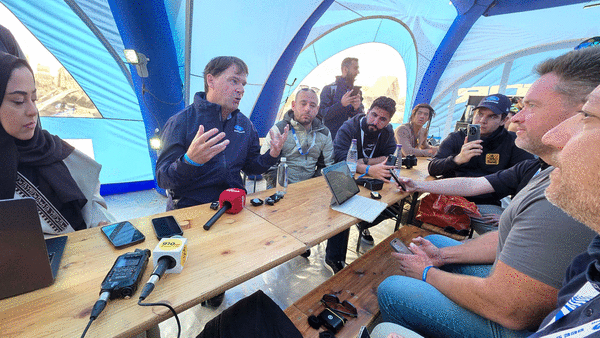
CEO Jim Farley sat down in Ford’s Dakar paddock (bivouac in Dakar-speak) to talk with international media — including The Detroit News. The wide-ranging discussion touched on racing, hybrids, quality control, software development, Chinese competition, the Saudi and European markets, and the irresistible sound of an American V-8 in the desert.
Question: Jim, we’re looking forward to the "Ford v Toyota" movie after you win Dakar. Is the Raptor T1 Ultimate the off-road equivalent of the GT40 back in 1960s? Is this the race to make Ford an international off-road racing brand?
Answer: I think it's closer to 1964 (Ford’s first race with the GT40 at Le Mans) — as you know, we didn't win Le Mans until 1966. There's a lot of connection between Le Mans and Dakar.
They both seem impossible to win, and it’s the outright win that matters. For us as an American brand, we have won everything: Formula One, Indy, NASCAR, Super V-8s in Australia. We’ve won races all around the world, but there's one race we have not won. It's at the center of our brand, which is to be the Porsche of off-road.
That is Dakar. The Baja 1000 (in Mexico) is amazing. King of the Hammers is amazing. But there's no race like Dakar.
Q: Why use the Raptor brand?
A: That's a good question. We debated it a lot because we believe Ford Racing should be an independent entity that has responsibility for road vehicles. In the history of Ford, Ford Racing was always a marketing expense, but it wasn't connected to the core engineering of the company.
We want to stop that.
The idea is to take Ford Racing as a separate entity, and for it to take racing and engineer road vehicles — super cars — all the way down to very affordable technology. That's a big change for Ford. This Raptor T1 in Dakar gives another feeling about the company.
We thought Raptor would be better than Ranger, for example — or Bronco — because Raptor is a compelling brand around the globe. We need to globalize it with Dakar. This can't be just a North America off-road image for the company. That's why winning Dakar from a business standpoint is so important.
EV Central Australia: How important is it to beat Toyota?
A: Really important. It's very personal for me because I worked (at Toyota) for 25 years, and I really respect their company. All those 30-year-old Saudi kids grew up driving Hiluxes (Toyota’s truck model for international markets) and Land Cruisers on the dunes. Generations grew up doing that. So beating Toyota here is kind of a spiritual moment — not so different than beating Ferrari at Le Mans.
EVCA: One of the reasons Toyota is successful — on the dunes, for example — is reliability. How do you improve that going forward in Ford road cars?
A: We've made a lot of progress, but we have a lot more to do. I'm not worried about fixing our reliability. We're doing a lot of things that people don't realize on the long-term durability of a powertrain. We're now testing in ways that Ford has never tested.
This is about creating a culture of quality, because Ford fixes quality when it's bad — then somehow we lose it again. I want to be the CEO that creates a culture where we don't lose it again. That's where Toyota is so effective.
The most important proof point for that is going to be Ranger globally. Taking on the Chinese, Great Wall, other body on frame vehicles . . . quality is going to be a differentiator for us. They may have great manufacturing quality, but they don't have the real-world experience of driving the vehicles for 300,000 kilometers. That's where our quality should be a differentiator compared to new competitors. Here in Saudi, 15% of sales are Chinese, so now we have to compete with them. It's not just Toyota.
EVCA: What have you learned over the last two years (in the Dakar Rally), and what is being fed back into the road cars?
A: What we've learned the most is (suspension) damping. Damping has transformed our company, the whole Raptor brand. Part of the reason people love Raptor around the globe is because it's such a compliant vehicle — really comfortable to drive. The on-road supercars? Not so comfortable. What's cool about off-road super trucks is that they're super fun to drive, but they're also really comfortable. Damping is the core.
The Raptor T1 category is like a whole another level of technology. The Coyote (V-8) engine sounds great. Every time the Ford goes by, it sounds a lot better than (competitors). I like that our company is unapologetically American with the sound.
That's something we've learned too, that the sound of the vehicle is important.
EVCA: You touched on the V-8. Is there any interest in going down the hybrid path (in the Dakar Rally) eventually?
A: We're going to race to win. So we'll race whatever is the best technological solution for us. We like V-8s — that's the genesis of our company. But our best-selling F-150 is the EcoBoost hybrid. We love hybrids. You can expect, in our performance of off-road vehicles, more and more hybridization.
The other thing people don't think about when we bring hybrid to our off-road performance vehicles is exportable power. A lot of people camp out in the desert. If you have a hybrid, you have batteries. If you have batteries, you could run a work site; you could run a camping site. You don't need to have a supplemental generator. So hybridization of off-road is much more interesting than just performance of the vehicle — it's exportable power.
EVCA: Any interest in combining hybrid with V-8?
A: I'm not going to make any announcements today. But I would say that the company — when we took our $19 billion write-off (for EVs) — we have accelerated the investment in hybrids across our lineup. That includes off-road.
Saudi Media: Why are you back for Dakar Rally, Formula One and also Le Mans? Do you think that history will repeat itself with Ford and Ferrari?
A: I hope so. 2026 is a breakout year in the history of the company. We have never had, in one year, Ford going for outright wins at Le Mans, the Dakar Rally and the Formula One World Championship.
Something is happening here in Saudi with Dakar that is very special. The fans really understand the sport now. So just like an outright win in Le Mans — if you want to be the Porsche of off-road — you've got to win Dakar. This is our North Star in motorsports.
I'm glad I'm not in the shampoo business, because the car business has an indigenous sport called motor racing. This is our industry, and we have the chance to win among the most prestigious races in the world. To do it in the Saudi desert is really exciting.
(Saudi Arabia) is a young country, they have a bright future in front of them. They understand off-road maybe more than any country. Winning Dakar here is very important for our brand. We're growing in Saudi. We're now number four (in market sales). I want to be number three or number two in Saudi.
As CEO, the easy part is to make the commitment (to racing), the hard part is to win. I'm frankly very humbled when we make these commitments to go after these races. I'm humbled by how difficult it is for us to win, because there's a lot of (manufacturers) that make the announcement, but the ones that win have the robustness.
SM: And Le Mans and the World Rally Championship in Europe?
A: We made a big announcement with Renault in Europe for our passenger cars and, potentially, commercial vehicles. The European market has become incredibly challenging with the EV requirements, as well as the competition with China. Our passenger car brand has to evolve in Europe.
We will not be a brand that serves every price point in every market anymore. I ran Ford of Europe, so I think I know a few things about the next five years. We believe that Ford in Europe should be an enthusiast brand. Enthusiasts can come from off-road and on-road. You'll learn more about the execution as you learn more about the Renault-based vehicles.
Motorsport magazine, England: You are entering F1 for the first time in 21 years. Is entering Formula One more as innovation or more as marketing?
A: It's not marketing. We’ve been very consistent about our relationship with Red Bull. It's really about tech transfer and the development of our own engineers.
What are the technologies to learn from Formula One for Ford? Well, it's not the old school idea of powertrain anymore. The real lesson is: who builds the best software for predictive failure components? Formula One. If I want to put software in my Transit van that predicts the failure of a component, I'll learn more in Formula One than any other sport.
Another good example: high discharge batteries. We're going to high-performance hybrids. We'll have a diversity of hybrids, including off-road and on-road enthusiast hybrids. We have a lot of experience with high discharge batteries that we can use in Formula One.
Because the batteries are so expensive, aerodynamics is becoming more important in our business. We really see Formula One as a tech transfer.
Another thing: we have young engineers, and when you work for Ford, you know you're going to have a long career. To take a young person and say: you're going to do the software for a Formula One power unit — that's like a dream job. We want to use Formula One to train some of our new engineers to have a long career with Ford.
EVCA: How hard is it taking a hardware-driven company and adapting to this new technology in the software world?
A: Most software has been in the supply chain. Now we're taking that software back to the company. It's hard.
We find there's a lot of great tech talent, but the car business is complicated. We have hundreds of different screens that we have to format — that we have to write software for. We have lots of different powertrains. We have old vehicles that we have to (do over-the-air updates) for.
Some electric architectures are 10 years old that we have to write software for. What we're learning is that the complexity of the car business is something that many technology software people have not seen before.
EVCA: It's important to have that software in house?
A: For sure. A lot of OEMs . . . rely on other companies entirely. But for Ford, at four and a half million unit (sales) . . . and people don't realize we have 1 million subscriptions at Ford.
It's all in the (commercial) Ford Pro side. Our Pro customers are buying our software subscription. This is a business model. This year, we'll make hundreds of millions of dollars with 70% margins.
Our vehicle margins are 5-10%, so software is a vibrant part of our business, We're controlling speed, access on weekends, fuel-level for rental car companies. That data is very valuable to a rental car company. Data itself now is a big business for us.
©2026 www.detroitnews.com. Visit at detroitnews.com. Distributed by Tribune Content Agency, LLC.









Comments