Minnesota's biggest companies starting to feel heat from ICE surge
Published in Business News
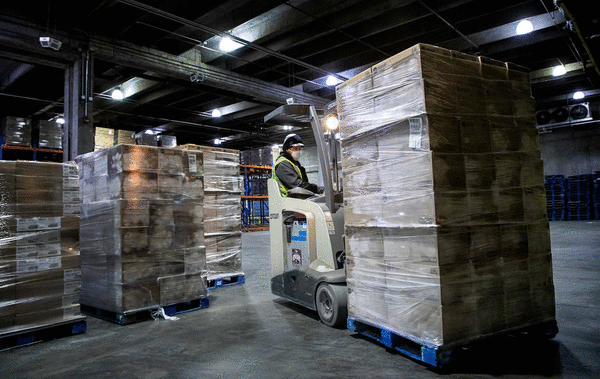
A video circulating on social media shows federal immigration officers putting a worker into a gray pickup truck in a parking lot behind General Mills’ Chanhassen manufacturing facility in the second week of January.
The 27-second clip with no audio demonstrates Immigration and Customs Enforcement’s growing presence at Minnesota’s workplaces, including those of Minnesota’s Fortune 500 companies.
A General Mills spokesperson confirmed the company is aware of the situation involving a contractor. “Our team requested ICE agent identification, followed all our safety protocols and partnered with local law enforcement,” the spokesperson said in an email. The Carver County sheriff’s office reported it “has no data” related to the apparent arrest.
In an email after this story was initially published, Department of Homeland Security Assistant Secretary for Public Affairs Tricia McLaughlin said ICE officers pulled over and arrested an individual in the General Mill parking lot who “unlawfully entered” the U.S. in 2023. She didn’t answer whether officers had warned the company it was pursuing the individual.
Businesses of all sizes are grappling with difficult and sensitive situations with the surge of federal immigration officers in Minnesota. Employers are dealing with detained employees, enacting safety measures for workers and navigating public communications about officers’ actions in a polarizing and volatile moment for the Twin Cities.
Bill George, a longtime Medtronic CEO who sat on the board of several companies, including Target, said business leaders’ top obligation is to protect employees’ well-being. The times are “extremely stressful” for businesses, he said.
The surge in federal officers, George said, “is certainly not helping growth, jobs or innovation in” Minnesota.
Minnesota Department of Employment and Economic Development Commissioner Matt Varilek said in a statement that ICE’s actions are having a “negative impact” on “businesses large and small.”
Varilek’s agency has heard that some businesses — especially those owned by people of color he said are targeted by the federal actions — will struggle to sustain payroll in the coming weeks amid the surge. Diversity, he said, is critical for “a thriving economy and is at the foundation of Minnesota’s communities.”
“Layer on the national immigration policy changes that are reducing international talent to Minnesota, and our already tight labor market faces even more strain,” Varilek continued.
Target has declined to comment on an incident at its Richfield store filmed by bystanders, which occurred a day after ICE agent Jonathan Ross shot and killed Renee Good in south Minneapolis. A state representative said U.S. Border Patrol detained and injured two Richfield Target employees on Jan. 8, both U.S. citizens.
Caribou Coffee sent a memo to managers outlining how they could respond if ICE agents visit stores. A source familiar with this memo said “the guidance was provided to support the safety of employees and guests in accordance with applicable legal requirements.”
The letter advised employees to remain calm and serve the officers. But the letter recommends employees not allow officers to conduct immigration actions. The letter said employees may tell federal officers that they cannot enter private areas of the stores unless they have a judicial warrant.
“ICE agents need your permission to go behind the counter, enter the backroom, or go anywhere in the coffeehouse where only employees can enter,” the letter reads. “If they don’t have a warrant signed by a judge, do not give them permission to enter these areas.”
Loan Huynh, who chairs the immigration group at Fredrikson & Byron, a Minneapolis law firm, said ICE can issue administrative warrants, which officials can use to make an arrest or seizure but do not allow them to enter private spaces or conduct searches.
Judicial warrants allow agents to enter private spaces and conduct searches but require probable cause and must be signed by neutral judicial courts — not immigration judges.
Caribou said in the letter that ICE is sometimes using administrative warrants to enter private spaces. Businesses, Huynh added, don’t have to follow these administrative warrants.
“It doesn’t mean your life is going to be [easier] if you don’t because you’re still facing their wrath and their pressure,” Huynh said.
Businesses face roadblocks in restricting ICE action, Huynh said. Businesses may open themselves up to being the target of discrimination claims if they refuse service, she continued.
Huynh said businesses are feeling the impact of ICE “more than ever.” Her firm has seen a large increase in the number of employers asking how they can protect themselves in the past two weeks.
“It is now all real for everyone — not just individuals who are here who are immigrants and foreign nationals — but also employers, too,“ she said. ”They are definitely part of the collateral consequences.”
Employers are losing employees, and not just undocumented ones, Huynh said.
“People are scared, and it has nothing to do with their immigration status,” she said.
The public-facing responses from Minnesota’s largest companies have been mostly muted. Since President Donald Trump’s inauguration, big businesses have largely remained quiet about controversial issues.
George encouraged Minnesota employers to “make a statement” about ICE’s presence.
“How can you expect a committed, loyal workforce if you’re not there to have their back?” George said. “You have to have their back when they need you.”
The Department of Homeland Security did not respond to emails requesting comment on the General Mills incident by deadline Tuesday afternoon.
(Carson Hartzog contributed to this story.)
©2026 The Minnesota Star Tribune. Visit at startribune.com. Distributed by Tribune Content Agency, LLC.








Comments