Medline survives tariffs, delays on road to biggest US 2025 IPO
Published in Business News
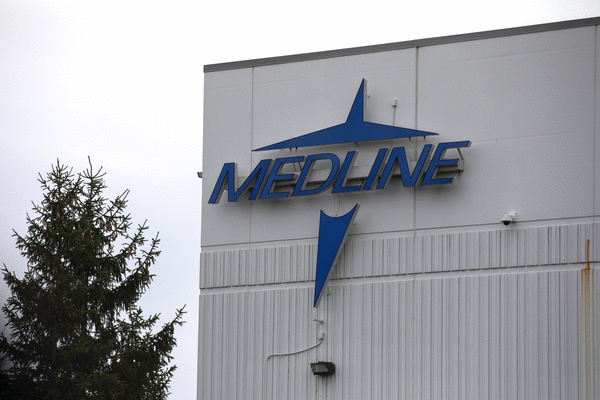
Medline Inc.’s long-delayed initial public offering is on track to raise the most of any listing this year, as investors keen on the medical supply company’s business model look past its rocky path back to the public markets.
The company, which was taken private in 2021 by Blackstone Inc., Carlyle Group Inc. and Hellman & Friedman in a $34 billion deal, is seeking on Tuesday to raise as much as $5.37 billion in the listing. That amount would make it the year’s biggest US IPO at the bottom of the price range, and at the top, the largest this year globally.
Even after delays stemming from the market’s reaction to U.S. trade measures and the longest-ever government shutdown, the maker and distributor of products including exam gloves, masks, swabs and syringes appears to be winning over investors. Close to half of the targeted raise is accounted for by cornerstone investors, and the offering is expected to price in the upper half of the marketing range of $26 to $30 per share, Bloomberg News has reported.
Along with Medline-brand medical and surgical products, the company distributes items for third parties. According to executives, a key differentiator is how Medline seeks to replace many of those items with its own products over time. Doug Golwas, Medline’s chief commercial officer, dubbed it a “flywheel effect,” driving margin expansion.
The share of Medline brand products sold to customers under multi-year distribution deals typically starts at about 10% at the start of a new distribution contract, Golwas said in an online marketing presentation. As customers get familiar with the value that can be achieved by switching to Medline-brand products, the figure can potentially rise to 60% over time, he said.
Medline’s bigger product lineup and strong cash flow gives it a leg up on competitors, according to Jonathan Palmer, a Bloomberg Intelligence health-care analyst, creating a virtuous circle that enables it to invest in more products and further entrench itself in the medical supply chain.
The model makes direct comparisons with peers such as health-care distribution companies like Cardinal Health Inc. and McKesson Corp., and medical equipment companies such as Medtronic Plc, more difficult, said Palmer.
“It’s going to fall into the health-care services bucket of company coverage by the nature of what their business is, but at the end of the day it’s more of a medical products company with distribution than the other way around,” Palmer said in an interview.
Expected earlier
Medline’s listing, which is set to rank among the biggest private equity-backed listings of all time, was expected far earlier than this.
The company filed confidentially for the listing with the U.S. Securities and Exchange Commission last December, but tariff uncertainty delayed its plans to list in the first half of 2025. Medline ultimately filed publicly in late October, weeks after the U.S. government shutdown complicated IPOs for many companies. It then waited until the logjam ended and the November holiday for Thanksgiving had passed before finally kicking off formal marketing earlier this month.
In pushing ahead with its IPO, both Medline and investors that are supporting the deal upfront are looking past the negative impact of tariffs. Only 16% of Medline’s total cost of goods sold is sourced outside the U.S., limiting the impact on income before taxes to $325 million to $375 million this year and $150 million to $200 million next year, according to the marketing presentation.
Investors are more comfortable with health-care suppliers’ ability to mitigate tariff impacts than they were six months ago and Medline would be able to pass on any cost increases to customers as its contracts were renewed over time, Palmer said.
Medline had net income of $977 million on revenue of $20.6 billion for the nine months ending Sept. 27, compared with net income of $911 million on revenue of $18.7 billion a year earlier, according to its filings.
Tariff risk
To be sure, tariffs aren’t the only risk to the company’s outlook. The company still has to maintain new prime vendor relationships and successfully convince them to adopt Medline-brand products, wrote Kyle Bauser, Roth Capital Markets’ senior research analyst, in a Dec. 11 report.
Bauser also cited the company’s need to reduce debt. Management plans to use its excess cash to bring down its net leverage ratio from 3.25 times to less than three times, according to its presentation.
“Their leverage is at the high end of the range of most companies in the space, but it’s not egregious in any way, shape or form and they have the ability to pay down debt very quickly,” Palmer said.
The flywheel nature of its business model helps justify the mid-teens forward earnings before interest, taxation, depreciation and amortization multiple the company is seeking based on the IPO terms, and its forecasts for high-single digit earnings growth, Palmer said, even though this represents a premium to distribution peers.
“On paper, the company’s been primed and preened to look as pretty possible for the dance, and everything’s going in the right direction, but maintaining that pace is key to maintaining the premium valuation going forward,” he said.
(With assistance from Bailey Lipschultz.)
©2025 Bloomberg L.P. Visit bloomberg.com. Distributed by Tribune Content Agency, LLC.







Comments