Maine lobster bill gets an assist from key Texas ally
Published in Political News
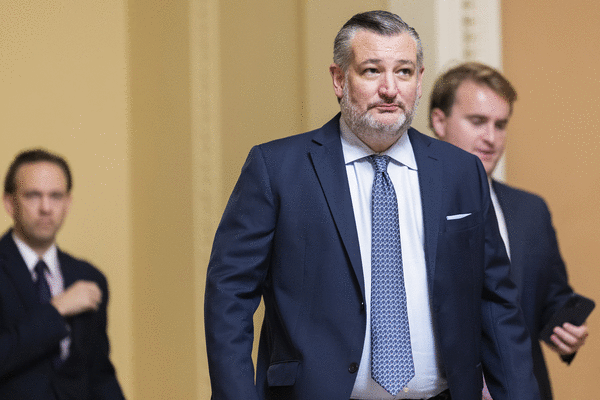
WASHINGTON — Senate Commerce Chairman Ted Cruz said his panel will take up legislation next month to extend a moratorium on new North Atlantic right whale protections, a move the Texas Republican credited to Maine GOP Sen. Susan Collins five days out from one of the most pivotal elections of her career.
Collins, who is in a competitive reelection campaign against Democratic nominee Troy Jackson, requested the committee take up the lobster industry-backed bill in a September letter with Sen. Angus King, I-Maine.
Cruz wrote Thursday on X that Collins’ “leadership has been instrumental in advancing this bill to protect Maine’s lobstermen from burdensome regulations. I hope we can move this bill without changes or further delay to put on President Trump’s desk ASAP.”
The House-passed bill is a priority for the state’s lobster industry, which argues an extension of the moratorium, set to expire Dec. 31, 2028, for another seven years would provide greater certainty — particularly with the presidency up in the air in 2028.
Congress first imposed the moratorium in late 2022 at the behest of the Maine delegation on both sides of the aisle, inserting it into a year-end spending package.
The move came in response to a Biden administration “biological opinion” issued in 2021 recommending tougher restrictions to try to keep the endangered right whales from getting tangled up in commercial fishing lines — a major contributor to the population’s decline.
But the potential for major changes such as a mandate to use “ropeless” gear and fishery closures was too much for the Maine lobster industry, which fears a future administration could revive similar efforts.
To try to balance the concerns of environmentalists, the 2022 law appropriated $20 million to “support the adoption of innovative fishing gear deployment and fishing techniques to reduce entanglement risk to North Atlantic right whales,” part of an overall $280 million appropriated in recent years for right whale recovery efforts.
The Maine Department of Marine Resources has been using the congressionally appropriated funds to collect data for the past few years. Collins and King wrote last month that extending the regulatory pause would allow such efforts to continue and better inform future decisions.
According to the Maine Lobstermen’s Association, the industry supports about $2 billion in annual economic activity and 17,500 jobs.
“It is critical that any future regulatory actions appropriately balance protecting North Atlantic right whales with the economic and practical realities facing Maine’s lobster industry,” Collins and King wrote.
Tight margins
Compounding matters for the industry has been tariff-driven uncertainty and higher inflation.
In response to Trump administration tariffs, the Canadian government initially retaliated against a range of U.S. exports, including seafood; after Collins and others intervened, Canada walked those levies back.
Still, other tariffs and cost increases have hit the industry hard, said Curt Brown, president of Bold Coast Seafood in Prospect Harbor, Maine. “Our traps are built of vinyl-coated steel. Trap prices have gone up, bait prices have gone up, fuel prices have gone up. So margins are tight,” he said.
Brown and other industry representatives say implementing greater protections for right whales would make matters worse, increasing costs and potentially forcing some lobstermen out of business.
“I don’t think you will find any fisherman that says they want to harm a whale; we all support very healthy oceans,” said Virginia Olsen, executive liaison and political director for Maine Lobstering Union Local 207.
But Olsen, whose family has worked in the lobster business for five generations, said more time is needed to study the new data coming in through the Maine Department of Marine Resources’ research.
Hence the Trump administration-backed legislation introduced by Reps. Mike Lawler, R-N.Y. — another top midterm target of Democrats — and Jared Golden, D-Maine, who is retiring, to extend the moratorium through 2035.
It passed the House on Sept. 1, but not without opposition from most Democrats and even a couple Republicans sympathetic to the whales’ plight. The vote was 219-196, with 10 Democrats in favor and two Republicans opposed — Brian Fitzpatrick of Pennsylvania and Aaron Bean of Florida.
While Fitzpatrick has previously voted against his party on matters concerning endangered species, Bean represents Amelia Island, the winter calving and nursery ground for the whales. Amelia Island has its own cottage industry to protect, with the annual Right Whale Festival scheduled for next month.
Aside from Golden and fellow Maine Rep. Chellie Pingree, other House Democrats who supported the measure include those in tough races in swing districts, such as Washington’s Marie Gluesenkamp Perez and Texas’ Vicente Gonzalez.
Maggie Goodlander and Chris Pappas of New Hampshire, next door to Maine, also supported the bill. Pappas is running for Senate to replace the retiring Democrat Jeanne Shaheen, against former GOP Sen. John Sununu; Inside Elections rates the race Tilt Democratic.
Lame-duck opportunity
With Democrats expected to make big gains next Tuesday, the lame-duck session may be the best chance for the bill’s supporters to get the bill enacted.
While Pingree is herself a senior Appropriations Committee member, the potential losses of Collins and Lawler, combined with Golden’s scheduled departure, could make it an uphill climb in the 120th Congress.
Inside Elections with Nathan L. Gonzales rates Collins’ and Lawler’s races each a Toss-up.
The bill has already been an assist to Lawler, who has pointed to it as evidence of his ability to work across the aisle. His race is in a district former Vice President Kamala Harris won in 2024.
Golden originally introduced his own bill that would implement an identical extension. Lawler, who represents a landlocked district in New York’s Hudson Valley, said he joined the effort through a desire to “fight for small business.”
Golden returned the favor last month by endorsing Lawler in his hometown paper The Journal News, highlighting their cooperation on the bill.
The reasons for House GOP leaders taking up Lawler’s identical, separate bill have never been made clear; some speculate it simply has to do with ensuring the credit goes to a vulnerable Republican.
While a Senate Commerce markup could give the measure some momentum, the battle for floor time in November and December will be intense. Collins, the Senate Appropriations chair, could try to insert the bill into another year-end spending package, though her staff wouldn’t comment on legislative strategy.
‘False dichotomy’
The North Atlantic right whale, with a remaining population of roughly 380, has been experiencing what’s known as an “unusual mortality event” under the Marine Mammal Protection Act for the last decade. Over 20% of the whales have either been either killed or injured, largely due to entanglements in fishing gear and collisions with ships.
Still, supporters of the bill point to National Oceanic and Atmospheric Administration data showing an increase in the number of individual whales since 2020, and 2026 was the largest calving season since the beginning of the unusual mortality event.
Jason Joyce, a lobsterman and director of advocacy for the New England Fishermen’s Stewardship Association, said the numbers demonstrate the need for more data before new regulations are imposed.
“What has happened since the current pause was put into place is births are up and deaths are down, so we’re in a better position now than we were when they were going to overregulate us,” Joyce said.
But Katherine Sayler, southeast representative for Defenders of Wildlife, said even with the recent growth the population is still down significantly compared to historical population levels.
“We’re not even close to the 500 North Atlantic right whales that we estimated in the population approximately 20 years ago,” said Sayler.
Dan Moss, senior government relations representative for Defenders of Wildlife, added that the bill would sideline the work of a team established by NOAA nearly three decades ago to address risk to whales, and that it effectively ignores a court ruling that found current regulations for right whales in lobster fisheries are insufficient under federal law.
Backers and opponents of the bill have focused on the potential for regulations requiring the use of ropeless gear to reduce whale entanglements.
In this system, there’s still rope to connect individual traps, however it lacks the vertical line that leads to a buoy. Instead it relies upon systems that remain submerged until the trap owner triggers them just prior to retrieval.
During House floor debate, Natural Resources ranking member Jared Huffman, D-Calif., argued that the federal government was “dragging its feet” on right whale regulations, including by de-prioritizing ropeless gear.
Both Olsen and Joyce said there are significant safety concerns related to the design of ropeless gear, since crew could become entangled without a simple method to retrieve them as with conventional gear.
“If my crew is wrapped and entangled in that rope and goes overboard, in my panic, I have to stop, grab a tablet, log in, open the app, deploy the buoy, wait for the buoy to get to the surface, and then put it in my hauler,” Olsen said. “There’s no way that my crew is going to come up alive.”
But Sayler argued the bill creates “the false dichotomy that there cannot be coexistence between fisheries and whales at a time when they face so many threats.”
She said that right whales play an important role in the ocean ecosystem through the nutrients they create and “that they are worth having on the planet for their incredible intrinsic value.”
©2026 CQ-Roll Call, Inc., All Rights Reserved. Visit cqrollcall.com. Distributed by Tribune Content Agency, LLC.













































Comments