In Congress, 'see no evil, speak no evil, hear no evil'
Published in Political News
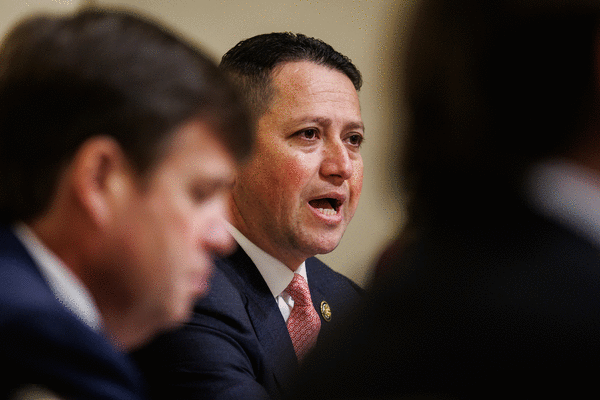



WASHINGTON — Two congressmen whose staff members accused them of sexual misconduct resigned Tuesday, leaving calls for reform and accountability in their wake.
Now, House veterans and victim advocates warn the departure of Reps. Reps. Eric Swalwell, D-Calif., and Tony Gonzales, R-Texas won’t — and shouldn’t — be the end of Congress’ reckoning with sexual harassment in the workplace.
“Here’s the problem in Congress: You know, it’s ‘see no evil, speak no evil and hear no evil.’ It’s this attitude that we’ll just look away,” said former California Democratic Rep. Jackie Speier, who spearheaded the #MeTooCongress movement in 2017 and led a push for reform and accountability for sexual misconduct on Capitol Hill.
“And it’s what has created a very corrupt environment in which to work.”
“I do think it will be a Me Too 2.0,” said Brittany Martinez, a former staffer for then-Speaker Kevin McCarthy, R-Calif., and executive director of Principles First, a self-described alternative to CPAC. “We live in the United States, you’re innocent until proven guilty, but also, we have to use our common sense … when the evidence is stacked against someone like this.”
Swalwell and Gonzales agreed to give up their seats after more than two dozen lawmakers — led by women — publicly stated they would vote to expel them. The Ethics Committee opened official investigations into both members.
Swalwell faces accusations from five women accusing him of a wide range of sexual misconduct, including rape, according to allegations originally reported by the San Francisco Chronicle and CNN.
Swalwell has apologized for any “mistakes in judgment” but continues to deny the allegations.
But accusations against Gonzales surfaced more than a month ago. The married father of six eventually admitted to having an affair with a staff member who later died by suicide. “I made a mistake and I had a lapse in judgment,” he said of the affair in March, adding he’s reconciled with his wife and asked God to forgive him.
A few weeks later, a second staff member accused him of pursuing her, according to reporting from the San Antonio Express-News. House rules prohibit members from engaging in sexual relationships with their staffers.
Resignation under duress
Swalwell’s resignation, which was effective at 2 p.m. EDT Tuesday, came without acknowledgment of misconduct or harm caused to those who have come forward with allegations. While he apologized for “mistakes in judgement,” the now-former California congressman said he will “fight the serious, false allegations” made against him.
“I wasn’t surprised, because I had heard rumors swirling about him before I left Congress,” Speier said about Swalwell. Both represented districts in the San Francisco Bay Area. Speier did not run for reelection in 2022.
Martinez said she’s heard many similar stories of harassment on Capitol Hill, but staff members aren’t willing to come forward out of fear the accusation will damage their careers, among other things.
“I’ve been doing D.C. politics for a while, and you hear these stories pop up every few years,” Martinez said. “The fact that we’re getting two salacious stories back-to-back — it sounds twisted to say, obviously I don’t want anyone to be harmed — but I’m glad that this is happening … and that they’re getting attention.”
“I think that can kind of be a catalyst for more people to come forward,” she said.
By the time the two congressmen resigned, more than two dozen members had publicly called for them to do so or face expulsion. Sarah Higginbotham, co-founder and co-director of the National Women’s Defense League, said this is common in state legislatures and Congress — members don’t face consequences for harassment unless the body demands it.
“It’s left up to the whims of the body to force a vote — usually a historic vote, because they’re very rare — that would force a resignation,” she said. “It’s designed to not screw with politics, that’s what the system is set up to do. And it’s doing it very well.”
Martinez added that the silence from Speaker Mike Johnson, R-La., and Minority Leader Hakeem Jeffries, D-N.Y., on the resignations was deafening.
“These are lives. These are real people,” she said. “And the fact that our leaders don’t step up … and call for resignations because it’s not politically convenient at the time — come on. Do your job.”
‘It’s got to be a sudden death’
Hill veterans and experts argue Gonzales’ and Swalwell’s resignations under duress fall short of holding them accountable. Especially if — or when, they say — more victims come forward.
“I have learned again and again since Me Too went viral that courage inspires courage … people are more likely to come forward when they see other people sharing their experiences, demanding that they be treated seriously, demanding accountability,” said Fatima Goss Graves, CEO of the National Women’s Law Center. “The problem right now that we may be having in Congress is that there are members who believe there won’t be real consequences.”
Allegations against Gonzales, for example, first publicly surfaced in February. Johnson urged him not to run for reelection, but stopped short of demanding his resignation. Gonzales dropped his reelection bid after he was forced into a runoff race in the March GOP primary.
Then, things quieted down. Gonzales kept his seat — until Tuesday, when his House colleagues threatened expulsion. His resignation was slated to go into effect at 11:59 p.m. Tuesday.
“I think the way that you saw the allegations around Rep. Gonzales playing out may have led people to believe there wouldn’t be consequences,” said Goss Graves. “He admitted to having a relationship with his staff person … Why wasn’t that enough for them to take action a long time ago?”
Speier said expulsion needs to be a greater deterrent for lawmaker misconduct on the Hill. Victims of misconduct often fear coming forward for fear of retaliation or being what Speier called “blackballed” from future jobs on the Hill.
“I think we’ve got to create a system that makes it perfectly clear that expulsion is going to be part of your legacy if you conduct yourself in a manner like that,” Speier said.
“If members recognized that they would lose their congressional office, that they would be expelled if they engaged in a sexual relationship with someone on their staff, then we might have a safer environment for young women and interns to work in,” she said.
But neither Swalwell nor Gonzales will now face an expulsion vote in the House. Their Ethics Committee probes will come to an end, because neither man will be in the panel’s jurisdiction. The Manhattan district attorney’s office is investigating one of the allegations against Swalwell that occurred in New York.
“It’s got to be a sudden-death experience for members if they engage in this conduct with their staff. That will change their behavior,” Speier said.
Time for change
Speier spoke publicly about sexual harassment and assault she experienced as a young congressional staffer at a 2017 House Administration Committee hearing, saying that two sitting members at the time of her testimony had sexually harassed staffers during her time on staff.
“Some people in Congress who get there and think that they are really untouchable, that they are entitled, and as long as you have a body that is willing to look the other way, these kinds of illegal acts can happen,” she said.
Almost a decade after the #MeToo movement made waves on the Hill, she said that Congress still looks the other way when it comes to misconduct, despite strides that have been made. She pointed to the Congressional Accountability Act in 2018 as a positive step, but said it’s time for more change.
Speier said the 2018 law required members to be personally liable for harassment settlements, rather than taxpayers. The law also removed mandatory mediation and nondisclosure agreement requirements and gave victims counsel instead of forcing them to find their own.
If there are settlements, the law requires members to pay them within 180 days.
“There should be a special committee set up, there should be a deep dive and there should be amendments to the 2018 law that should make it safer for women to come forward,” she said.
Some current members agree that change is long overdue.
In a statement Tuesday, the Democratic Women’s Caucus leadership said it supports improvements to the Office of Congressional Workplace Rights and the Ethics Committee “so important investigative work can be done with the urgency that these cases demand.”
But reform in Congress can be slow, and as long as the current system stands, advocates fear victims will be reluctant to come forward and the cycle of misconduct and abuse of power will continue.
“There’s work that still needs to be done and I hope that Congress takes it seriously,” Speier said. “It’s a toxic environment for young women to work in and as long as you have a superstructure that doesn’t enforce the rules or provide the kind of protection necessary, it’s going to continue to be that.”
_____
©2026 CQ-Roll Call, Inc. Visit at rollcall.com. Distributed by Tribune Content Agency, LLC.



















































Comments