Hungary's new leader faces post-Orban economic hurdles
Published in Political News
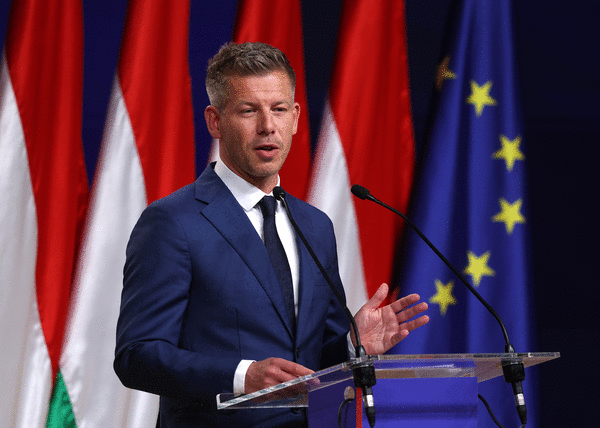
Hungary’s next leader will lay out his plans on Monday to shore up the economy and dismantle Prime Minister Viktor Orban self-styled illiberal system, a day after a landslide election win over the nationalist premier who had been backed by Donald Trump and Russian President Vladimir Putin.
Peter Magyar campaigned on a promise to improve the living standards of ordinary Hungarians, restore the rule of law and bring down Orban’s 16-year old illiberal system. Key to that will be to unlock frozen European Union funds as well as to bring Hungary back to the European mainstream.
A 45-year-old former ruling party insider, Magyar had galvanized the country over the past two years with his message of change in the face of an increasingly authoritarian regime. His dominant showing in Sunday’s election, where his Tisza party secured a parliamentary supermajority, was welcomed by markets, with the currency and stock market extending a months-long rally on expectations for an economic revival.
Magyar will hold his first post-election news conference at 2 p.m. in Budapest. Here are some of the important actions his government plans to take in foreign policy, economy and domestic politics:
Politics
Magyar’s ability to dismantle Orban’s nationalist project may well hinge on his ability to dislodge political loyalists. Magyar wasted no time on Sunday calling on the country’s president, top justices and chief prosecutor to hand in their resignations.
Removing them became easier to do after Tisza’s landslide election win appeared to lock in a two-thirds parliamentary majority.
That will also help Magyar to single-handedly pass a new constitution and change election rules that had until now heavily favored Fidesz, steps which will require a supermajority in parliament.
He’s also pledged to limit to two the terms of prime ministers, to prevent Hungary sliding back to authoritarianism in the future. He’s said the rule would effectively disqualify Orban from running again for the top job.
Foreign policy
Repairing Hungary’s frayed ties with the European Union and unlocking some of the more than $20 billion in E.U. funds that has been withheld from the Orban government over graft and rule of law concerns are at the top of the agenda.
After casting his vote on Sunday, Magyar said the new government plans to move quickly to pass anti-corruption legislation, shore up the independence of the judiciary, and ensure media and academic freedom — all contentious issues on which Orban was unwilling to compromise.
Time is of the essence: Hungary must submit receipts for completed E.U.-funded projects by the end of August to tap funds from the bloc’s pandemic-recovery program. Failure to do so would lead to Budapest losing more than €10 billion ($11.7 billion) in grants and loans for good.
The E.U., for its part, is waiting for Hungary to clear vital €90 billion loan to Ukraine, which the pro-Kremlin Orban blocked last month. While Magyar will likely want to avert the hardball tactics of his predecessor, showing goodwill for Kyiv could in turn buy Budapest reciprocity from Brussels over its stalled funds.
Magyar said his first trip will be to Warsaw, to patch up ties with Poland. A historic ally for Hungary, Prime Minister Donald Tusk’s government had become a scathing critic of Orban’s Russia-oriented foreign policy, which included diluting E.U. sanctions against Moscow and slow-walking NATO expansion. Magyar will then travel to Vienna and Brussels.
Improving relations with neighboring Ukraine, whom Orban had cast as the “enemy” in the campaign, will also be on the agenda. The toughest task may be to loosen ties with Russia without jeopardizing energy imports completely, as well as to establish relations with Trump, who had repeatedly endorsed Orban.
Economy
Magyar inherits from Orban a struggling economy with a runaway budget deficit, high interest debt payments and a sovereign credit rating that’s on the brink of junk grade.
While the new government will likely enjoy a honeymoon period after investors had bet big that Magyar’s election would open the E.U. money spigot — boosting the forint and government bonds — there’ll be little time to waste for fiscal consolidation.
Magyar has said that the first order of business will be to pass a new budget that puts state financing on a sustainable path. That would also be a step toward the eventual adoption of the euro, something Orban had adamantly opposed.
His party has vowed to introduce a wealth tax to make a flat-tax system more equitable and also to punish a new class of politically-connected ultra-rich who had risen under Orban. There are also plans to end lavish tax exemptions for the car and battery industries, which enjoyed special treatment until now. That would potentially allow for an eventual reduction in onerous special industry taxes including on the banking sector.
Magyar has pledged to save money by cutting funds to what had been Orban’s system of patronage, including via advertisements to pro-government outlets, overpriced procurements and by cutting funding to public media, which had become a government mouthpiece over the past 16 years.
But he’ll also be under pressure to quickly boost spending on health-care, education, social services and public transportation — all of which suffered from under-investment under Orban and which Magyar had promised to put in focus.
Business
Magyar has pledged to boost competition in the economy after a period in which business and politics were increasingly blurred and where government intervention in the private sector was pervasive.
That will help lower the cost of equity for Hungary’s largest lender, OTP Bank Nyrt., on lower political and regulatory risk, according to Bloomberg Intelligence analysts Tomasz Noetzel and Ilia Shchupko.
In a statement, the Hungarian Banking Association said it looked forward to cooperating with Magyar’s government to achieve “sustainable development and stability.”
Tisza is also poised to examine the leadership of Mol Nyrt., the Hungarian energy company that imports Russian oil and whose longtime chief executive had been a close Orban ally.
There’s also the case of listed companies closely associated with Orban, including telecom and defense company 4iG Nyrt. and tourism, construction and energy conglomerate Opus Global Nyrt. Their share prices had tanked in the lead-up to the election on concern state orders and regulations benefiting the companies may end.
©2026 Bloomberg L.P. Visit bloomberg.com. Distributed by Tribune Content Agency, LLC.










































Comments