Reps. Cline, Kiggans propose legislation to reinstate police partnerships with ICE
Published in Political News
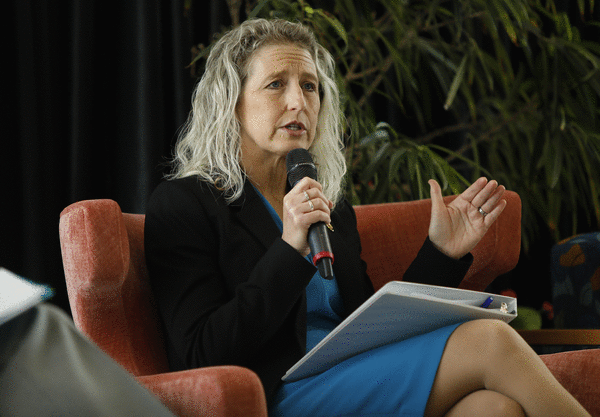
U.S. Reps. Ben Cline and Jen Kiggans introduced legislation that would require state and local law enforcement to enter into cooperative agreements with Immigration and Customs Enforcement in order to receive certain federal grant funding.
The Virginia Republicans’ bill would effectively mandate that state and local police perform some immigration duties in order to receive grant funding from the Community Oriented Policing Solutions program with the Department of Justice. Those grant funds go toward things like hiring more police officers and anti-drug task forces.
That’s a response to actions Gov. Abigail Spanberger took to rescind some of those 287(g) agreements.
Kiggans said she was signing on as a co-sponsor in light of last month’s shooting at Old Dominion University.
“We want to obviously prioritize safe communities,” Kiggans said. “The shooting that happened at ODU was really kind of a wake-up call.”
The man who shot and killed an ROTC instructor and wounded two students at ODU last month was a felon and naturalized citizen who had purchased a stolen gun illegally. Asked if the legislation was spurred by the ODU shooting, Kiggans demurred but said the shooting brought to light lots of issues, including military safety.
“We know that there are terrorist cells in our country, so I am more concerned for their safety, even watching the events a couple of weeks ago at ODU,” she said. “So it certainly highlighted just the need that we use every tool at our disposal to keep our streets safe, our communities safe, our college campuses safe.”
Under 287(g), local and state law enforcement act as immigration agents. That can look like detaining people suspected of being here illegally in the course of ordinary police work, detaining people at jails for ICE even after their sentence is complete, or serving an executing administrative warrants for people in custody suspected of immigration violations. Being in the U.S. without authorization is generally a civil violation, not a criminal one, which means state and local law enforcement would not ordinarily be a part of enforcing immigration.
Last year, then-Gov. Glenn Youngkin entered Virginia’s State Police and Department of Corrections into a 287(g) agreement by executive order. On her first day in office, Spanberger removed the requirement for state agencies to cooperate with ICE through 287(g); she subsequently used a second executive order to cancel the agreement with state agencies altogether. The directives do not apply to local law enforcement agencies that might have existing 287(g) agreements, though no sheriffs’ offices in Hampton Roads have any. ICE reports it has 287(g) memorandums of agreement with more than 1,600 agencies in 39 states.
Kiggans announced Tuesday she was signing on as an original co-sponsor of Kline’s bill, which has not yet been assigned to a committee. She said state law enforcement should work together with federal immigration enforcement.
“What Congressman Kline’s bill does is reverse what the governor had done when she first came into office, where she told state law enforcement that they do not have to work with ICE agencies,” Kiggans said. “There is no reason that Virginia, as a commonwealth, needs to be separating and making law enforcement lives harder and not easier for them to do their job.”
A spokesperson for Spanberger said in a statement that was a mischaracterization of the executive orders, noting the Department of Corrections continues to notify ICE when individuals born outside of the United States are in state custody.
“Virginia state law enforcement officers stand ready to work with federal partners, including ICE — but Virginia will not subordinate highly-trained and professional state law enforcement officers under ‘the supervision or direction of’ ICE, nor will agencies undertake law enforcement action without a warrant,” the statement said.
“Governor Spanberger believes that Virginia’s state law enforcement officers must not be required to divert their focus from their core mission — investigating crimes, enforcing the law, and keeping Virginia’s communities safe — to do the civil immigration enforcement work of ICE.”
Virginia State Police said they could not comment on legislation that has not yet been passed.
Before and after the executive orders, the Virginia Department of Corrections maintains a more informal arrangement ICE, including providing the agency with a monthly list of individuals in custody who were born outside of the U.S. and notice of their release. But without the 287(g) task force model, it is not obligated to hold individuals for longer periods of time while waiting for ICE.
Virginia state and local agencies, combined with national and and international law enforcement associations headquartered in Virginia, received more than $17 million in COPS funding in 2025. A spokesperson for Kiggans said national organizations like the National Center for Policing Innovation and the National Sheriffs’ Association would be subject to the proposed legislation and would be unable to access that funding without signing on to a 287(g) agreement.
The number with just Virginia state and local agencies is closer to $12.5 million. Petersburg received about $5.7 million in funding through the COPS Hiring Program, and Virginia State Police received about $3.9 million in funding for the Anti-Heroin Task Force.
_____
©2026 The Virginian-Pilot. Visit pilotonline.com. Distributed by Tribune Content Agency, LLC.





















































Comments