Editorial: Congress must reassert its constitutional role in federal governance
Published in Political News
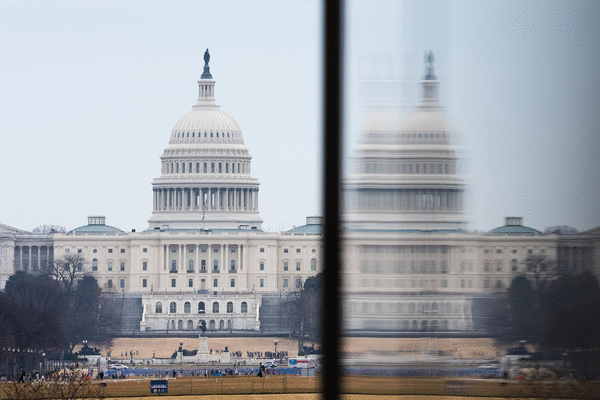
Is the U.S. Congress still a functional legislative body? It’s a reasonable question to ask after the Senate, and then the House, rejected legislative attempts to constrain President Donald Trump’s power to conduct the ongoing war with Iran.
At a time of growing domestic and international crises, the institution granted sweeping powers under Article I of the Constitution continues to sit on the sidelines rather than exert itself. Its nearly unprecedented lack of productivity is a failure of leadership, an abdication of duty and a threat to the stability and future viability of our federal system.
After securing American independence at Yorktown and signing the Treaty of Paris, the Founding generation set about building a system of government that would put its power in the hands of the people and, above all, would guard against the emergence of a monarchical power.
They cleverly designed a system of checks and balances to constrain all three branches of government, but primarily invested power in a federal legislature, reasoning that its members would be more responsive to the population which elected them. While the Constitution grants the president with authority over the military, for instance, it also gives Congress the authority to declare war.
That division of responsibility, evident in so many federal powers, was intended to ensure that elected officials seek broad consensus before taking consequential decisions. To wit, Congress can pass laws, but the president has the ability to reject them through vetoes — which lawmakers can then override if enough feel they are in the nation’s best interest.
The emergence of an “imperial presidency,” as political scientists and others call it, undermines that thoughtful balance. The term emerged in the 1970s thanks to a book by historian Arthur M. Schlesinger Jr. about Richard Nixon’s presidency, but the push-pull between branches dates back much further.
In recent years, however, the consolidation of power in the executive has swelled the influence of that office enormously. The largest modern shift came in the aftermath of the Sept. 11 terrorist attacks 24 years ago, when Congress willingly ceded considerable power to then-President George W. Bush to conduct a “global war on terror” — though that was not the only constitutional responsibility absorbed by the executive thanks to congressional choice or indifference.
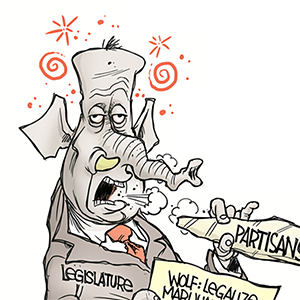
What remains now is a legislative body paralyzed by partisan division, beset by weak-kneed leadership and willing, if not eager, to allow the president to act unilaterally on a host of areas where Congress should assert its authority.
Consider that the last Congress, seated from 2023-25, passed only 153 bills, less than half of the 380 bills averaged between 1989-2023. This Congress, the 119th, is on a similar pace, having passed only 79 bills since it convened in January 2025. Precious few of these would be considered meaningful and only one — the One Big Beautiful Bill spending measure approved in July — had any serious and sweeping impact on the lives of most Americans.
Instead, this Congress, under the leadership of House Speaker Mike Johnson, R-La., and Republican Senate Majority Leader John Thune, R-S.D., appears perfectly content deferring to President Donald Trump on nearly every issue, from the imposition of taxes in the form of tariffs to the deployment of our military into combat.
So many of our nation’s ills — from energy to immigration, federal spending to military readiness — fester as a result of congressional inaction and, frankly, fecklessness. That’s worsened in recent months as federal lawmakers have moved from passive deference to the Trump administration to votes that refuse to intrude on executive decisions — again, the tariffs and the Iran war being prime examples.
What good is a legislature that won’t legislate? What purpose is a constitutional body that won’t assert its authority under the Constitution?
As Americans turn their attention to primary and general elections this year, those questions, and their implications, should be in the front of their minds. If we want a country that moves to address our most pressing national questions, that begins with a Congress willing to act.
©2026 The Virginian-Pilot. Visit at pilotonline.com. Distributed by Tribune Content Agency, LLC.















































Comments