Trump pegs new tariffs to a payments crisis experts doubt exists
Published in Political News
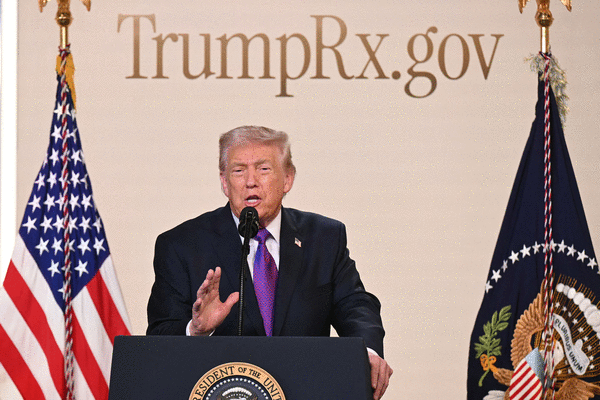
With his move to impose new global tariffs, U.S. President Donald Trump isn’t just trying to repair a trade policy dismantled by a Supreme Court rebuke. He’s also declaring the world’s largest economy is facing a profound balance-of-payments crisis.
The potential problem for Trump and his administration with that argument: Many economists — and financial markets so far — don’t see the U.S. teetering on any such precipice. That means his latest import taxes seem likely to lead to yet another legal challenge and more uncertainty for trading partners, companies, consumers and investors.
To roll out a tariff of 10% — which Trump later raised to 15% — to replace those the court invalidated in its landmark ruling on Friday, Trump invoked Section 122 of the Trade Act of 1974. The statute allows U.S. presidents to impose duties for up to 150 days “in situations of fundamental international payments problems.” Those include “large and serious United States balance-of-payments deficits” and an “imminent and significant depreciation of the dollar.”
Treasury Secretary Scott Bessent, in interviews with CNN and Fox News on Sunday, said the new tariffs would be temporary, ensure that revenues continue to flow to the Treasury and eventually be replaced by ones under separate authorities that “have withstood more than 4,000 challenges since the president’s first term.”
Short-term ‘bridge’
“We’ll see what Congress does, but the 122 is likely a five-month bridge during which studies on Section 232 tariffs and Section 301s are done,” Bessent told CNN, referring to other tariff authorities that require investigations before being implemented. “So this is more of a bridge than a permanent facility.”
To Fox News, he added that Section 122 is “a very robust authority.”
Bessent didn’t say that the new tariffs were necessary to address a particular payments crisis. The Treasury did not respond Sunday to a request for additional comment.
An executive order Trump signed Friday announcing the new import taxes pointed to the U.S. trade deficit and other financial flows as evidence of “large and serious” balance-of-payments deficits.
Among the things Trump identified was a net international investment position — the difference between U.S. investments abroad and foreign investments in the U.S. – that is now $26 trillion in the red.
What he didn’t mention was that his use of levies to force U.S. and foreign companies to invest more in the U.S. would lead to that number ballooning further. Or that in its latest report in January on the position, the U.S. Bureau of Economic Analysis pointed to the soaring valuations on U.S. equities markets that Trump has hailed as a vote of confidence in the U.S. as a major cause of the increase in the U.S.’s negative investment position.
Dollar resilience
The issue most economists see is that despite the president’s proclamation, there’s no evidence the U.S. isn’t able to pay its bills or meet the obligations it has to international investors. If there was, financial markets would be selling off American assets and the dollar would be collapsing amid a loss of confidence in the U.S. economy and the most dominant reserve currency.
“Wearing my (former) IMF hat I will say that the U.S. does not have a fundamental international payments problem,” Gita Gopinath, the former first deputy managing director of the International Monetary Fund, wrote in a social media post Sunday.
In an email to Bloomberg News on Sunday, she added that “150-day tariffs will do little to durably reduce trade deficits. It will mainly result in another round of volatile trade numbers as importers try to time their purchases to avoid tariffs.”
Jay Shambaugh, who occupied the top international job at the U.S. Treasury during the Biden administration, said in an interview there was no evidence the U.S. was facing any balance-of-payments crisis despite Trump’s proclamation.
“That would be a situation where not enough money is flowing into the country to balance all the things where money is flowing out of the country,” Shambaugh said.
But that’s not the case with financial flows into the country balancing the trade deficit. If it wasn’t true, that would be evident in a dollar “depreciating rapidly because nobody wanted to put money into the U.S. to cover the things that are going out,” Shambaugh said.
Mark Sobel, another former senior Treasury official, said the entire premise was based on an antiquated view of the U.S. economy and an artifact of the long-dead Bretton Woods regime of fixed exchange rates and the gold standard. He also argued that Trump has the wrong targets in his sights.
“The president should be far more concerned about the fiscal outlook. Many estimates point to our fiscal deficits averaging 6% of GDP annually over the next decade, before subsequently going much higher,” Sobel said. “That is a lot of Treasury issuance for global markets to digest and could push interest rates much higher.”
The last time a U.S. president imposed tariffs to address balance-of-payments concerns was in 1971 when Richard Nixon introduced a 10% duty that lasted for just a few months and was meant to force other nations into renegotiating fixed foreign exchange rates and address an overvalued dollar. The fundamental payments problem faced by the U.S. then was that the U.S. didn’t hold enough gold in its reserves to match the value of the dollar and speculators were starting to attack the currency.
Section 122 was actually part of a law passed by Congress in response to Nixon’s tariffs and to ensure that future presidents would have boundaries on their use.
There are economists who argue that the Trump administration is partially justified in invoking the Section 122 provision.
Brad Setser, a former U.S. Treasury and trade official now at the Council on Foreign Relations, said the U.S.’s current-account deficit now around 3%-4% of gross domestic product was significant enough to merit the “large and serious” definition.
‘Big’ deficit
But whether the U.S. faced “‘fundamental international payments problems’ is a harder question,” he wrote in a series of social media posts Sunday. “The deficit is big,” Setser said. But portfolio inflows into the U.S. in 2025 remained strong enough to fund a $500 billion external deficit, he said, “and the dollar is currently quite strong.”
Some trade experts argue Trump’s invocation of a balance-of-payments crisis to impose tariffs could lead to the U.S. or other countries to report the measures to the World Trade Organization, which could lead to the IMF getting involved and being asked to adjudicate whether the U.S. faces a crisis that justifies the use of tariffs.
Trump’s latest tariffs and his reason for them could also end up back before the Supreme Court.
“It’s not clear to me that he’s met the conditions” of Section 122 or that the reasons for the statute even exist since the U.S. abandoned the gold standard, said Jennifer Hillman, a former top U.S. trade lawyer and judge now at Georgetown University’s law school.
She said such a case would be less clear-cut than the challenge Trump lost on Friday, in which the Supreme Court found that the original 1977 statute he used didn’t even mention the word tariff.
Neal Katyal, the prominent lawyer who argued the case against Trump’s global tariffs before the Supreme Court, pointed out over the weekend that one issue the president could face if his new tariffs are challenged is that his own lawyers argued Section 122 wasn’t appropriate for them.
“Nor does (Section 122) have any obvious application here, where the concerns the president identified in declaring an emergency arise from trade deficits, which are conceptually distinct from balance-of-payments deficits,” administration lawyers wrote in a filing last year.
That may be moot, Setser argued.
While he said he was sure the justification for Trump’s tariffs would end up before the courts, “more importantly, I don’t think litigation over the meaning of a fundamental payments problem and a balance-of-payments deficit will be sorted in 150 days,” he wrote. “So my bet is that the clock on the tariffs will expire” before the courts rule.
©2026 Bloomberg L.P. Visit bloomberg.com. Distributed by Tribune Content Agency, LLC.






































Comments