Supreme Court ruling against Trump's tariffs leaves Mexico in cautious wait-and-see mode
Published in Political News
Mexico's secretary of the economy, Marcelo Ebrard, urged "prudence" Friday in the aftermath of the U.S. Supreme Court ruling invalidating part of President Donald Trump's sweeping tariff regimen.
"We have to see where this is going," Ebrard told reporters. "We have to see what measures (Washington) is going to take to figure out how it is going to affect our country. "
Amid widespread concern about tariffs in Mexico — the United States major commercial partner, with almost $1 trillion in annual two-way trade — Ebrard cautioned: "I tell you to put yourselves in Zen mode. As tranquil as possible."
Across the globe, nations were assessing how the Supreme Court's ruling might affect them. Some world leaders expressed relief or satisfaction with Friday's decision.
"The justices have shown that even a US president does not operate in a legal vacuum. Legal boundaries have been set, the era of unlimited, arbitrary tariffs may now be coming to an end," wrote Bernd Lange, chair of the European Parliament's International Trade Committee, on X.
Also writing on X, Canada's trade minister, Dominic LeBlanc, referred to the International Emergency Economic Powers Act, which the Supreme Court improperly used to impose tariffs: "The United States Supreme Court's decision reinforces Canada's position that the IEEPA tariffs imposed by the United States are unjustified."
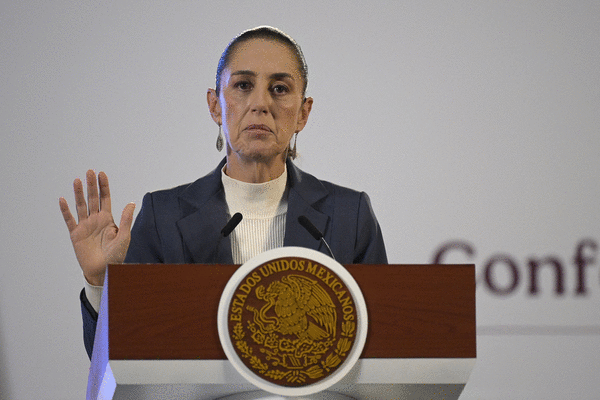
Mexican President Claudia Sheinbaum, in her daily news conference, diplomatically made a no-comment when asked about the tariffs. "We'll review the resolution carefully and then gladly give our opinion," she said.
Ebrard, her economy secretary, plans to travel to the United States next week to clarify matters, he said.
Last year, Ebrard noted, Mexico managed to stave off Trump's threats to impose a 25% across-the-board levy on all Mexican imports.
However, Mexico has been pushing back against Trump administration tariffs on imports of vehicles, steel and aluminum, among other products.
The Supreme Court voided so-called fentanyl tariffs on Mexico, China and Canada. The Trump administration imposed those levies in a bid to force the three nations to crack down on trafficking of the deadly synthetic opioid.
In the aftermath of Friday's ruling, Trump said he planned to seek alternate legal avenues to impose now-stricken tariffs.
About 85% of Mexican exports to the United States are exempt from tariffs because of the United States-Mexico-Canada Agreement. The signature accord extended a mostly free-trade regimen between the three nations, replacing the previous North American Free Trade Agreement.
The three-way pact is scheduled for joint review starting July 1. That date marks six years since the agreement was signed during the first Trump presidential term.
©2026 Los Angeles Times. Visit latimes.com. Distributed by Tribune Content Agency, LLC.









































Comments