How government killings and kidnappings in Argentina drove mothers to resist and revolt − and eventually win
Published in Political News
A series of shootings by federal immigration agents, including two deaths in Minneapolis, have galvanized intense local and national protests against the Trump administration’s immigration enforcement operations. Federal immigration agents killed Renee Nicole Good, 37 – a mother of three – and Alex Pretti, a 37-year-old nurse, weeks apart in January 2026.
Since Donald Trump assumed the presidency on Jan. 20, 2025, Immigration and Customs Enforcement agents have detained thousands of people across the country, including U.S. citizens and legal residents. At least 11 people have been shot, including a Venezuelan migrant in Minneapolis on Jan. 14, 2026. Children and babies have been tear-gassed.
I am a political scientist who studies authoritarian regimes. I also lived through Argentina’s brutal military junta of the 1970s and 1980s. When I consider today’s ICE violence, I think of the state terrorism that tore Argentina apart – and how mothers became a potent force in resisting authoritarianism and ultimately restoring democracy.
U.S. federal immigration enforcement actions began raising human rights concerns starting in April 2025, when masked federal agents in plain clothes began detaining international students.
Historically in the U.S., police and other official state security forces have used face coverings almost exclusively during undercover operations to protect agent safety and the integrity of ongoing investigations, according to federal law enforcement sources.
The global human rights group Amnesty International has begun using the phrase “the Trump effect” to describe masking and other administration actions that it believes violate global human rights standards.
Meanwhile, violence by ICE agents also runs counter to international law – as does police violence more broadly.
Several United Nations principles require that police action be guided at all times by legality, necessity, proportionality and nondiscrimination. Any use of force that does not comply with these principles violates international law.
Amnesty International’s policing guidance is based on these standards. It explains that police must attempt to use nonviolent means first, such as verbal commands, negotiation and warnings.
When force is necessary, officers must use “the least harmful means likely to be effective.” In such cases, proportionality requires that “the harm caused by the use of force may never outweigh the damage it seeks to prevent.”
Good’s and Pretti’s killings occurred in broad daylight. Video analysis suggests that Good was attempting to turn her vehicle away from the scene when an ICE agent shot her three times. Pretti had a holstered weapon, but witnesses and videos show he had been disarmed before a federal agent fatally shot him.
As nonimmigrant local community members, neither victim would be the apparent target of immigration enforcement operations in Minneapolis.
In both its use of masks and its brazen disregard for proportionality, ICE evokes in me unsettling memories of all-powerful, authoritarian governments that exercise control over life and death.
In March 1976, the Argentine armed forces overthrew a weak and chaotic government – that of María Estela Martínez de Perón, widow of Juan Domingo Perón – claiming the need to restore order in a country engulfed in political violence. So began one of the darkest periods in contemporary Argentine history.
Between 1976 and 1983, approximately 30,000 people were forcibly “disappeared,” meaning secretly kidnapped, never to be seen again. The vast majority were young men and women involved in labor unions, political organizations or student movements with left-wing ideologies, including Catholic priests and nuns who embraced liberation theology, a movement within the church that interprets the gospel of Jesus Christ through the experiences of poor people and the oppressed.
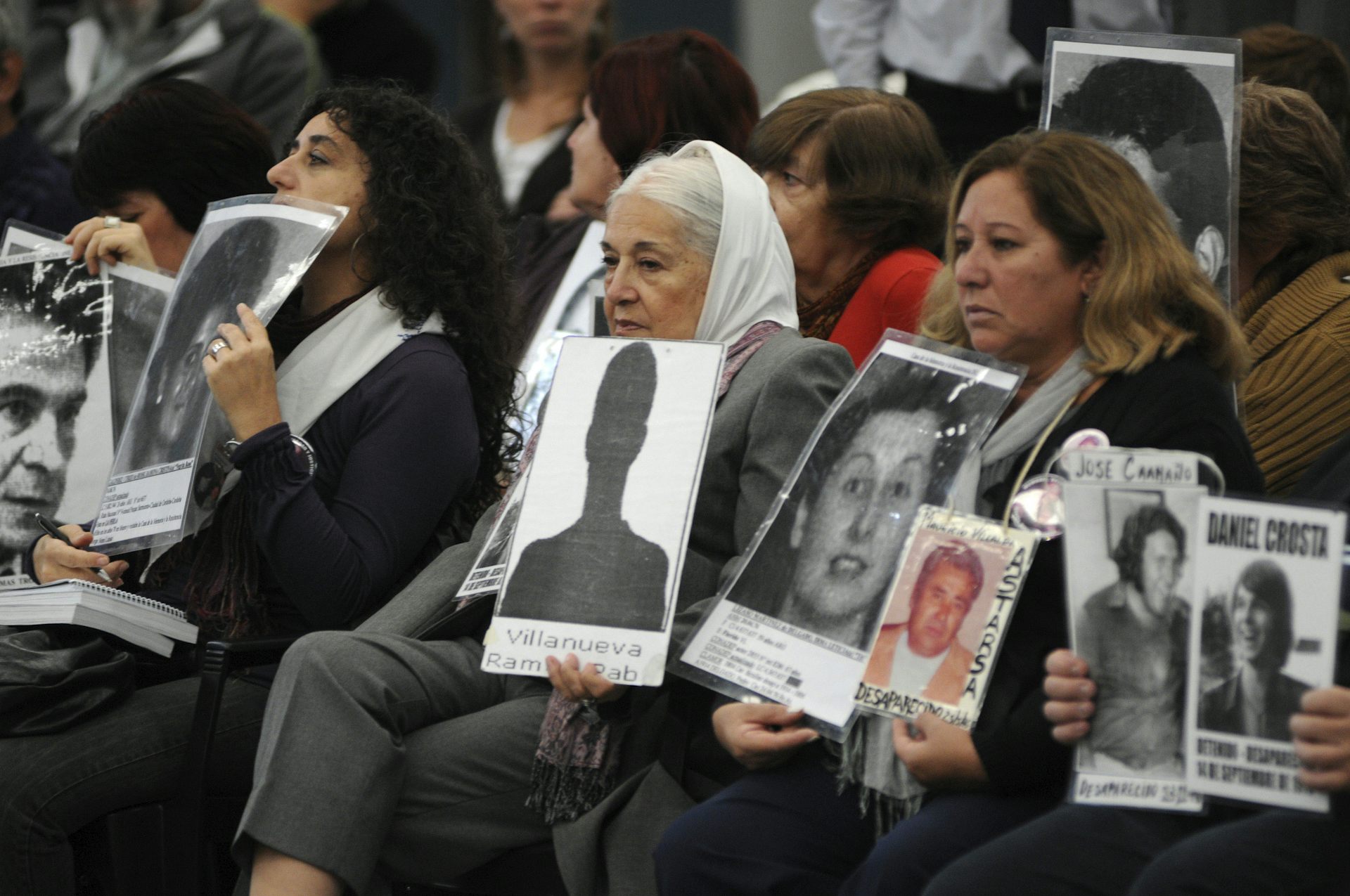
In April 1977, roughly a year after young Argentines first began vanishing, 14 women gathered in the Plaza de Mayo, a central square in Buenos Aires that faces the presidential palace. They were searching for their sons and daughters, who had been detained by the police or the military.
Some of these arrests had taken place at night, in the homes where these young victims lived with their families. In those cases, the women – who came to be known as the Madres de la Plaza de Mayo, or Mothers of the Plaza de Mayo – knew their children had been taken by security forces. In other cases, their children had simply failed to return home. Nothing was known of their whereabouts. They had disappeared.
Even those who had been detained at home had disappeared, too, as their location remained unknown.
Later, the nation would learn that many of the regime’s victims were tortured, then flown in airplanes over the nearby River Plate and dropped into the water on so-called “death flights.” All this information was compiled in a 1984 report written during the first democratic government after military rule and published under the name “Nunca Mas”: Never again.
The Mothers didn’t know that yet. They wanted their children back – alive.
The dictatorship had imposed a state of siege prohibiting all forms of assembly. To technically evade this restriction, the Mothers walked in circles around the plaza, avoiding the concentration of people in any single location, demanding truth and justice.
The regime reacted by systematically attempting to discredit the grieving women. To weaken their moral authority, state-controlled media labeled them as emotionally unstable “mad women.” The were called Las Locas de Plaza de Mayo instead of the Madres de Plaza de Mayo.
Regime media also suggested the Mothers were political subversives with links to guerrilla groups and members of foreign organizations out to damage Argentina’s international reputation.
Officials accused the women of exaggerating or inventing kidnappings and sometimes mocked their ever-growing weekly marches. By attacking their credibility and dignity, the dictatorship sought to undermine public sympathy and maintain a climate of fear.
At first, this narrative worked. Early in the dictatorship, many Argentines viewed the Mothers with ambivalence, skepticism or even fear. Others, while privately sympathetic, avoided expressing support due to fear of repression and social consequences.
The government’s attacks were not only rhetorical. In 1977, three of the founding Mothers – Esther de Balestrino, Azucena Villaflor and Mary Ponce de Bianco – disappeared when a group of military personnel stormed the Church of the Holy Cross in Buenos Aires. Twelve other people were abducted. None have ever been found.
The Mothers received substantial support from abroad. International human rights organizations, foreign journalists and religious institutions all played a crucial role in legitimizing their claims and broadcasting their struggle to the world.
France, in particular, helped publicize the Mothers’ cause in Europe, which put diplomatic pressure on the Argentine regime. This international solidarity contributed significantly to breaking the dictatorship’s silence and exposing its crimes.
Over time, as evidence of systematic forced disappearances became undeniable, public perception of the Mothers gradually shifted in Argentina, too. The Mothers came to be seen as a brave force for moral resistance.
In 1982, the military dictatorship invaded the South Atlantic islands known in Argentina as the Malvinas, or Falklands. The land has been British since 1833, but Argentina’s generals claimed sovereignty. Argentina was quickly defeated, and the military government fell.
After democratic elections were held in October 1983, the Mothers continued their efforts to uncover the histories of their children and to find and bury their remains. Many also started working to locate their grandchildren who had been born in captivity and illegally adopted after their parents were disappeared.
Their dedication to recovering their loved ones exposed the full extent of the regime’s atrocities.
In 1983, President Raúl Alfonsín, who reestablished Argentine democracy, established the National Genetic Data Bank to identify kinship between the parents and children of the disappeared. Thousands of analyses were conducted on children suspected of being born in captivity and illegally adopted by military families.
More than 120 grandchildren have since been identified.
The Mothers and children of the disappeared have also played a fundamental role in convicting dozens of military officials for crimes against humanity. As direct witnesses to the long-term consequences of forced disappearance, they have repeatedly testified against military officials.
The Mothers’ activism, which continues today, has helped sustain public pressure in Argentina for accountability and to transform private trauma into collective political action.
The killings in Minneapolis inspired me to recount this story for a simple reason: The government can protect, condemn or kill. Argentine history shows that it matters how society reacts to state terrorism.
This story was produced in collaboration with Rewire News Group, a nonprofit news organization that covers reproductive health.
This article is republished from The Conversation, a nonprofit, independent news organization bringing you facts and trustworthy analysis to help you make sense of our complex world. It was written by: Laura Tedesco, Saint Louis University – Madrid
Read more:
Shooting of Alex Pretti in Minneapolis has put America’s gun lobby at odds with the White House
Americans have fought back against authoritarianism at home before
Grandmother’s reunion highlights Argentina’s long road to recovery from its ‘Dirty War’
Laura Tedesco is an Amnesty International donor.

















































Comments