Missouri trial could affect abortion access across the Midwest and South
Published in Political News
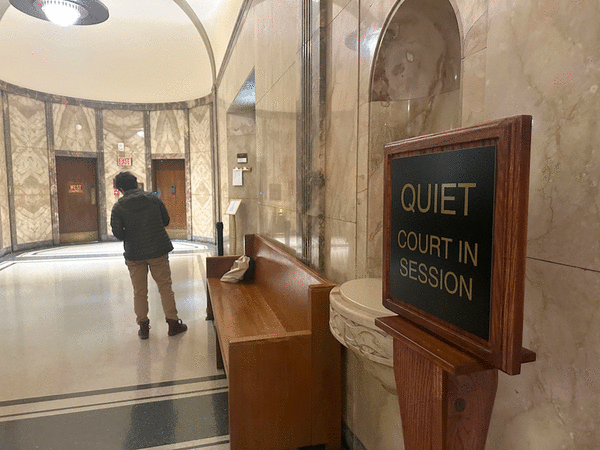
KANSAS CITY, Mo. — The outcome of a trial over Missouri’s abortion regulations could ripple far beyond the state, potentially creating new availability for women in the Midwest and South who can’t access abortion close to home.
As a judge weighs the constitutionality of a litany of state restrictions on abortion, the stakes are clear for Missouri women: The decision could hamper access for nearly everyone in the state — or greatly broaden it in ways not seen in decades. That would allow women in a dozen nearby states with abortion bans to travel a shorter distance to access the procedure.
“Opening and reestablishing rights in the state of Missouri would help to alleviate some of the pressure that other states have since so many Southern states have banned abortion,” said Julie Burkhart, the co-owner of Hope Clinic in Granite City, Illinois. “It just seems logical that we would see a shift in migration patterns of patients in the country.”
At her clinic, about a 15-minute drive from downtown St. Louis, Missourians account for about half of all patients, Burkhart said. Though Missouri voters in 2024 enshrined a right to abortion in the state constitution, access has remained highly limited because of restrictive state laws. Only procedural abortions are available on a limited basis across three Planned Parenthood clinics in the state.
Many of those state laws face legal scrutiny this week as a Missouri judge weighs the constitutionality of regulations targeting abortion providers. Those include a 72-hour waiting period between initial appointments and procedures, mandatory pelvic exams for medication abortions and a ban on telemedicine appointments for medication abortions.
Planned Parenthood affiliates in Missouri argue state restrictions are unconstitutional under 2024’s voter-approved constitutional amendment. Over decades, state restrictions have gutted Missouri’s provider networks, limited appointment availability and ultimately forced abortions to a halt in 2022, before a limited number resumed after the 2024 vote.
Experts and advocates are closely monitoring the Missouri case, which is expected to be appealed regardless of the outcome, because of its practical implications on access in the region. While many women now rely on abortion medication, procedural abortion is still crucial for those seeking later-term abortions or who prefer an in-clinic procedure.
But the two-week bench trial in downtown Kansas City also tests lawmakers’ ability to put in place rules so restrictive that they effectively ban abortion — a practice used by anti-abortion lawmakers in other states looking to limit access to the procedure.
“Judges do not operate in a vacuum,” Burkhart said, “ … and we know for a fact that judges look outside the borders of their state for information and for guidance. I do see this as having national importance.”
That’s especially true in other states also litigating abortion access, including Arizona, Michigan and Ohio, said Rebecca Reingold, an associate director at Georgetown University’s O’Neill Institute for National and Global Health Law.
While state judges are not bound by the decisions of judges in other states, their deliberations can be informed by court rulings, particularly involving novel legal questions or areas of the law that are evolving.
“There is little doubt that advocates and decision-makers in other states navigating similar legal challenges are closely monitoring the litigation over Missouri’s abortion regulations,” Reingold said.
Restrictions targeting abortion
In the first days of the trial, Planned Parenthood leaders argued that ever-changing state laws and agency regulations have drastically limited access, caused needless red tape and posed privacy risk for their patients.
Dr. Margaret Baum, chief medical officer with St. Louis-based Planned Parenthood Great Rivers, said the Missouri requirements specifically target abortion rather than all other kinds of medical care.
“I provide vasectomies routinely. … And I am not required to have a complication plan, contact a primary care physician, even ask the patient how many miles they live from the health center.”
Baum said state-mandated reporting rules unique to abortion require clinicians to ask the race, education level, marital status and specific location of each patient — none of which is relevant to their care.
Planned Parenthood Great Rivers would like to offer abortion services in Springfield, Baum testified. Access in that region would provide an option for rural Missourians, and also could help serve residents in nearby Arkansas, Oklahoma and Texas, where abortion is almost universally banned.
But the organization’s facilities there do not meet state abortion regulations for physical attributes, including hallway size, doorway size and the number of recliners in recovery rooms, Baum testified.
Lawyers for the state defended Missouri’s restrictions as commonsense safeguards aimed at protecting vulnerable women. The attorney general’s office argued that complication risks of abortion justify additional state regulation — despite professional medical associations saying it’s generally safe. The AG’s office also maintained that Planned Parenthood faced a conflict of interest because of its financial motivations.
“Abortion is a business,” Deputy Solicitor General Peter Donohue said during a procedural argument on Monday. “Your Honor, the plaintiffs are asking to deregulate their profession in order to make more money.”
The state was expected to call as witnesses anti-abortion doctors and activists later in the trial.
Patients traveling for care
Since the U.S. Supreme Court’s ruling that overturned federal constitutional protections for abortion in June 2022, the number of abortions has increased slightly across the country, according to the health research nonprofit KFF.
The group points to expanded telehealth, which can offer medication abortion more affordably through virtual appointments.
Since the 2022 ruling and subsequent state abortion bans, patients have experienced higher travel costs for abortions and delays in care, according to research published in the American Journal of Public Health in July.
Researchers from the University of California, San Francisco found that travel time to access abortion increased from 2.8 hours to 11.3 hours for residents in states with abortion bans. Travel costs increased from $179 to $372. And more than half of survey respondents said their abortion care required an overnight hotel stay, compared with 5% before an abortion ban.
In 2024, an estimated 7,880 Missourians traveled to Illinois and 3,960 traveled to Kansas to access abortion, according to the Guttmacher Institute, a research and policy organization focused on advancing reproductive rights.
Those Missourians were among the approximate 155,000 people who crossed state lines to access abortion care that year, representing 15% of all abortions provided in states without total bans.
Ongoing uncertainty
Regardless of its outcome, the Missouri case is expected to be appealed. Even if the plaintiffs are ultimately successful, it may take a long time to restore care networks across the state, said Isaac Maddow-Zimet, a data scientist at the Guttmacher Institute.
“And that’s particularly the case when there are states that have a lot of legal uncertainty or restrictions coming into effect and then coming out of effect,” he said. “It’s not quick to open up a clinic. It’s not quick to even necessarily expand the kinds of services, or the kinds of the number of people that a clinic can see.”
Kimya Forouzan, the organization’s principal state policy adviser, said Missouri’s landscape is evidence that lawmakers can drastically curb abortion access without total bans. And despite an overwhelming vote to amend the constitution, legal battles can follow.
Even if the state’s laws are found unconstitutional, Forouzan said, lawmakers will likely still push anti-abortion measures. She noted that several bills have already been introduced in this year’s just-convened legislative session, and that Republican lawmakers are pushing a ballot measure to repeal 2024’s reproductive rights amendment.
“There’s very much a push to pass as many restrictions as possible and kind of see what happens later and how things shape up later. … Time will tell, but we do know that they’re still pushing forth restrictions,” she said.
____
Stateline reporter Kevin Hardy can be reached at khardy@stateline.org. Missouri Independent reporter Anna Spoerre can be reached at aspoerre@missouriindependent.com.
____
©2026 States Newsroom. Visit at stateline.org. Distributed by Tribune Content Agency, LLC.




















































Comments