Trump's right on this one. Senators should back rescheduling cannabis
Published in Political News
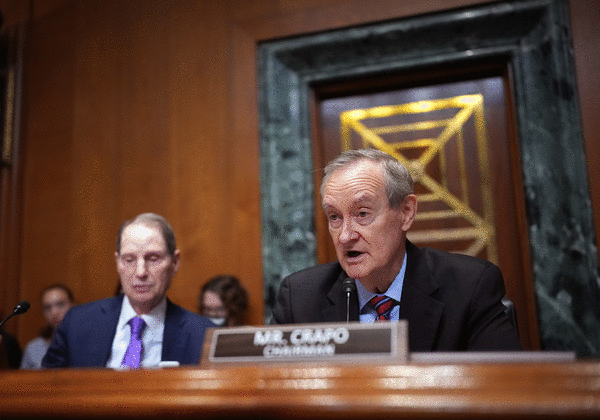
It seems Idaho U.S. Sens. Mike Crapo and Jim Risch have finally broken with President Donald Trump — on one issue, at least.
But they seem to have picked about the worst one they could have.
As the Statesman’s Kevin Fixler reported, the two signed onto a letter in mid-December objecting to the Trump administration’s plans to move cannabis from Schedule I to Schedule III of the Controlled Substances Act.
Schedule I, which includes drugs like heroin, MDMA (ecstasy) and LSD, is supposed to include substances with “no currently accepted medical use and a high potential for abuse,” according to the DEA. Schedule III, which currently includes drugs like codeine, ketamine and anabolic steroids, is supposed to include substances with some medical uses and with “a moderate to low potential for physical and psychological dependence.”
It is rather clear from these definitions that cannabis has no business being Schedule I, and Schedule III seems to be a reasonable classification. Some people who use cannabis do suffer addiction. In rare cases, generally with heavy use, they can develop very serious side effects, including cannabinoid hyperemesis syndrome. But on the whole, studies of the psychological, physical and societal impact of drug use consistently place cannabis use lower than most other drugs, and far lower than some unscheduled drugs like alcohol.
There has been no clear opposition to rescheduling from major medical organizations like the American Medical Association (though they have called for more research on the medical applications of cannabis, something that is greatly impaired while cannabis remains on Schedule I). The American Nurses Association and the American Association of Nurse Anesthesiology have explicitly endorsed it.
Of all the areas Idaho’s senators could break with the Trump administration, why this one?
What the Trump administration proposes here isn’t a step toward legalization or decriminalization. It isn’t to say that cannabis use poses no risk to health or poses no risk of addiction. It’s simply to classify cannabis as a drug that has potential medical uses along with relatively low risk of dependence — on par with some lower-level opioids.
The administration’s position here is, somewhat unusually, pretty darn reasonable.
As legal experts told Fixler, there are no real consequences resulting from rescheduling in terms of the criminal cases or penalties for cannabis, though it may send the general signal that prosecution for this drug is a lower priority than for other drugs.
That is, in fact, a good message to send. With the major influx of fentanyl, and remaining problems with much more serious drugs like methamphetamine, cocaine and heroin, it makes a lot of sense to prioritize prosecutions, and that prosecution of cannabis-related offenses would be relatively lower priority, all else being equal.
The one point verging on reasonability that Crapo and Risch raise is that rescheduling would allow cannabis businesses to deduct business expenses, which could mean more funds for recreational cannabis marketing. And just like there’s an argument that lots of tobacco and alcohol marketing isn’t a great thing for society, there’s an argument that lots of cannabis advertising isn’t great either.
This is an issue Crapo and Risch have the power to tackle directly.
Restrictions on advertising cannabis seem reasonable, and Congress can pursue them, as it did with tobacco advertising. (It should also pursue fixing the damaging policy of permitting the advertising of prescription pharmaceuticals, which generally results in patients being flooded with misleading claims that good doctors are constantly working to correct.) Writing laws is, after all, the job Crapo and Risch signed up for.
The main effect of keeping cannabis on Schedule I is to block research into its medical efficacy. Quite simply, there is no reasonable case for doing that.
Crapo and Risch should abandon this foolishness and do the job for which Idahoans sent them to Washington.
____
Julie Yamamoto does not join in this opinion.
Statesman editorials are the opinion of the Idaho Statesman’s editorial board. Board members are opinion editor Scott McIntosh, opinion writer Bryan Clark, editor Chadd Cripe, assistant editor Jim Keyser and community members John Hess, Debbie McCormick and Julie Yamamoto.
____
©2026 Idaho Statesman. Visit at idahostatesman.com. Distributed by Tribune Content Agency, LLC.


















Comments