Republican defense hawks broke with Trump repeatedly in 2025
Published in Political News
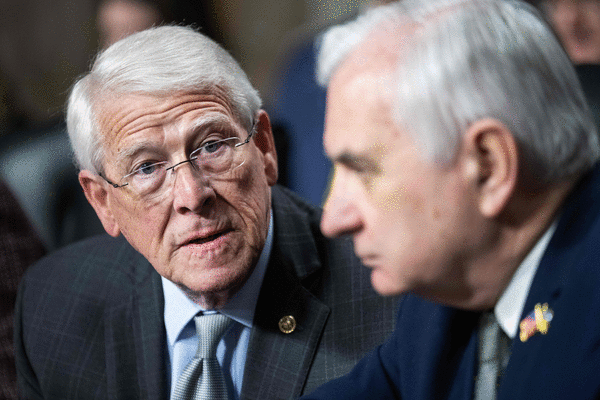
WASHINGTON — Republican lawmakers rarely publicly break with the Trump administration. But the GOP leaders of the House and Senate Armed Services committees have done so on a number of key occasions during the first year of President Donald Trump’s second term.
Sen. Roger Wicker, R-Miss., and Rep. Mike D. Rogers, R-Ala., both longtime lawmakers and outspoken defense hawks, have criticized the Trump administration’s efforts to scale back American presence on the global stage, particularly in Europe.
Although they back President Donald Trump in general and on many of his other military priorities — including controversial ones, such as deploying thousands of National Guard members to support police in American cities — their decision to speak out illustrates a lingering divide in the Republican Party. While Trump favors a more isolationist foreign policy that focuses on the Western Hemisphere, some other Republicans want the U.S. to remain engaged in Europe and around the world.
In many ways, Trump has shifted the Republican Party toward his “America First” vision. But defense stalwarts Rogers and Wicker repeatedly demonstrated over the course of the year that they will not quickly abandon long-held convictions when it comes to U.S. ability to project power globally.
Combatant command shift
In March, the two Republicans panned a potential Trump administration plan to consolidate U.S. European Command and U.S. Africa Command; combine U.S. Southern Command and U.S. Northern Command; and relinquish the U.S. post of NATO’s supreme allied commander in Europe, who also serves as the head of U.S. European Command.
“U.S. combatant commands are the tip of the American warfighting spear,” Rogers and Wicker said, adding that they were “very concerned about reports that claim DoD is considering unilateral changes on major strategic issues” without coordinating properly with Congress.
The plan never became a reality, and the fiscal 2026 defense authorization includes language that bars the Defense Department from modifying or combining the missions, responsibilities or force structure of a geographic combatant command without certifying to Congress that the action is needed for national security and analyzing the costs of such a move.
But the Armed Services committees may not be done with the issue of the command consolidation. In December, The Washington Post reported on a Defense Department plan to put U.S. Central Command, U.S. European Command and U.S. Africa Command under a single international command, thereby reducing their autonomy and influence.
Romania withdrawal
The two leaders were similarly outspoken in October about their opposition to a Trump administration decision to withdraw troops from Romania, part of a broader effort to become less involved in European security.
They praised Trump’s efforts to increase European countries’ defense spending — in July, NATO countries agreed to eventually spent 5 percent of their gross domestic product on defense — but condemned any effort to pull U.S. forces back from NATO’s eastern flank.
“European rearmament will take time,” they said in a joint statement. “Pulling back U.S. forces from NATO’s Eastern flank prematurely, and just weeks after Russian drones violated Romanian airspace, undermines deterrence and risks inviting further Russian aggression.”
They similarly sought to register their disapproval through the fiscal 2026 NDAA, which requires the Pentagon to assess the impact on U.S. security prior to undertaking certain actions that would diminish the U.S. military presence in Europe — including reducing troop levels below 76,000, giving up land or property or removing from the region equipment valued at $500,000 or more.
Ukraine peace deal
And Wickers and Roger were rankled by reports in November that a potential peace deal negotiated by the Trump administration between Ukraine and Russia included terms favorable to Moscow and would require Ukraine to cede some of its territory.
In a joint statement, they called for a peace plan with “reasonably balanced” terms, with Ukraine and NATO countries “full participants in its design and invested in its outcome.”
Wicker, in a statement of his own, was harsher.
“This so-called ‘peace plan’ has real problems, and I am highly skeptical it will achieve peace,” he said. “Ukraine should not be forced to give up its lands to one of the world’s most flagrant war criminals in Vladimir Putin.”
On-again, off-again peace talks to try to resolve the conflict between Ukraine and Russia have yet to bear fruit. Ukrainian President Volodymyr Zelenskyy said in an address in December that Russia is preparing a “year of war” next year despite the ongoing negotiations.
The fiscal 2026 NDAA is another reflection of Rogers’ and Wicker’s ongoing support for Ukraine. The legislation authorizes $400 million for the Ukraine Security Assistance Initiative, funding that was not requested by the Trump administration.
©2025 CQ-Roll Call, Inc., All Rights Reserved. Visit cqrollcall.com. Distributed by Tribune Content Agency, LLC.
















































Comments