Michael Hiltzik: Minnesota's Fortune 500 corporations finally speak out about ICE, but not loudly enough
Published in Op Eds
Here are a couple of points about the business community of Minnesota you may not have known.
First, it's home to a surprisingly large cadre of 17 major corporations, members of Fortune's roster of the 500 largest U.S. companies.
Some of America's best-known consumer companies, including UnitedHealth Group, Target, Best Buy, 3M and General Mills have chosen the windy, cold and snowy — but heretofore tranquil — state for their headquarters.
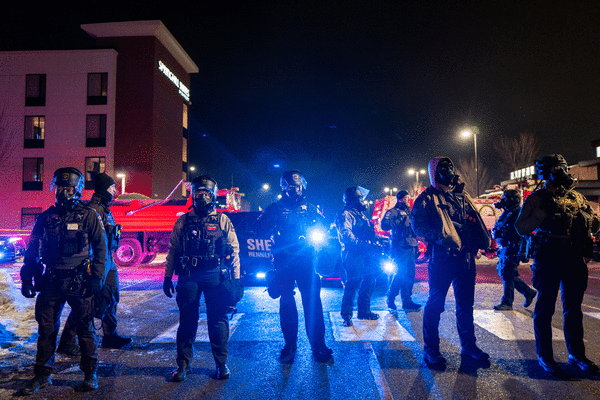
Second, this collection of elite businesses largely has been silent about the federal government's assault on the people of Minneapolis, which has been going on since the beginning of December. The silence ended Sunday, when 60 Minnesota businesses issued a joint statement through the state Chamber of Commerce calling for "an immediate deescalation of tensions."
That so many businesses came together for the statement was an achievement, given the customary reluctance of corporate leaders to address incendiary political issues. But in terms of its actual content, the statement was pretty thin gruel, bristling with public relations-style circumlocution and vagueness.
If anything, the Minnesota statement underscores the quandary facing American corporations in the Age of Trump, when the president viciously and publicly attacks anyone he deems to be a personal adversary. For a business, that can translate into a threat to the top and bottom lines.
Business leaders faced with a choice between going along with Trump, or poking him with a stick, almost invariably have chosen the first path.
That Minnesota's businesses even went as far as they did does suggests the tide may have turned on challenges to Trump's policies. Even so, we're still standing only on the edge of the water.
The refusal of the American business community to take a strong stand against Trump's policies has been a long-lasting scandal.
"This shows the greatest cowardice in the history of the Business Roundtable," says Jeffrey Sonnenfeld, the Yale School of Management's expert in corporate leadership, referring to the organization of corporate chief executives that should carry the flag of backlash against Trump's actions.
I asked the Roundtable to comment on the chaos in Minneapolis. It replied with a statement from CEO Joshua Bolten, a former White House aide to George W. Bush, endorsing the Minnesota Chamber's call for "cooperation between state, local, and federal authorities to immediately de-escalate the situation in Minneapolis."
Is that sufficient?
What's needed is for leaders to name names and demand concrete steps, at least as long as our political leaders remain missing in action. In Minnesota — indeed, wherever Trump policies trample norms and values — the situation has become a moral crisis for all American society, including the commercial.
That said, it isn't surprising that Minnesota's big corporations, like almost all American corporations, have been gun-shy about confronting a political issue like this head-on. They can properly feel that they've been burned before.
Target, the second-largest public corporation headquartered in the state (after UnitedHealth), experienced a front-page blowback from political controversies twice in recent years.
In 2023, as I reported then, the company capitulated when a braying mob of anti-LGBTQ+ reactionaries targeted it for displaying Pride-themed merchandise in its stores during June's Pride Month observances.
Target, which had proudly displayed such merchandise in previous years, told personnel in many stores to shrink or even eliminate their Pride-themed merchandise displays or move them to less conspicuous sections of the stores. Some LGBTQ+ designers discovered that their products had been taken off the shelves.
Last year, only days after Trump launched his second term with a flurry of antidiversity executive orders, Target announced it was "concluding our three-year diversity, equity and inclusion goals." The company also withdrew from "all external diversity-focused surveys," including a widely followed Corporate Equality index sponsored by the Human Rights Campaign, which tracks corporate policies on LGBTQ+ rights and inclusion.
The backtracking backfired. Target's sales cratered, in part because consumers were angry about its DEI reversals. During a conference call with Wall Street analysts following its first-quarter earnings report, CEO Brian Cornell attributed the company's ugly performance to factors including "the reaction to the updates we shared ... in January," an allusion to its ending of DEI initiatives.
The escalating crisis in Minneapolis seems to have been the trigger for the state's business leaders to issue their joint statement. "To get all 60 of the major CEOs to sign onto a statement was a remarkable feat," says Bill George, a former CEO of Minneapolis-based medical device maker Medtronic and a former Target board member.
"Maybe some people wanted it to be stronger," George told me, "but I believe a statement signed by every Minnesota CEO of size represents a turning point in the whole discussion between the federal government and the state government." He hoped that it would be enough to prompt Trump to simply "declare victory" in Minnesota and "move on to other challenges."
Still, the text of the Minnesota chamber's communique illustrates that corporate America still is reluctant to confront Trump directly.
The statement refers, vaguely, to "the recent challenges facing our state," which "created widespread disruption and tragic loss of life."
In other words, the statement alludes to something having happened, but doesn't identify who did it or even what it was. A "tragic loss of life," after all, can befall people slipping on the ice and cracking their head, as well as someone being shot 10 times in an unprovoked attack.
The statement asserts that "for the past several weeks, representatives of Minnesota's business community have been working every day behind the scenes with federal, state and local officials to advance real solutions. These efforts have included close communication with the Governor, the White House, the Vice President and local mayors. There are ways for us to come together to foster progress."
It calls for "an immediate deescalation [sic] of tensions and for state, local and federal officials to work together to find real solutions."
Lacking are specifics. What "real solutions" are on the table in these "close communications" with public officials? Who is in on these behind-the-scenes conversations? What actions would bring about "an immediate deescalation of tensions"?
I asked the Chamber of Commerce to answer those questions, but a spokesman told me the statement would have to stand by itself.
The statement doesn't even mention Renee Good and Alex Pretti, whose killing finally provoked the Chamber's members to speak out. Nor does it address the unmistakable discrepancies between how the Trump administration described the killings and their victims, and what millions of people can see in videos.
What's infuriating is that for many Americans — including, notably, Minnesota Gov. Tim Walz and Minneapolis Mayor Jacob Frey — the solution to this crisis is crystal clear:Get ICE and the Border Patrol out of Minneapolis neighborhoods. That even occurred to the editorial board of the Wall Street Journal, which on Sunday advised Trump to "pause ICE enforcement in the Twin Cities to ease tensions and consider a less provocative strategy."
One might have thought that Minnesota companies would be among the leaders pushing back against Trump policies, especially those unfolding in their front yards.
"Minnesota in general has been the hotbed of traditional progressive politics," Sonnenfeld says. "The Minnesota business community was always the paragon of social investment — very philanthropic and socially responsible — and had soaring performance to show for it. Minneapolis was always the model showing that doing good is not antithetical to doing well."
Minnesota business leaders clearly were becoming concerned that Trump's anti-immigrant surge threatened their ability to do well.
"This situation is very harmful to their businesses," George says. "It's extremely important that their employees feel that they are safe and secure in their place of work, and that their corporate leaders have their back."
Some Minnesota companies feared Trump's immigration crackdown could make it harder to recruit executives.
"If this drags on, it will have a devastating effect on Minnesota companies' ability to attract people from around the world," George told me. "They depend upon bringing executives in from New York and L.A., but also from China, Japan and Europe. This situation is really a deterrent to that."
Whether Minnesota's corporate pushback will move the needle on Trump's policy isn't clear, though there are faint signs that he recognizes he isn't winning fans on the issue.
On Monday he assigned his border czar, Tom Homan, to take charge of the Minnesota surge — not that Homan has the reputation of a peacemaker on immigration issues.
According to Border Patrol official Gregory Bovino, up to now the face of the surge, the agents involved in Saturday's killing, including the two known to have fired gunshots at Pretti, are still on the job, though he said they were transferred out of Minneapolis "for their safety." (There were reports Monday that Bovino is being sent out of Minnesota and back to his prior post in California.)
Nor are there signs that the surge is over. ICE and the Border Patrol are still on the streets of Minneapolis, so further mayhem is possible.
____
©2026 Los Angeles Times. Visit at latimes.com. Distributed by Tribune Content Agency, LLC.

































Comments