Clothes That Age With You
Published in Fashion Daily News
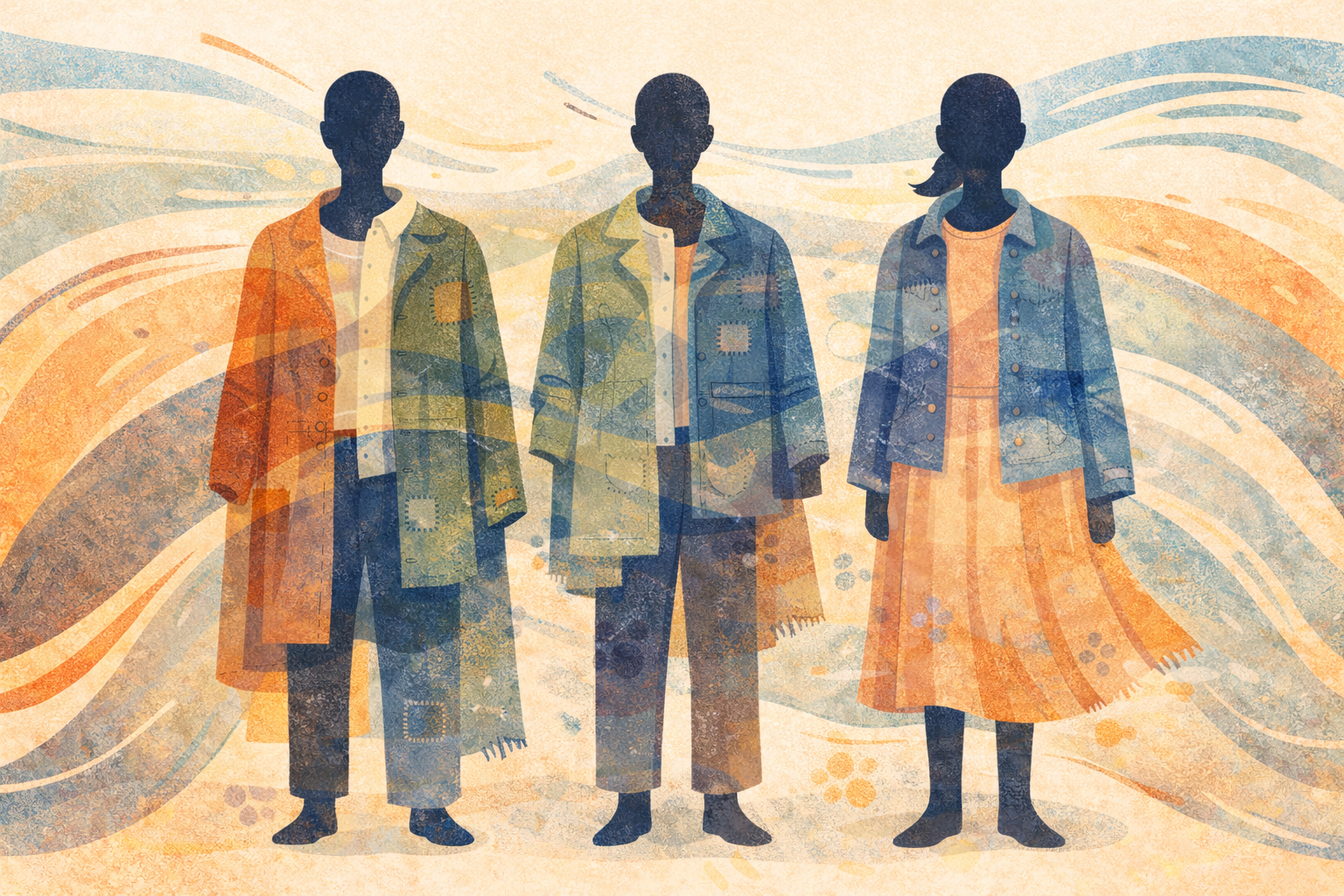
For decades, fashion has been built around an assumption rarely stated aloud: that the wearer will remain fundamentally the same. Sizes may fluctuate slightly, trends may rotate, but the ideal body—and the ideal life—are imagined as stable, youthful, and endlessly adaptable. When that assumption breaks down, the clothes are blamed. Or the body is.
A growing number of designers, wearers, and critics are questioning that premise. Instead of asking bodies to conform to garments, they are asking garments to accompany bodies over time. Clothes that age with you are not about concealment or compromise. They are about continuity—designing for change without panic.
What “Aging” Means in Clothing
Aging is often framed as decline, but in clothing it is more accurately described as variation. Bodies shift due to time, work, illness, caregiving, climate, and habit. Shoulders round. Waists expand or soften. Knees stiffen. Heat tolerance changes. So do preferences.
Clothes that age with the wearer account for these shifts without dramatizing them. They do not require constant replacement or rigid adherence to a single silhouette. Instead, they allow room—literally and metaphorically—for life to leave its marks.
This is not about elastic waistbands alone. It is about acknowledging time as a design parameter.
The Failure of Size as a Fixed Idea
Traditional sizing assumes a linear, predictable body. In reality, bodies move irregularly. Weight redistributes. Muscle changes. Proportions alter in ways that standard grading does not anticipate.
Garments that age well often sidestep rigid sizing altogether. Adjustable closures, wrap constructions, strategic pleating, and modular tailoring allow a single piece to accommodate multiple states of the same body.
This approach does not erase size. It contextualizes it.
Fabric as a Long-Term Partner
Fabric choice is central to how clothing ages. Materials that perform well when new often fail under long-term wear. Others improve.
Natural fibers—wool, linen, cotton, silk—respond differently to time than synthetics. Wool relaxes and molds. Linen softens and creases with familiarity. Cotton thins and breathes more easily. These changes are not defects; they are records of use.
Clothes designed to age gracefully anticipate these transformations. They choose fibers that tolerate repair, respond well to washing, and retain integrity after years, not months.
Designing for Movement, Not Display
Many garments are designed to look correct when standing still. Fewer are designed to live with a moving body over time.
Clothes that age with the wearer prioritize ease of motion. Gussets, generous armholes, articulated knees, and balanced weight distribution reduce strain on both fabric and body. This becomes increasingly important as flexibility changes with age.
A garment that allows comfortable movement at 30 is not guaranteed to do so at 60. Designing for movement is designing for longevity.
The Role of Repair
Repair is often treated as a concession. In reality, it is a design philosophy.
Clothes that age well are made to be mended. Seams are accessible. Fabrics accept stitching. Construction allows panels or components to be replaced without dismantling the whole garment.
Visible repair, once stigmatized, is increasingly embraced as evidence of care and continuity. A patched elbow or reinforced hem signals that the garment has earned its place.
Repair keeps clothing in relationship with its wearer. It resists disposability.
Why Trend Cycles Undermine Longevity
Trend-driven fashion discourages long-term relationships with clothing. Silhouettes are declared obsolete not because they fail functionally, but because novelty demands turnover.
Clothes that age with the wearer are often trend-resistant by necessity. They rely on proportion, material, and construction rather than seasonal cues. This does not make them dull. It makes them legible across time.
When a garment is designed to remain relevant for years, it must be rooted in use rather than spectacle.
Clothes as Companions, Not Costumes
There is a psychological dimension to aging clothes that is rarely discussed. Garments worn through significant periods of life accrue meaning. They become associated with places, routines, and identities that cannot be replicated by new purchases.
When clothes are designed to accommodate change, wearers are less pressured to abandon them at moments of transition. A jacket that still fits after illness. A dress that adapts post-pregnancy. A pair of trousers that survives retirement.
These clothes do not mark phases. They accompany them.
Gender, Aging, and Design Assumptions
Much of the fashion industry’s resistance to aging bodies is gendered. Women’s clothing in particular is designed with narrow windows of acceptability. Men’s clothing, while also constrained, has historically allowed greater continuity across age.
Designing clothes that age with the wearer challenges these assumptions. It rejects the idea that maturity requires camouflage or that youthfulness is the primary aesthetic goal.
Clothes that age well do not pretend time is not passing. They accept it without apology.
What Consumers Are Asking For Now
Demand for longevity is no longer niche. Consumers increasingly ask where garments are made, how they are constructed, and whether they can be repaired. They want clothes that justify their presence over time.
This shift is not purely ethical. It is practical. Replacing entire wardrobes every few years is expensive, exhausting, and unsatisfying.
Clothes that age with the wearer offer an alternative: fewer pieces, chosen with intention, allowed to evolve.
The Economics of Aging Gracefully
From an industry perspective, designing for longevity disrupts traditional profit models. Clothes that last are bought less frequently. But they may be bought more thoughtfully—and at higher quality.
Some brands are experimenting with repair services, resale programs, and lifetime guarantees. These approaches treat garments as assets rather than consumables.
Whether the industry can scale this model remains uncertain. But the desire for clothes that age well is not fading.
Redefining Fit Over Time
Fit is often discussed as a snapshot: does this garment fit right now? A more useful question is whether it will continue to fit meaningfully as the body changes.
Clothes that age with the wearer allow for recalibration. They do not demand perfection at every moment. They allow looseness, adjustment, and reinterpretation.
Fit becomes a conversation, not a verdict.
The Quiet Radicalism of Staying Put
In a culture that equates change with replacement, staying with the same garment through change is quietly radical. It resists the narrative that progress requires constant renewal.
Clothes that age with you do not promise to make you look younger. They promise to remain useful, dignified, and responsive as you become older.
That promise is modest. It is also rare.
========
Eleanor Marsh is a fashion and culture writer focused on longevity, material intelligence, and the relationship between clothing and time. She has worn the same wool coat through three careers and refuses to apologize for it. This article was written, in part, utilizing AI tools.




Comments