'Carrie' review: Prime adaptation of Stephen King's first novel is superb
Published in Entertainment News
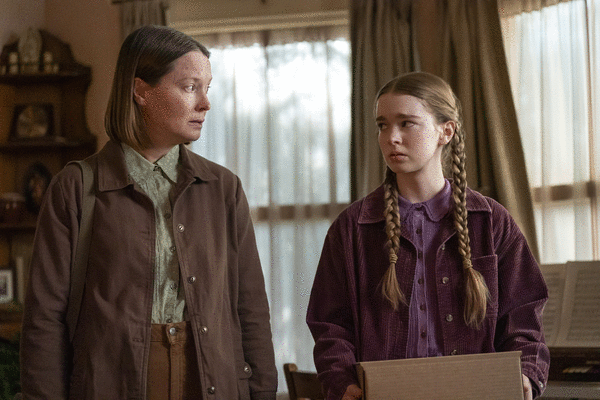
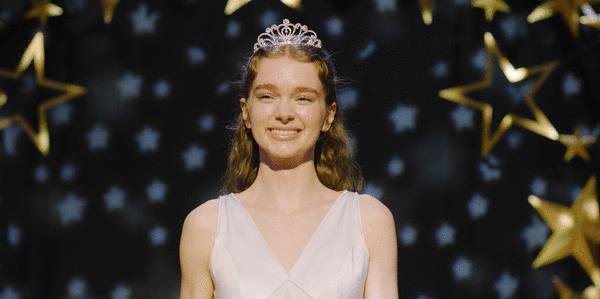

“Carrie,” Stephen King’s debut novel, is seminal horror reading. Its tale of a relentlessly bullied high school girl who in turn inflicts massive devastation upon her tormentors with her telekinetic abilities was an instant classic when it was published in 1974 — and for good reason. It’s utterly compelling, engrossing in the way it unspools a story of neglect, abuse, cruelty, revenge and the supernatural. Since then, it’s been adapted multiple times (including, for some reason, into a Broadway musical), but the only one worth watching has been Brian De Palma’s fantastic 1976 film starring a captivating Sissy Spacek — until now.
Prime Video’s “Carrie,” an eight-episode miniseries which premiered Wednesday, is a stellar reimagining of the 52-year-old source material. It’s set in modern day, with all of its trappings — cellphones, social media, school shootings, the internet — but its tale of a shy, sheltered girl, the inhumanity she suffers and the soul-searing violence that erupts hits just as hard and is just as damning.
Developed by horror aficionado Mike Flanagan (his “The Haunting of Hill House” is a must-watch), “Carrie” maintains the novel’s basic plot: Carrie White (Summer H. Howell, perfectly cast) is still raised in an abusive religious household; she still finds no relief at her high school, where she’s ridiculed for her social ineptitude; and she still brings the small town of Chamberlain, Maine, to its knees during the horrific “Black Prom” event. But because of its nature as a series rather than a feature film, there’s greater depth of character and deeper exploration of motive, which elevate it above more recent adaptations, including the lackluster 2013 film “Carrie.”
Flanagan’s “Carrie” opens at the finale of King’s story: with a high school on fire and a town in ruins, as desperate students and residents flood 911 with calls for help. The eight episodes then proceed to introduce us to Carrie and explain why that fire started. In this version, Carrie is home-schooled by her parents, father Ralph (Tahmoh Penikett) and mother Margaret (Samantha Sloyan, a frequent Flanagan collaborator and a winning choice here). Daddy is a conspiracy theorist: chem trails, the deep state, red dye 40 — his distrust of the outside world is absolute. Mama, like in previous iterations, is a religious fanatic, afraid that everything beyond the walls of her home will corrupt her daughter. And until the start of the series, that’s all Carrie has ever known, this little “cult of three.”
But then dad dies, and mom has to get a job and Carrie has to go to public school. It’s not an easy transition for her. She’s so very different — a brilliant student eager to learn, but so naive when it comes to the unspoken rules of high school and the outside world. Case in point: She doesn’t know what a school shooting drill is. That’s where the cruelty starts, in ways big and small, and so does the manifestation of her telekinetic abilities, with light bulbs shattering and desks moving. And yes, we get the scene in which Carrie has her first period, and the subsequent sequence — Carrie thinking she’s dying because she has no idea what’s happening; the other girls throwing tampons and pads at her, yelling to “plug it up”; the cellphones recording everything (something that happens so very often in this series) — is just as traumatic as it was in the novel and De Palma’s film.
It gets worse from there, and we all know how this ends — in blood and tragedy and regret — but “Carrie’s” greatest strength is highlighting the why of it all. Across this series, we’re given a front-row seat to those motives, and all of them are all so realistically petty and small-minded. We better understand why the ringleader of Carrie’s torment at school, Chris Hargensen (Alison Thornton), is so eager to focus on the weird new kid. We see, through fellow student Sue Snell (Siena Agudong), how kindness can be performative, even if that wasn’t the intention. We experience how relationships — Sue’s with her genuinely good boyfriend Tommy Ross (Joel Oulette), Chris’ with her stunningly psychotic boyfriend Billy Nolan (Arthur Conti), Carrie’s with her authoritarian mother — can warp someone into something unrecognizable.
What is recognizable, though, is how the scourge that is social media plays such a pivotal role in all the bullying and meanness and dehumanization. A cruel Instagram meme account starts with a video of Carrie’s locker-room freakout, and it spirals from there, because it’s the internet and of course it does. The situation isn’t helped when Margaret uses her own IG account to inflame the public under the guise of “parents rights” though really just wanting full control of her teenager again — she at one point calls herself a prisoner after Carrie starts openly using her powers at home, and the hypocrisy is breathtaking. And it’s all happening under the light of a thousand smartphones. It’s a vicious cycle, one that breeds discourse but not solutions. Sound familiar?
Like he did with “Hill House,” Flanagan has created an excellent adaptation, one that’s hard to look away from, even with all of its horrors. And as the tension builds episode by episode — the title card cleverly turning redder and redder in a nod to what we know comes next — the latest iteration of the novel that launched King’s career never forgets that while the world may be full of monsters, Carrie was never one of them.
———
'CARRIE'
Rating: TV-MA
How to watch: Prime Video
———
© 2026 The Seattle Times. Visit www.seattletimes.com. Distributed by Tribune Content Agency, LLC.









Comments