Movie review: 'The Social Reckoning' lacks nuance but delivers a meaningful message
Published in Entertainment News
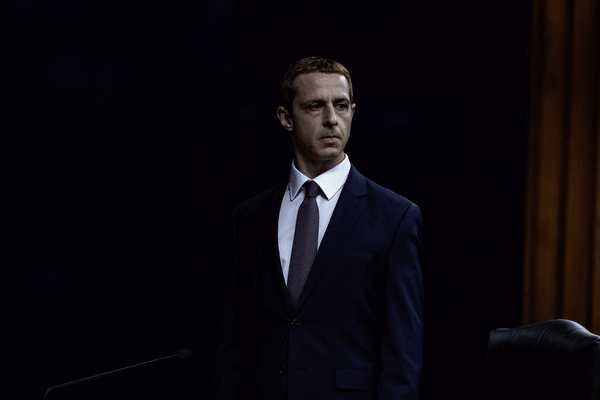
If David Fincher’s 2010 tech drama “The Social Network” was about Mark Zuckerberg’s legal battle to secure the Facebook bag, Aaron Sorkin’s “The Social Reckoning,” arriving 15 years later, is about the burden of what it means to carry that bag. Zuckerberg himself couldn’t have predicted what he would unknowingly unleash on the world when he created Facebook under the guise of “connection,” but in the harsh light of the 2020s, was wresting it away from his early collaborators all worth it? Perhaps not, argues Sorkin, and perhaps Zuckerberg is the worst person to end up steering the Facebook ship.
Sorkin, who won an Oscar for his “The Social Network” screenplay, takes on both writing and directing duties in the sequel. This is his fourth feature film as a director, and his talents do not lie behind the camera, but on the page. He’s a televisual artist, not a cinematic one, and his film directing work is blunt, even ham-fisted at times, bearing none of the sleekness or nuance of “The Social Network.”
However, Sorkin is a deadly effective communicator with dialogue; even if none of the characters in his scripts speak like real people, they get his point across with plenty of style and panache. There’s no mistaking what Sorkin is trying to say about any of his subjects at hand, even if one might crave a bit of subtlety in the mix.
But subtlety is not the goal of “The Social Reckoning,” which dramatizes the 2021 Facebook Files leak published in the Wall Street Journal. Instead, Sorkin utilizes the medium of mainstream popular film to drive home the major revelations from the Facebook Files for audiences who may not have read the articles or paid attention to the testimony of whistleblower Frances Haugen, played here by Oscar winner Mikey Madison.
He also points out how Zuckerberg (Jeremy Strong) repeatedly placed his thumb on Facebook’s algorithmic scale in order to maximize company profits over the safety of people and indeed, democracy itself. In order to keep users scrolling and engagement up, Zuck makes the call to emphasize a metric called “Meaningful Social Interaction,” which rewards outrage bait, leading to online extremism. Sorkin directly links this to the Jan. 6 insurrection, and while Haugen did testify about Facebook’s role in those events, Sorkin fudges the dates and condenses the timeline for dramatic effect.
Jeremy Allen White plays Jeff Horwitz, an investigative reporter on the Facebook beat for the Wall Street Journal, despite his lack of tech-savvy. White is in a version of “All the President’s Men,” but instead of Nixon goons, he’s chasing down socially awkward computer engineers, the mysterious White House now Facebook HQ. His “Deep Throat” becomes Frances, suspicious and skittish, but her moral compass overrides her company loyalty and belief in its mission.
Sorkin makes some filmmaking choices that are absolutely maddening, like his insistence on intercutting a re-creation of the Jan. 6 insurrection into the reporting or testimony scenes, draining them of their power. He relies on ominous black and white for flashbacks, and his camera has an obsession with Frances’ leg warmers.
Madison is unfortunately stiff, but White delivers a performance that’s warm and convincing.
Watching Strong is like peering at an AI-generated Zuckerberg: uncannily accurate mimicry, but something’s off, because it’s a completely different person. His posture is erect, his mouth stiff, and by the end of the film, Sorkin and Strong have depicted Zuckerberg as a completely antisocial and incompetent leader of a company that’s twice the size of the largest country in the world.
Surrounded by yes people and henchmen like comms expert Teddy (Billy Magnussen), Zuckerberg is so insulated from the outside world that when a former adviser and vocal critic (Bill Burr) shows up at his congressional testimony prep, Zuckerberg’s utterly baffled to be challenged. Their arguments reveal that he can’t comprehend any value other than monetary.
As a movie, “The Social Reckoning” is big, broad and bears a certain amount of cringe-worthy creative choices that are earnest Sorkin hallmarks. It feels less like a thorny, complex film about one of our most challenging structural societal ills, and more like a very special episode of “The West Wing” or “The Newsroom,” where one person learns they can make a change, and what it means to actually pump your fist in victory.
Frances spends much of the film explaining to Jeff what exactly Facebook is doing, in plain language, and that seems to be Sorkin’s mission here too: communicating that to the general public, one sledgehammered point at a time. It might not be artfully executed, but his argument about the dangers of algorithms and the men who make them is loud and clear, and there is value — and valor — in wrapping a message that important in easily digestible mainstream entertainment, too.
———
‘THE SOCIAL RECKONING’
2.5 stars (out of 4)
MPA rating: R (for language)
Running time: 1:52
How to watch: In theaters Oct. 9
———
©2026 Tribune Content Agency, LLC









Comments