Q&A: Joe Satriani has a mantra for the guitar and music: 'Learn the rules and then break them'
Published in Entertainment News
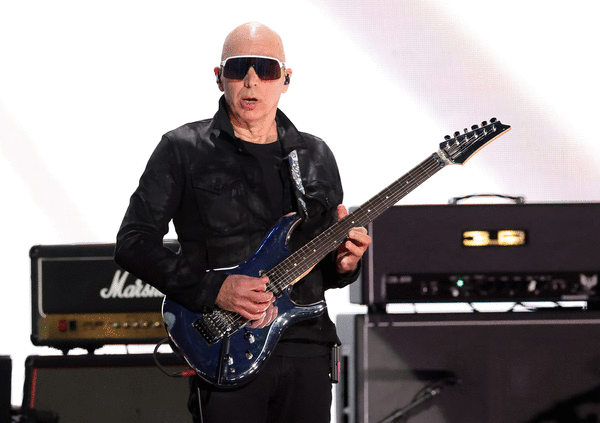
SAN DIEGO — Other guitar virtuosos might crave at least a little downtime between concluding a Las Vegas concert residency with one band and launching a national tour with another band, not but Joe Satriani.
Last month, he wrapped up a six-show stint in Sin City playing with veteran solo star and former Van Halen singer Sammy Hagar at Dolby Live at Park MGM. The next day, Satriani was in Los Angeles to start rehearsals with the SATCHVAI Band — the five-man group he co-leads with fellow guitar ace Steve Vai — before they kicked off their 40-city U.S. tour in Seattle on April 1.
“Musicians have to prepare,” Satriani said.
“They have to practice the music. They have to make sure their gear is working properly, that things are in tune, that they can hear everybody. When that level of preparation has been met, you can sort of forget about everything. You know: ‘Learn the rules and then break them.’ And it’s true. But the preparation is, I think, very important, and that’s different for everybody.”
Preparing for this tour is made easier for Satriani in at least two key ways.
Kenny Aronoff, the acclaimed drummer in Hagar’s band, is also the drummer in SATCHVAI. Aronoff’s myriad other credits range from John Mellencamp, Bruce Springsteen and John Fogerty to Melissa Etheridge, Bruno Mars, San Diego troubadour Sara Petite and dozens more.
Satriani befriended Vai 53 years ago when he became the then-12-year-old Vai’s guitar teacher, Satriani was all of 15 at the time. In 1996, they re-teamed up for their first G3 tour — short for Guitar 3 — with Eric Johnson. A dozen more G3 tours have followed, most recently in 2024, with different guest guitarists joining in. Satriani and Vai launched the SATCHVAI Band in 2024 when Johnson was not available for a G3 tour. The new band’s first album is now underway; three songs from it have been released so far.
Satriani spoke to the Union-Tribune by phone recently from a Los Angeles area hotel. The interview has been edited for length and clarity.
Q: Given how much better you and Joe know each other and know each other’s playing now, and with all your years of working together, is it easier or more difficult for the two of you to surprise each other with your playing? And how important is it to have that element of surprise?
A: I think it’s easier, way easier, now. The normal process of growing up as a musician is always an exciting but interesting obstacle that you have to get over. You know, not being sure of yourself, not knowing who you are, peer pressure, trying to find your way through — let’s say — the music business, trying to find your style, and figuring out how to bring all the talent you have to fruition and to the stage. I think all those things get in the way when you’re younger.
Q: What is the format for SATCHVAI Band concerts? Do you play together and then alternate solo sets doing your own material?
A: We came up with a format when we toured Europe last year. We hit the stage together, and it’s a full band with us, playing a number of songs to start off. Then, alternately, one of us will leave the stage for a song or two, and then come back on and join in on one of our songs that people are familiar with but have never seen us play live together. We do that through the first maybe two-thirds of the set, and then for the last third of the set, we’re on stage together right to the end.
Q: What did you learn from the tour of Europe about what worked really well and what maybe needed to be tweaked that you can now apply to this tour?
A: I think the only difficult part about the tour was that we actually didn’t get to play enough! You know, usually people complain about playing too much, but I think we could have done a three-hour show, easily, and still feet like we had more that we wanted to give the fans every night. But but that’s always the case.. Sometimes, you leave the stage thinking: “I wish I could have stayed and played another 45 minutes or an hour.” But you do have to get off the stage at some point or the venue starts to charge you (for going overtime). So, what I learned from our European tour was that it’s too bad we can’t do it a three-hour show.
Q: You just finished your latest Vegas residency with Sammy Hagar and his band, which also features former Van Halen bassist Michael Anthony and plays a fair number of Van Halen songs. Directly or indirectly, does anything from playing that music seep into what you do on tour with SATCHVAI?
A: It’s actually a relief, because having to concentrate on someone else’s guitar style — in this case, Eddie Van Halen’s — is something I’ve never seen as my forte. I’ve spent decades trying not to sound like other people. So, it’s kind of ironic that I wound up playing with Sammy and Mike, and having to emulate a lot of Ed’s amazing guitar playing. When you get a gig like that, you want to approach it with respect and give the audience the best performance, and the best version of someone else’s playing, as you can.
But I made it pretty clear, right from the beginning, that I’m not an imitator. I don’t do impressions of other guitar players. So, when that gig with Sammy is over and I get to go back to being myself, it’s a big relief. I can just forget about all that stuff and the anxiety of knowing that people in the audience want me to play in the style of Ed, instead of in my style. So, I just leave it all behind.
Q: So, what do you get from performing with Sammy and playing these songs that you were not originally a part of?
A: I think the biggest part is the fun of playing songs by Montrose, Sammy’s solo stuff, all the great Van Halen songs, plus songs by Chickenfoot — the band Sammy and I formed in 2008 — and one of my solo numbers. Playing these great songs, hit songs, that have instant recognition in the audience is a lot of fun and are really a joy to play and to celebrate with the audience. When that happens, I feel it deep in my core.
Q: Your 1987 solo album, “Surfing with the Alien,” sold more than a million copies, which — then and now — is very unusual for an all-instrumental rock guitar album. Apart from Jeff Beck’s “Blow By Blow” and “Wired” albums in the 1970s, there wasn’t really any precedent for a vocal-free rock guitar album to do that well. Did making “Surfing” feel like both a mission and a risk to you?
A: I think it was such a big stretch. It was my third instrumental solo record, and I think we all thought that if we could somehow convince the record company to let us do another album, that that would be the greatest thing ever. We had no idea that there would be commercial success of any kind. When we turned in that album, I just assumed that the label would drop me and I’d have to come up with some other idea to figure out what to do with myself. So it was a complete surprise.
Q: Were there any guitar albums you had heard that made you think there was a path for you?
A: I suppose, because I started listening to music intensely when I was extremely young, my reference points were the jazz and classical that my parents played all the time. Plus, songs I heard on the radio from when I was, you know, almost an infant, like “Sleepwalk” by Santo & Johnny, and The Ventures; you know, any of that instrumental guitar stuff that somehow would pop up now and then through the ’60s.
By the time I became a (Jimi) Hendrix fan, his instrumentals — like “Third Stone From the Sun” and any of Jimi’s instrumentals hit me more than anything else as just the way that my brain heard music. So, in that early ’70s period, Jeff Beck was a giant in my eyes and and Hendrix was my number one influence. But I was also heavily influenced by Allan Holdsworth and John McLaughlin. although the fusion thing really wasn’t my thing, I was just a straight ahead rock and roll kid. So, when I heard Black Sabbath, my favorite songs were the instrumentals on their albums.
Those were my reference points. I didn’t really think of it in terms of, you know: “You’re this kind of an artist and you put out this kind of an album.” I just noticed that I related more to the music than to the lyrics. Let’s put it that way. So, by the time we got around to doing these instrumental records of mine, it really was for fun and we really didn’t think they were going to be commercially successful. I think that added to the charm, because people would listen to it and say: “Why would somebody do this?”
Q: Does that seem a million miles away now? That is, there are obviously some really good young guitarists out there — Matteo Mancuso comes to mind. But I just don’t see a radio environment or even an online environment where there could be that kind of national impact with an all-instrumental guitar album.
A: It’s a different world now and and it’s it’s impossible to figure that out. If musicians or record executives could figure out how to get a sure-fire hit, they would. But they can’t. And I think that’s really a good thing that, you know, artists should just be artists and then be happy when they get lucky — and don’t take it personally when things don’t connect.
I mean, that’s to me the healthiest way to look at it. Otherwise, you get calculations instead of inspirations. But, yeah, Mateo is absolutely amazing. It’s a very exciting time for guitar players, not in the marketplace, but in all the basements and bedrooms and rehearsal rooms. Guitar players are playing better than they’ve ever played before. Younger generations are pushing the instrument into areas that have never, ever been attempted.
The technical ability is really amazing, and their scope, their musical scope, is so broad because the Internet brings music from around the world to their ears in a split second, every single day. So, their musicianship is deeper and more cultured, and the techniques are shared. Whereas, when I was growing up, you had to drive places to find out how somebody played, and most of the time they turned their back to you on stage. So, it was really difficult to to share, unless you were old enough to go to concerts and watch people and had the money to do it. The internet has had a big impact on the guitar community. But unfortunately, society is not that interested in this amazing leap forward that guitar players are taking.
Q: There’s more immediacy but less anticipation, since everything is a click away.
A: I mean, the good news is also the bad news. The good news is that being connected so much through the internet has allowed people, including the strangest artists, to find their fans and to have a great relationship going. And the bad news is it’s very difficult to make a living off of it. Because the old model of success would would allow someone to finally quit their day job and and live off their artistic earnings. This doesn’t necessarily mean that it increases the quality of the art. But in this particular case, the quality of the art is really fantastic all over the world. But how is a phenomenal heavy metal kid in Calcutta who plays amazing guitar gonna get to the front of the line, ahead of Taylor Swift or someone like that. It’s just not going to happen, But exposure works both ways. It can be the thing that gives you financial success, but it can also be the thing that influences you and stops you from being original.
©2026 The San Diego Union-Tribune. Visit sandiegouniontribune.com. Distributed by Tribune Content Agency, LLC.







Comments