The Oscars are leaving Hollywood in 2029, ending long run at Dolby Theatre
Published in Entertainment News
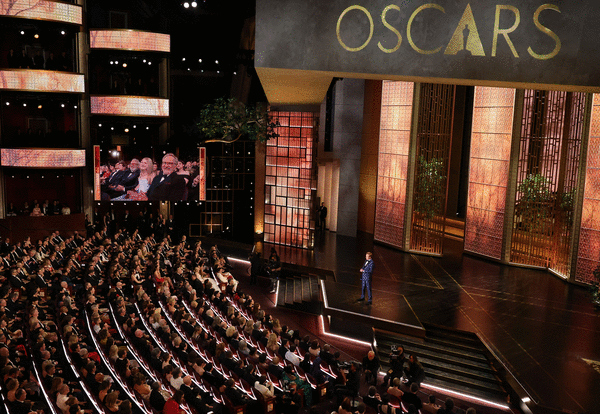
LOS ANGELES — The Oscars are leaving Hollywood — or at least Hollywood Boulevard.
Beginning in 2029, the Academy Awards will move from the Dolby Theatre, their home for nearly a quarter century, to L.A. Live in downtown Los Angeles, the Academy of Motion Picture Arts and Sciences and AEG announced on Thursday. The ceremony will be held in the theater currently known as the Peacock Theater, which is expected to be renamed before the Oscars arrive.
The new agreement runs through 2039. Discussions about the move have been underway for the last couple of years, according to people familiar with the planning who were not authorized to speak publicly.
The change in venue comes as the Oscars are also moving away from their traditional home on broadcast television. Late last year, the Academy announced that the ceremony will begin streaming live worldwide on YouTube in 2029, ending a five-decade run on ABC.
Since 2002, the show has been closely associated with Hollywood Boulevard, where the red carpet runs alongside the Walk of Fame and, for one night a year, the area becomes the symbolic center of the film industry. The Dolby Theatre sits at the corner of Hollywood and Highland, inside a retail and entertainment center near the TCL Chinese Theatre and the El Capitan. Originally opened as the Kodak Theatre, the venue had designed with the Oscars in mind as a possible long-term home.
L.A. Live offers a more centralized, campus-style setting, with venues and event spaces clustered together. The complex is adjacent to Crypto.com Arena and the Los Angeles Convention Center and is part of a larger sports and entertainment district developed and operated by AEG that regularly hosts concerts, sporting events and awards shows, including the Emmys and the Grammys. AEG has recently proposed adding a new hotel, residences and additional entertainment space to the complex, part of a longer-term expansion of the site.
In some ways, the move out of the Dolby is less a break than a return: The ceremony was staged for years in downtown L.A. at the Dorothy Chandler Pavilion and at the Shrine Auditorium before settling at the Dolby.
At the Oscars' new home, the red carpet, ceremony, press operations and post-show events can all be staged within a compact footprint that includes the adjacent JW Marriott hotel and its ballroom. The theater itself is expected to undergo upgrades to its stage, sound and lighting systems, allowing it to be configured more specifically around the show. The move is also expected to increase capacity, a growing consideration as the academy's ranks have expanded significantly in recent years, now numbering more than 11,000 members.
At the Dolby, space has long been tight. Each year, multiple blocks of Hollywood Boulevard are shut down for days at a time, rerouting traffic and turning the area into a heavily secured zone — conditions that were even more restrictive this year with security tightened further amid the war in Iran, including a 1-mile police buffer around the theater. Originally opened as the Kodak Theatre in 2001, the venue had been designed as a long-term home for the Oscars.
The academy had been looking for a venue that offered greater control over how the show is staged, including how the audience is arranged and how the room is used for both the broadcast and the live event. The new venue is expected to provide more room for press areas, green rooms and backstage operations, along with upgraded technical infrastructure for staging the ceremony.
Early design renderings released by the academy suggest that, for viewers at home, the Oscars may not look all that different. The stage retains the sweeping, curved proscenium that has defined the Dolby Theatre era, suggesting a similar visual approach at a larger scale, with expanded screen space and a more immersive ceiling design.
For both the academy and AEG, which owns and operates the complex, the appeal is in keeping everything in one place — arrivals, ceremony, the Governors Ball and afterparties — rather than spreading events across multiple locations. The setup also creates new opportunities for hospitality and sponsorship tied to the broader campus.
"L.A. Live was built to host the moments that define culture and there is no greater global stage than the Oscars," said Todd Goldstein, AEG's chief revenue officer. "Together, we will create an environment that celebrates creativity, honors excellence and delivers an unforgettable experience for movie fans everywhere."
Taken together, the changes amount to a significant reset for the Oscars, which have seen their audience decline from more than 40 million viewers in the late 1990s to 17.9 million this year, down 9% from the previous year. Moving to YouTube offers a way to reach a broader, more global audience at a time when traditional television viewership has declined.
The Oscars will remain at the Dolby through the 100th ceremony in 2028 before making the transition the following year.
"For the 101st Oscars and beyond, the Academy looks forward to closely collaborating with AEG to make L.A. Live the perfect backdrop for our global celebration of cinema," Academy Chief Executive Bill Kramer and President Lynette Howell Taylor said in a statement.
©2026 Los Angeles Times. Visit latimes.com. Distributed by Tribune Content Agency, LLC.











Comments