Q&A: In new movie 'Clika,' corrido singer Jay Dee takes his true story to Hollywood
Published in Entertainment News

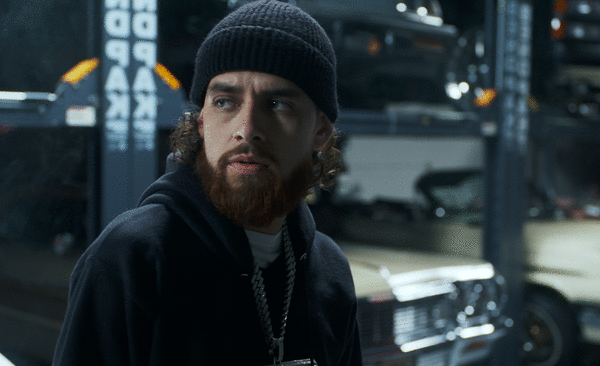


LOS ANGELES — For the trap corrido singer Jay Dee, there were never any shortcuts in life.
Growing up in Yuba City, he would spend hours harvesting peaches in the Northern California orchards, stacking heavy buckets of the stone fruits while enduring high temperatures and pollen-induced allergies.
But this arduous, back-breaking task instilled discipline in Jay Dee, whose real name is Jesús Diego Orejel — and eventually motivated him to launch a music career as the frontman of Herencia de Patrones, one of the first corrido tumbado bands in the late 2010s.
“For me [harvesting peaches is] what pieced everything together to not want to continue that lifestyle. I wanted to do something different,” says Jay Dee on a Zoom call.
Now, the singer is returning to his days working in the fields to fulfill a different purpose: this time as the star of a major motion picture loosely inspired by his own life.
In “Clika,” aspiring musician Chito (Jay Dee) dreams of making it big with fresh corrido tumbados, a blend of traditional Mexican ballads that contain elements of trap music. But when life and ambition get in the way of his vision, will he take a shortcut to get there?
Now in theaters, “Clika” is the first major motion picture focusing on música mexicana in the U.S. Directed by Michael Greene, it also stars social media personalities Concrete and DoKnow, as well as actors Laura Lopez, Nana Ponceleon and Eric Roberts.
It is also the first film produced by Jimmy Humilde, founder and CEO of Rancho Humilde, who signed Herencia de Patrones in 2019 following its debut EP “Clika Fija” and live studio album “En Vivo Desde Wounded (En Vivo).”
Drawing inspiration from the likes of “Friday,” “8 Mile,” and “Boyz n the Hood,” Humilde got the green light from Columbia Pictures and Sony Music Latin, who backed the project.
One of the most unique elements of the film is that it showcases the rise of corridos tumbados, which have risen in popularity in recent years thanks to acts like Herencia de Patrones, whose earliest releases include 2018’s “ Cosas De La Clica” (feat. Legado 7 and Fuerza Regida) and “ Ladeando” (feat. Fuerza Regida).
“At the end of the day, I would just make [corridos tumbados] for myself and for my friends. Everybody started bumping it. Then all of a sudden, it’s not corny to listen to,” says Jay Dee, who frequently uses the term “ clika” in his songs; a Spanglish take on the English-French word “clique,” which represents his crew.
Central to the “Clika” storyline is the group’s famous corrido, “Es Difícil Ser Un Santo:” a cheeky number about having more fun as a mischievous character than a saint. The track marks a pivotal moment for Chito in the film when it goes viral on social media.
This also happened in real life for Jay Dee; since 2019, the video has amassed over 91 million views on YouTube.
Along with the release of “Clika” comes a new album from Herencia de Patrones, titled “El Mundo Es Tuyo” (or, “The world is yours”), which draws inspiration from Brian De Palma’s 1983 crime drama “Scarface.”
Living by such an ambitious motto doesn’t seem to rattle Jay Dee, who days prior to the “Clika” release, has steeled himself to step into the spotlight as an actor.
“ The excitement just grows more and more,” he says.
[This interview has been edited and shortened for clarity.]
Q: Walk me through the process of when you were first approached to appear in “Clika.”
A: It’s been maybe three years. It was Jimmy Humilde’s idea. He had gone to a couple of different artists to see if they would fit the role, [then] told me that I could [better] fill the shoes because the story he was telling is really [similar] to my life — from picking peaches in the orchards to making music and collaborating with major artists.
I was hands-on with the project with the dialogue. In the script, they didn’t write anything down for me — they were basically telling me to [give it my] most genuine response. [There] was a lot of lingo that I put in the movie. The ones who wrote it, Michael Greene and Sean McBride, they’re American, but they really got into the culture and what life was like for me growing up as a Mexican American kid [in] a family of immigrants.
Q: Tell me more about those scenes.
A: One of the scenes that really hits me is just [when we filmed] in my city. I was hitting the same fields I worked at growing up, now I’m doing a motion picture [about those days]. I would have never thought about [doing this film after] waking up every day early in the morning to go pick peaches for eight hour-days, eleven hour-days. Doing that, to now [being] in a motion picture, it’s like you wake up wanting to do it. It’s life-changing.
Q: What was it like to grow up in Yuba City, which perhaps didn’t have the same resources as a city like Los Angeles?
A: We’re blessed to live in this day and age where there’s social media. Nowadays you could really make it wherever you’re from. When I started with my music, all this corrido stuff, all this música mexicana was considered corny. They’d make fun of people playing guitars in school. I’m talking about 2015, 2014. People weren’t accepting this. I was the only one in my school making music, Spanish music ‘cause I grew up with a Mexican family and this is what we know.
I was always known as the kid that’s pulling up with his guitar and making music for his friends and just singing other people’s music. I started singing about myself, I started singing about my crew, my boys and what we would be doing. In the corrido game, at that point, you would be hearing stuff about narcos, [and] all of these powerful people from Mexico, but I would just sing about what’s real to me, what I would feel like everybody else would relate to.
Now everybody that goes to high school is bringing their guitars, jamming out at lunch. It became a normal thing, especially right now as the Mexican music genre is just taking off.
Q: What were some challenges that you faced going from music to acting?
A: I took no acting classes prior. Nobody was teaching me how to do it, other than my [castmates], who were with me every day. It was difficult. [Before shooting] some scenes, I would be having a good day, so [I’d] come in with that mentality and then they’d [say] “Hey, for this scene, your mom is losing the house. You’re walking in and you’re gonna be sad.” It’s difficult to lock into a persona like that. But once you’re in a room with so many talented people, you feel the energy. You gotta lock in.
Q: What were some of the most memorable moments that you experienced with other members of the cast?
A: There was one [moment] that really stuck out to me [with] Eric Roberts. It was one of those “lock-in” moments. In the scene, [my character] was mad, beyond pissed: “My uncle just backstabbed me. Because of it, I almost died.” [But] when I came in, the director was like, “That’s not cutting it, man.”
I was like, “What do you mean it’s not cutting it, bro? I’m literally pissed, I cannot get any angrier. I feel like I’m gonna explode. I feel like I’m gonna just walk off set, what are you talking about?” Then he was like, “That’s what I’m looking for right there.”
Usually for my projects, I’m very hands-on. It’s just me and my boys making the music and the videos — I’ve always been really hands-on with the operation. This is the one project where I had to follow along.
Q: What lessons did you take away from this film?
A: Oh man. There’s no shortcuts in life to your dreams. There’s only one way to do it, and that’s the right way.
I hope this film inspires people to pursue their dreams, showing that it’s really possible to make it out regardless of where you come from or your background. You could get it if you really want it [with] hard work and dedication. Especially if you’re raza. If you’re raza, you’re gonna get [what you want] if you want it.
Q: With this project comes a new album for Herencia de Patrones. Is it inspired by the film?
A: Definitely. “El Mundo Es Tuyo,” is the title of the album. It’s [got a] “Scarface” theme, just wanting to take over, being hungry for more. There was a lot of music that I had before this project, but I was just waiting for the right time to release it. [After] shooting the movie, everything was just common sense, it was going to tie in perfectly.
Herencia de Patrones is known more for corridos, but [in the new album] we also do romanticas. Half corridos, half romanticas, because there’s a whole love story in the movie. There’s drama, there’s love, there’s action, there’s a little bit of everything.
We actually shot a music video for “Versos del Corazón,” which features Laura Lopez, who plays my girlfriend in the movie. You would have to see the movie to know [she’s] my girlfriend. I haven’t really put it out there for people, I want them to do that research themselves.
Q: What comes next in the life of Jay Dee?
A: Herencia de Patrones is planning [a U.S.] tour after the movie and album drop. Then in February we’re dropping “Clika” in Mexico, so then [we’ll] plan some shows there. Mexico is always a vibe. The energy there is just so different from the United States. They both show love, but in their own way.
Hopefully, if possible, other countries too. I get a lot of messages from people from Columbia, Chile, Spain, just all around, hopefully we lock in and we make it happen.
©2026 Los Angeles Times. Visit at latimes.com. Distributed by Tribune Content Agency, LLC.









Comments