Pittsburgh-area school districts adopt digital hall passes to better track students
Published in News & Features
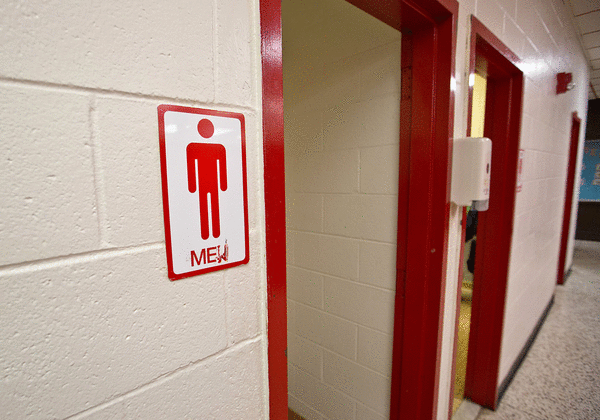
When the seventh period bell sounds, teacher Tim Broderick slides into a desk outside the fourth-floor boys restroom at Allderdice High School, ready for bathroom duty.
Throughout the period, Broderick uses a scan gun to capture a barcode on student IDs, logging their bathroom visits and uploading the data into a spreadsheet. At times he steps inside to tell kids to get moving. Or he acts as a bouncer, allowing only three to five teens in at a time.
The scanning system started at the Pittsburgh Public high school this year to streamline a clunky paper process used in the past and to ensure kids aren’t skipping class, although teachers have been bathroom monitors for about four years.
“It's not the most glamorous thing in the world to do that job,” Broderick said, “but it's necessary at a school, and especially a school with 1,300 kids in it.”
Gone are the days of paper hall passes.
Instead, area districts are turning to digital options to better streamline the process, reduce hallway incidents and keep tabs on kids. The systems, officials say, reduce the amount of time kids are out of class. And students, some of whom grumbled at first, have largely adjusted.
Penn Hills and Peters Township school districts also use digital hall passes, which permit students to create electronic pass requests approved by teachers and for administrators to monitor how many students are in the halls.
“It's really no different than what they were doing on paper,” Peters Township High School Principal Lori Pavlik said. “It's just electronic, and it's much easier for us to pull the information together.”
But nationwide, some advocates are pushing back against the technology.
An Oregon parent sued the Beaverton School District last year, arguing that digital hall passes are being used for more than tracking hallway activity, The Oregonian newspaper reported. Some New York City public school students this year said they feel like they’re being spied on, CBS News reported.
PA Unplugged, a statewide group with several local parent-run cohorts that advocate for distraction-free schools, in a statement encouraged districts to “exercise caution” with the technology to ensure student privacy data is safe.
“If an existing hall pass system is working — especially in elementary and middle schools — we question why schools are trying to fix something that isn't broken?” the statement says.
But Kenneth Trump, president of the National School Safety and Security Services, called the technology an “extra tool.”
He pointed to its ability to track how many kids are in the hall and where they’re going; identify chronic hall pass users; and monitor if teachers are giving out too many passes.
“We’re required to know where you are at all times,” Pittsburgh Public Schools Assistant Superintendent Melissa Pearlman said. “And so if students are roaming throughout the building we’re doing our jobs to educate you and keep you safe.”
Digital hall passes
With the click of a button Penn Hills High School teacher Will Gonsowski can approve a students’ hall pass request — or deny it if there are already too many teens roaming the halls.
Penn Hills last year expanded to the elementary and high schools a digital system piloted in 2024-25 at Linton Middle School. At the time, some high schoolers would go on “self-guided tours” of the building, causing them to miss a chunk of class, said the high school associate principal, Nick DiCarolis.
Now, DiCarolis said, hallways are empty, classrooms are full, and the number of behavioral referrals and incidents occurring in unsupervised spaces has dropped.
“It’s a lot more conducive to studying and carrying out a lesson without constantly having people at your door or having noises out in the hallway,” DiCarolis said. “In general, it’s a much more positive environment.”
Penn Hills, where 1,000 of the district’s 2,900 students are high schoolers, pays $7,400 per year to use Minga, a campus management platform, in the district’s three buildings.
The system allows the high school to permit only 20 passes at a time, and it limits which periods students can request to go to the restroom.
Passes can also be denied if someone the requester doesn’t get along with is already in the halls.
Kids, DiCarolis said, “weren’t super happy at first.”
But today, students have largely adapted, and the system is not a major concern among the student body, said 17-year-old Joy Orwana, student council president.
So far, the total number of hallway hours has decreased — between the first day of school and mid-October 2025, students spent 3,600 hours in the halls; that dropped to 1,400 for the same period this year. DiCarolis stressed student needs such as nurse visits are still being met.
And last year, high schoolers spent on average 16 minutes per pass. That number dropped to eight minutes in the same period this year.
DiCarolis wants to see that number closer to 6½ minutes.
“There’s just always areas of growth,” DiCarolis said. “I don’t want to be content.”
At Peters Township, where 1,200 of the district’s 4,000 students are high schoolers, officials started using the digital hall pass system Securly three years ago to streamline the process and to help identify where students are in case of an emergency.
Once a student has a pass, Pavlik, the high school principal, can see who’s in the hallways per period. Parents can also request information on their child’s pass use.
“It's been a positive shift, and it kind of holds everybody accountable for their location and where they are,” Pavlik said. “And in today's day and age, that is really important for safety and security, and that's obviously one of our number one priorities.”
Pittsburgh Public
Allderdice teachers have to work an assigned duty such as monitoring bathrooms or hallways or checking students in at the door, Principal Danielle Michalski said.
Educators, Michalski said, were “excited” about the bathroom change.
“They were noticing that if a kid was dipping into the bathroom during class exchange and the kid doesn't like whatever class, they could spend the entire period in the bathroom and no one would ever know where they were,” Michalski said.
In addition to having a time stamp of bathroom visits, hall monitors and school security officers stationed on each floor ensure students return to class.
Bathrooms are locked between periods and the teachers switch roles. Throughout the nine-period day, the bathroom system requires about 36 teachers.
The system was the brainchild of students who last year wanted to modernize the old paper system. Staff then created the barcode — placed on the back of the student ID — and spreadsheet. They purchased scanner guns from Amazon for about $250.
Data collected through the spreadsheet — accessed by administrators and bathroom monitors — is checked to see whether kids are “abusing the bathroom privilege” or if they are going to the bathroom every period, Michalski said.
Conversations are then held to ensure students are OK, and to emphasize the importance of them being in class.
“They realize, ‘Oh, wow, they are looking at this,’” Michalski said, adding that the system has “led to some interesting conversations” about a student’s class engagement.
Michalski, who added that Carrick High School has a similar system, said the system has largely been well received. As with other systems, officials will collect student and parents feedback throughout the year. Any changes would be made over the summer.
“It's really giving us an opportunity to provide students with accountability and to make sure that we're also monitoring and keeping things safe,” Michalski said.
_____
© 2026 the Pittsburgh Post-Gazette. Visit www.post-gazette.com. Distributed by Tribune Content Agency, LLC.





Comments