Judge denies feds' request to block 20,000 California ballots in blistering opinion
Published in News & Features
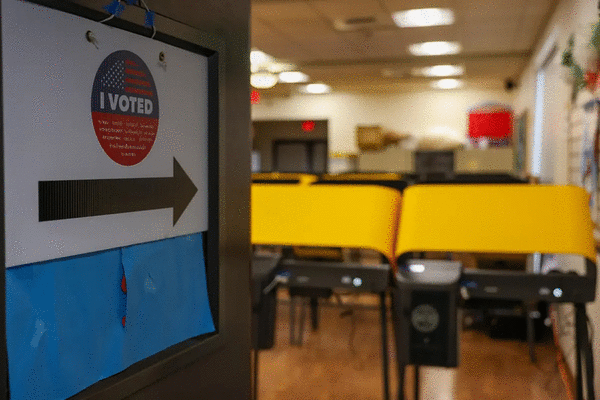
A federal judge in a blistering opinion Wednesday denied a Trump administration request to immediately block California elections officials from counting the ballots of 20,000 voters whose citizenship the administration questions. The administration swiftly said it would appeal.
U.S. District Judge David O. Carter ruled that the administration’s allegations were “not credible” and that the intervention it sought would violate a host of federal laws, sow chaos in the ongoing midterm election, likely lead to the disenfranchisement of legitimate voters and foster future political meddling in elections.
“This request violates longstanding constitutional principles mandating that states have control over their elections,” Carter wrote. “If (the Trump administration’s) last-minute request for relief were granted, either party could create chaos for their own political purposes to disrupt the election process.”
Carter, an appointee of President Clinton, wrote that never in American history “has the federal government, on the eve of an election, sought to coerce a state and local government to abandon their own Constitutional elections procedures and bend to the will of the Executive Branch,” and that, in bringing its suit, the Trump administration was asking the court to “believe that it reigns as a sole sovereign.”
“But California and its people are sovereign, too,” Carter wrote.
Carter’s ruling was the second to deny the Trump administration a temporary restraining order against the state and Los Angeles County this week, after a three-judge panel of the U.S. 9th Circuit Court of Appeals denied the government’s emergency request in a separate order Monday.
Carter ruled after a 3 1/2 hour hearing Tuesday, where a slew of attorneys for the state, county and independent voting rights groups argued against the administration’s demands.
First Assistant U.S. Atty. Bill Essayli — who is the top federal prosecutor in L.A. and argued for the Trump administration at Tuesday’s hearing — wrote on X that his office had already filed notice of appeal and “will immediately seek an emergency order” reversing Carter back in the 9th Circuit.
“Every day, more ballots are processed by election officials. This ongoing emergency disenfranchises American citizens through dilution,” Essayli wrote.
State elections officials — including Secretary of State Shirley Weber and Los Angeles County Registrar-Recorder/County Clerk Dean Logan, whom the Trump administration sued along with the state — did not immediately respond to requests for comment. However, other state leaders, voting rights advocates and election experts cheered the ruling.
“For the second day this week, our country’s legal system is standing up to the President’s authoritarian attempts to remain in power unchecked and unchallenged,” Gov. Gavin Newsom said.
“Today’s ruling is yet another important victory for the rule of law and the right to vote,” said California Atty. Gen. Rob Bonta. “But this fight is not over. We will keep fighting to protect California’s elections from unlawful federal interference and get this baseless lawsuit dismissed.”
Anna Baldwin, the director of voting rights litigation at Campaign Legal Center who argued before Carter on behalf of the NAACP and the League of United Latin American Citizens, said Carter had “affirmed what the Constitution has already made clear: The states and Congress oversee our elections, not the White House and not the Department of Justice.”
Rick Hasen, director of the Safeguarding Democracy Project at UCLA School of Law, said Carter’s ruling was as sweeping a rejection of the Trump administration’s illegitimate attempts to interfere in California’s election as could possibly be written.
“The federal government lost in every way it could possibly lose. It lost on the law, and it lost on the facts, and it lost on the equities — (or) weighing the harms to the various parties,” Hasen said.
And that is appropriate given that the case was a “total overreach of federal power,” Hasen said. “The Constitution’s clear that states have the authority to run Congressional elections unless Congress passes a statute otherwise — and Congress didn’t do so here.”
The Trump administration sued California, Weber and Logan on Oct. 15 — three months after Homeland Security Secretary Markwayne Mullin wrote a letter to Weber alleging that there may be more than 190,000 noncitizens registered to vote in California, and two days after acting Deputy Atty. Gen. Trent McCotter wrote again to Weber and Logan, giving them 48 hours to set aside the ballots for the 20,000 voters on the latest list.
Much of the debate since has centered on the origins and evidence in support of that list.
California and L.A. County officials have said the list appears to be inaccurate, with Logan’s office saying its review of a subset of about 200 voters found that a substantial portion appeared to have been born in the U.S. — a claim that has been disputed by Homeland Security officials.
Elections officials from several other California counties have also raised concerns about the accuracy of smaller lists of voters derived from the 20,000 that were sent to them by Justice Department officials last week, along with a warning that they could face criminal penalties if they tabulate those votes. Officials have said the lists they received contained the names of individuals who did not appear to live in their counties or did not appear to be registered.
State officials have pointed to similar lists being rejected as inaccurate elsewhere, including in Nevada. And during Tuesday’s hearing, multiple attorneys for voter advocacy groups — including the NAACP and Mi Familia en Acción — challenged both the origins and the reliability of the Trump administration’s data, and questioned why the Trump administration has so far refused to disclose when and from whom it obtained the purchased California voter roll data it says its analysis is based on.
State and county officials have said that complying with the Trump administration’s demands would badly disrupt the election and could disenfranchise legitimate voters who are wrongly included on its inaccurate list.
Justice Department officials have defended the list, saying it is composed of 20,000 individuals whom the administration has “high confidence” are not citizens, and that that number represents the “floor” to the issue — while the earlier, 190,000-strong list was the “ceiling” and also included people the administration had suspected but had less confidence were noncitizens.
They argued that Carter should immediately bar the state and county from tabulating ballots from the flagged voters until they can prove those voters are citizens — in part because, as soon as cast ballots are received in person or removed from their envelopes, they cannot be resegregated.
Essayli has said federal authorities have “overwhelming evidence” to support their claims. At Tuesday’s hearing, he said once federal authorities obtained the purchased voter registration records from the state, they “had to enrich or enhance or add, supplement, information to the voter file, so they took the info that was on there — names, addresses — and they used a database that’s often used by law enforcement, it’s used commercially.”
However, in sworn court filings, other administration officials have acknowledged “discrepancies” with some of the records and noted that more recent reviews of the data did show some people on the list appear to have citizenship claims. Essayli told Carter, “We’re never going to stand here and tell you that everything is 100%.”
In his ruling Wednesday, Carter also focused in part on the reliability of the list, noting that the process by which the Trump administration compiled it, and the reliability of outside databases to build it, remained unclear and could not be determined to be reliable based on the record before the court — particularly given that administration lists elsewhere have been shown to be unreliable.
But Carter also touched on several other weaknesses he saw in the Trump administration’s case — weaknesses that were also hit on by the 9th Circuit panel that rejected the administration’s request Monday.
Among them, Carter found that the request violates federal law precluding altering of election rules on the eve of an election.
______
©2026 Los Angeles Times. Visit at latimes.com. Distributed by Tribune Content Agency, LLC.





Comments