'A destination for transplant innovation': Northwestern launches new transplant institute
Published in News & Features
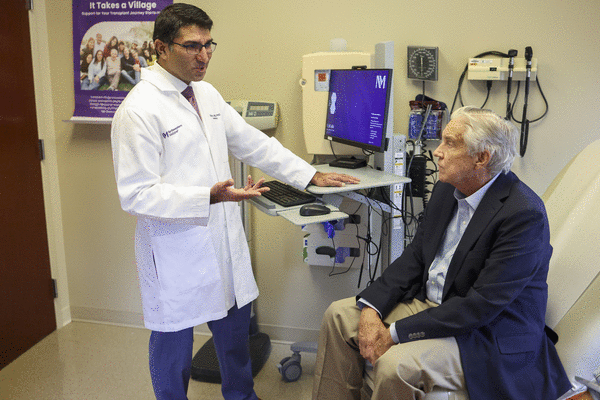
Northwestern Medicine has consolidated its robust transplant program into a new Transplant Institute, with a focus on tech and innovation.
Spearheaded by transplant surgeon Dr. Satish Nadig, the announcement of the Northwestern Medicine Transplant Institute comes just a month after the hospital’s 3,000th liver transplant, according to a spokesperson for Northwestern Medicine.
“The idea is to be a destination for transplant innovation,” Nadig said. “What this institute allows us to do is to have the funds to be able to do more and be able to bring in the brightest minds in the country and the world.”
Nadig emphasized that the hospital’s patients are ultimately the driving motivation behind the implementation of the new institute and the technologies it fosters.
Art Nichols, a kidney recipient who had his transplant operation performed at Northwestern Medicine in September, was astonished to learn that his organ donor was his daughter, Natalie.
After getting diagnosed with multiple myeloma, a rare blood cancer that severely damaged his kidneys, Art Nichols, 70, began the grueling process of treatment in January of 2023.
“I had to start on dialysis,” Art Nichols said.
“And chemo and radiation,” Natalie Nichols, 42, quickly added. “He was in a neck brace for almost six months … he had a stem cell transplant to help clean the bad cancer cells out of his body, and I mean, he’s just a fighter.”
While Art Nichols could have remained on dialysis for a longer period of time, there were severe health risks.
“Every year one is on dialysis, their lifespan is shortened by a significant percentage,” Nadig said. “Eventually they’ll succumb to the side effects.”
After meeting with Northwestern’s transplant doctors, the Nichols began looking for a potential donor.
“We put together a little Facebook post and an overwhelming amount of people reached out to me,” Natalie Nichols said. “I’m thinking, all these people are coming forward for my Dad. How can I ask this of other people without looking into it myself?”
Not wanting to put pressure on her father, and fearful that he might reject her proposal to donate one of her organs, Natalie Nichols kept her plans secret.
“I’ve done a few things without my Dad knowing in my life,” she said with a laugh. “This is probably the biggest.”
A day following the surgery, Northwestern’s doctors asked Art Nichols if he was interested in meeting his donor.
“In walked Natalie and I was just totally in shock,” said Art Nichols, shaking his head. “She had kept it so quiet, you know?”
“He had tears in his eyes, and we both just looked at each other,” said Natalie Nichols. “It was just like an incredible moment and just such a relief.”
“I would have said no from the beginning,” Art Nichols said. “But it went so smoothly, you know? Thanks to Northwestern, it went really great.”
Both Natalie and Art Nichols reported swift recoveries.
“I didn’t expect him to be sitting up and looking as great as he did, just, you know, the next day after the surgery,” said Natalie Nichols. “I was just up and walking within like three days.”
“People think, when they see the word transplant, that people are in the hospital for days on end,” said Nadig. “Our average length stay, without any of our newer techniques that we’re using, is about two to three days anyways.”
“I really can’t say enough good things about the way they treated me and took care of me,” said Art Nichols, of Northwestern.
“What patients don’t realize is we get an immense amount of satisfaction seeing this, this is what drives us,” Nadig said of Art and Natalie Nichols. “If we’re able to build that culture, I think it just translates to better patient care.”
The Institute, which houses over 300 people and runs over 80 clinical trials, aims to continue developing technologies to make transplant surgeries as seamless as possible.
“Things we don’t even know that are on the horizon,” Nadig said. “We’re building for growth within the institute.”
One of the new technologies that the Institute aims to cultivate is machine perfusion, which allows doctors to keep an organ alive outside of a human body for extended periods of time. Using this technology, Nadig said he has been able to keep a liver alive for up to 32 hours, a bold leap from the standard six to eight-hour interval at other programs in the country.
Each extra minute gives doctors more time to optimize patients before transplantation, Nadig said.
Also using machine profusion, doctors at Northwestern have been able to more optimally use a single organ, taking two different parts of one liver and inserting it into two recipients.
“We were the first place in the country to partition a liver on a machine profusion pump and transplant two people,” Nadig said.
Other developments include AI-powered donor matching and a potential reduction in the amount of medicine patients have to take following a transplant surgery.
“Any medication has side effects. What if we could eliminate them all together?” said Nadig.
The institute now has 37 patients off anti-organ rejection medication after their transplant surgeries, which according to Nadig, is more than anywhere else in the world.
“We want to try and set the foundation for what medicine’s gonna look like … ” said Nadig. “And the fact of the matter is, medicine changes, physicians are resistant to change, and we are trying to change that narrative.”
____
©2026 Chicago Tribune. Visit at chicagotribune.com. Distributed by Tribune Content Agency, LLC.




Comments