'Highest king tide ever' swamps South Florida and exposes danger of sea rise
Published in News & Features
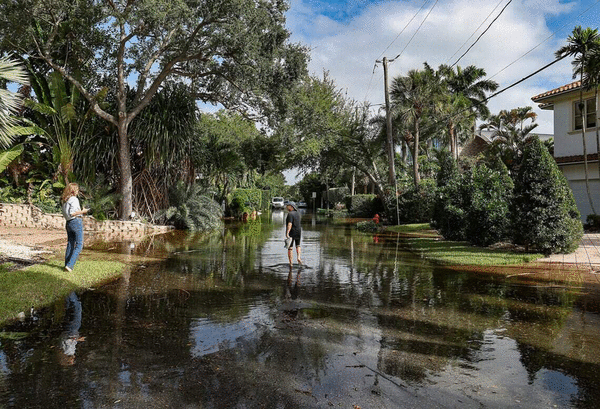
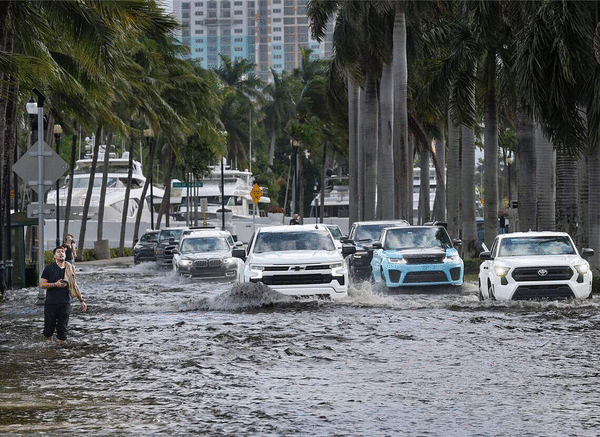
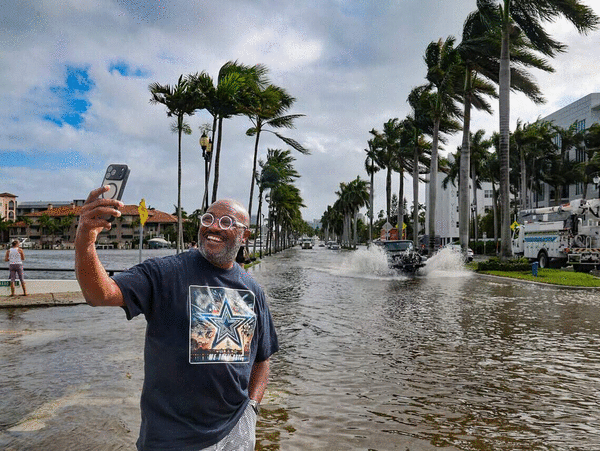
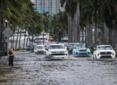
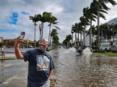
MIAMI — All signs point to this week’s king tide as the highest in South Florida’s history — supercharged by onshore winds and sea level rise.
From Miami to West Palm, an unprecedented amount of saltwater surged ashore. It submerged lanes of major thoroughfares, leaving drivers to navigate intersections with water up to their wheel wells. It crept to the doors — and beyond — of coastal businesses, including several in Miami Beach and Fort Lauderdale.
“I couldn’t even open the door because if I opened it, water would get all over my workplace,” said Pedro Arraz, a 21-year-old manager at Chima’s Steakhouse Fort Lauderdale.
On Tuesday morning, floodwaters began to rise so high outside his restaurant that he left because of safety concerns. He walked nearly a mile through floodwaters to get to his car that he parked at a nearby 7-11 convenience store. He didn’t park at his workplace because he was worried that his car would be damaged.
Fort Lauderdale officials shut down the Las Olas Bridge due to flooding on the north and south side, leading to an intense traffic jam. Robert Tate, a retired police lieutenant who walks along the bridge every morning, looked at the flooded bridge in awe.
“My car is a low car, so yesterday I was scared.” he said. “I wouldn’t dare try to make this.”
Investment banker Gonzalo E. Vazquez walked from Las Olas Bridge back to his house in nearby Hendricks and Venice Isles with soaking shoes and socks in his hand. He regularly takes morning walks, but today was different.
Vazquez bought his home in 2006 and has only seen the water rise as high as it did Tuesday morning one other time.
“This is the second time I’ve seen the water so high,” Vazquez, 65, said.
Vazquez is concerned that city officials aren’t doing enough to help community members deal with the rising tides.
“We need the city to take care of it,” he said. “We need something to alleviate this area because this is going to continue year after year.”
This round of king tide started on Friday, leaving coastal streets and parks soggy during high tide all weekend. It’s set to continue through at least Wednesday.
Record breaking
Tuesday marked the peak of the latest round of king tides, the highest tides of the year. The tides are predictable: scientists knew this one was going to be the worst all the way back in January. But what they couldn’t predict was the low pressure system passing by the coast this week, “bulldozing water onto the coast,” said Brian McNoldy, a senior research associate at the University of Miami’s Rosenstiel School of Marine and Atmospheric Research.
Both Fort Lauderdale and Miami registered about 2.5 feet of water above high tide, which the National Weather Service considers “major” flooding.
Records show this is the most water ever recorded at Miami’s Virginia Key tide gauge outside of a hurricane since it was installed in 1994. The top spot still belongs to Hurricane Irma in 2017, which brought a whopping 3.6 feet of water above high tide.
“Hurricane Wilma in 2005 and Irene in 1999 and this current high tide are so insanely close it’s basically a 3-way tie,” McNoldy said.
It’s a similar story at Port Everglades’ tide gauges, which broke the record it set back in September of 2 feet — the highest flooding measured at the station since it was installed in 2018.
For South Florida, it’s clearly a record-breaking level of water to see outside of a hurricane or tropical storm.
“This is the highest king tide we’ve ever had. And by ever I mean ever ever, not just since the gauge went in,” McNoldy said. “There is no way king tide ever got this high before 1994.”
While these king tides are a natural feature, they’re getting higher as climate change raises sea levels. Miami has clocked about 8 inches of sea level rise since the gauge was installed in 1994, and research shows a distinctive trend toward more hours of higher than high tide as sea levels rise.
Failing infrastructure
In Miami Shores, the waters submerged the city’s golf course, shutting it down for days to dry out. Near hole 12 is a South Florida Water Management District flood control barrier, one of several structures installed in the mouths of canals in Miami-Dade and Broward to let water flow out to Biscayne Bay.
On Tuesday, it was not working. Instead, water was flowing backwards: over the barrier and backing up into the canal. It was the same story at the two other structures in Miami’s Little River and North Miami Beach.
This is exactly the problem that district managers have sounded the alarm about for years, the failure of South Florida’s more than 80-year-old drainage system in the face of rising seas. They warned that without bigger pumps and gates, they cannot keep homes and neighborhoods dry.
The district secured $150 million in federal funding to fix the issue, but it was yanked back as part of cost-cutting efforts in 2025, then recently re-instated this year.
“The BRIC awards for construction have been reinstated, and the grant agreements are currently under negotiation. All three projects are undergoing federal and state permitting,” Jason Schultz, district spokesman, said in an email.
And it’s not just pumps and pipes that can’t keep up. This king tide flooded roads, backed up sewage systems and stalled cars up and down the coast.
Serena Hoermann, director of Florida Atlantic University’s Center for Urban and Environmental Solutions, said that South Florida cities and counties are spending hundreds of millions to address sea level rise risks that are only increasing.
“It’s all kind of compounding to wear down our infrastructure over time,” she said.
Scientists predict that South Florida could see two feet of sea rise by 2060 and potentially up to six feet by 2100. That puts millions of people and billions in real estate value at risk. And although Florida is pouring cash into fixes like higher roads, better pumps and stronger buildings, many argue it’s not enough.
“We’re kind of still in a reactive state. We see the water and our residents in that moment maybe are showing support for the changes we need to make,” Hoermann said. “I think we Floridians do understand that we need to do something.”
‘This is horrible’
On Tuesday morning, streets on Crespi Boulevard in Miami Beach were completely submerged. Maria Martell used a broom to try to keep the water from reaching her doorstep. Shortly after 11 a.m., the water had completely submerged her front yard and crept to within inches of her door.
“This is horrible,” she said in Spanish. The flooding was the worst she had seen in the year she had lived in her house.
A couple of blocks away, Luis Chavez Espinosa stood knee-deep in water in the middle of the road, phone in hand, showing the flooding to his social media followers during a livestream.
The 53-year-old has lived in the neighborhood for three years and said the recent king tide flooding was the worst he had seen.
“People can’t leave,” he said.
Just behind him, Claudia Stevens, 28, walked barefoot through the water, sandals in hand, as she tried to reach her car to get to a yoga class in Wynwood.
Stevens has lived in the North Beach neighborhood for a week but has been in Miami Beach for years. She said she was “used to rain flooding,” but the king tide had been particularly intense.
“It’s frustrating,” she said, blaming climate change and rising sea levels for the particularly bad season.
©2026 Miami Herald. Visit at miamiherald.com. Distributed by Tribune Content Agency, LLC.






Comments