LA's next mayor will face transit challenges. Troubled LAX people mover is Exhibit A
Published in News & Features
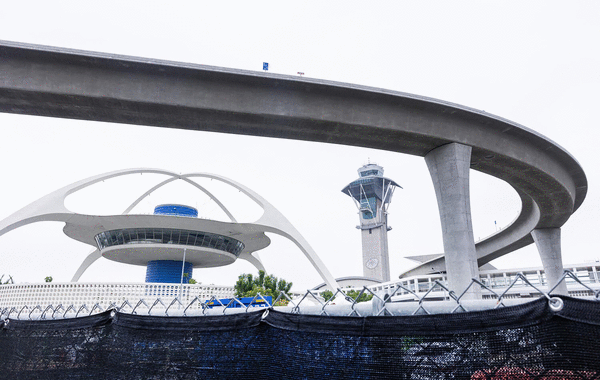
LOS ANGELES — There are myriad public transportation challenges for the next Los Angeles mayor, but perhaps none is more visible than the long-awaited Skylink people mover train at Los Angeles International Airport.
The 2.25-mile train, designed to whisk people from airline terminals to ground transportation, is years behind schedule and more than $1 billion over its original construction budget — bogged down by technical issues and a court battle between the contractor and city airport officials.
And now it has become one of the more contentious issues in the mayoral race between incumbent Karen Bass and challenger Nithya Raman.
Raman says Bass and the the city's board of airport commissioners, which the mayor appoints, haven't done enough to keep costs in check and to ensure construction deadlines are met.
"Over two years ago, when the project was already a year behind schedule, Mayor Bass's airport commissioners cut a $550 million check in order to cover project cost overruns and supposedly to secure a start service in January of this year, 2026," Raman said in a statement to The Times. "That date came and went and she hasn't said anything about how she'll get the project on track."
Bass said that the project and its problems began before she took office and that "we pushed for a settlement so there would be a firm finish line."
"I expect LAWA [Los Angeles World Airports] and the contractor to finish this job and get riders on board," Bass said in a statement to The Times.
The Skylink train is just one of many transit challenges Los Angeles' next leader will face, as voter-approved street improvements and road safety initiatives lag. But it has become one of the more significant given its location at LAX, the gateway to Los Angeles for millions of international travelers.
As the city prepares for the 2028 Summer Olympic Games, a $30-billion makeover for LAX is underway. Skylink is a linchpin of that upgrade, designed to ease vehicle traffic in the notoriously gridlocked horseshoe at LAX — and area freeways — by giving travelers and airport workers a new way to reach remote parking lots, rental car lots and the bus and light rail lines at the LAX/Metro Transit Center.
When it was greenlit by City Council in 2018, Skylink had a projected construction budget of roughly $1.9 billion and was expected to be completed by March 31, 2023.
The project contractor now says Skylink won't be running until January 2027 at the earliest, and cost overruns have driven up the price tag by 74%, to more than $3.3 billion.
Raman has repeatedly bashed the train's delays on social media while scrutinizing Bass' performance as mayor. A recent video about the project and the airport commissioner's approval to raise fares on ride-share drivers at the airport is one of the most top-viewed on her campaign's Instagram page.
"Instead of fighting the $1-billion overage [for Skylink], she's making people who are using the airport pay for it," Raman said in the video.
Skylink construction began under the administration of Mayor Eric Garcetti. But disputes between the airport and the contractor have led to years-long delays and change orders have largely been approved during Bass' tenure under the airport leaders that she oversees.
Records show that the City Council, including Raman, backed the airport commissioners and approved $550 million in settlement claims in 2024 between the airport and the contractor, LAX Integrated Express Solutions (LINXS).
The contractor behind the train recently sued the city, blaming it for the delays. But an independent grand jury report previously found that it was the contractor, not the airport, that was largely to blame for the problems. The report also questioned the role of outside consultants who signed a contract with the city.
When it comes to transit, Raman and Bass are aligned on some issues. Both have spoken about the need to expand Metro's rail and bus network and agree that buses, especially, are the backbone to the city's system.
"Public transit, quite literally, is one of the most powerful tools to change and improve the quality of life — and that's what we are building," Bass said this summer after she assumed the chair of L.A. Metro, the countywide transit authority.
Raman says she believes that infrastructure needs an overhaul and has included it under her top priorities.
"Our buses are slow, unreliable, and not frequent enough. A system that gets stuck in the same traffic as every other car on the road is a last resort rather than a real alternative to driving. Too many Angelenos who have a choice don't take the bus because they can't trust it to get them there on time," Raman said in her statement to The Times. Her plan would include making permanent the priority bus lane network being developed for the Olympics.
Bass voted with the Metro board majority earlier this year to approve the multibillion-dollar Sepulveda Transit Corridor project, which will connect the Westside to the San Fernando Valley by subway. Raman also shared public comment at a Metro board meeting in support of the project.
But the two candidates have often diverged on priorities.
Raman has a background in urban planning and has made transit a top issue during her campaign. She's been endorsed by one of the major safe streets advocacy groups in the city, Streets for All. Hedge fund manager and bike lane advocate Aaron Sosnick has been a major backer of the campaign, putting $7 million into two independent expenditure committees supporting Raman.
And her campaign is being overseen by political consultant Jeff Millman, who worked on the Measure HLA push that would enforce bike lanes, bus lanes and pedestrian enhancements.
Bass has a background in healthcare and community organizing. Her campaign hasn't emphasized transportation issues.
While Bass' campaign website references infrastructure improvements around streets, sidewalks and crosswalks under her reasons for running and her list of accomplishments, there's been no mention of rail, buses or public transit. Both she and Raman declined to be interviewed about their vision for transportation and mobility, instead responding to questions with written statements.
As chair of Metro's 13-person board, Bass holds vast power over the Los Angeles County bus and rail network. In addition to being a board member, the person in the mayor's seat gets three board appointees.
"The mayor has the opportunity to steer a nearly $10-billion budget and determine what investments Metro makes throughout the region through the implementation of Measure R and Measure M," Eli Lipmen of the public transit advocacy group MoveLA said about the power the city's leader holds. Both measures were voter-approved and would fund transit projects.
During Metro's state of the agency address on July 22, Bass announced her goal to make fares free on the rail and bus system.
"This is the Metro that I've fought for since my first term and as mayor in this city: a world-class system that creates opportunity for all, including our veterans, those with disabilities and those who deserve a second chance," Bass said in her address, stressing the need for affordability.
The mayor didn't say how she proposes to cover the cost of free fares. In response to questions from The Times, she described the initiative as an expansion of existing programs that provide free fares to students and discounts to low-income riders.
"This year, as Metro chair, I'm building the long-term financial strategy to take us the rest of the way," she said.
Los Angeles has some of the lowest public transit fares in the country with a regular one-way ticket on both Metro buses and rail lines costing $1.75.
Raman said she supports "free rides for people who need them" but called Bass' idea untenable.
"The fact that Mayor Bass announced this with no plans to fund the billions in additional costs over the coming years indicates that this is not a serious proposal from a mayor who hasn't prioritized transit riders," Raman told The Times. "Actual riders frequently state in surveys that their preference is for Metro to prioritize safety along with a faster and more frequent network, not free fares."
Bass has also taken heat from safe streets advocates who want more attention paid to pedestrian, cyclist and driver safety. After an audit last year found significant flaws with the city's Vision Zero plan — a nationwide initiative to eliminate traffic deaths that began under Garcetti — advocacy group Streets Are For Everyone called on Bass and the City Council to declare traffic violence a public health crisis.
Damian Kevitt of Streets Are For Everyone said it's clear that the initiative is not a city priority.
"Clearly we have a major issue — there are more fatalities than homicides three times [years] in a row," said Kevitt, whose group recently sent a letter to Bass and the City Council calling for action.
Raman said that if elected, she would treat Vision Zero like a "mandate" and hire a director to oversee the initiative.
Bass said that the Vision Zero initiative is a priority and that as it is being restructured under one department, the city was not waiting for that reorganization to be finished before making changes. Updates to speed humps, speed cameras and more crossing guards near schools are among the progress that has already been made, she said.
©2026 Los Angeles Times. Visit at latimes.com. Distributed by Tribune Content Agency, LLC.






Comments