Dolly Parton's nephew, former lawmaker struck arms deal in Haiti. Millions are missing
Published in News & Features
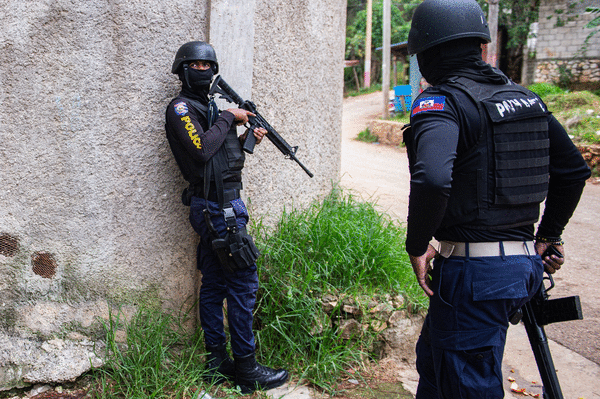
A private security firm founded by two people close to late country music legend Dolly Parton is at the center of an unusually complex arms deal in Haiti that several sources with knowledge of the matter say was worked out with little due diligence.
The security firm, Fencebridge Strategic Risk, entered into a multimillion-dollar agreement about a year ago to supply the Haiti National Police with semi-automatic rifles and thousands of rounds of ammunition, as the agency struggles to combat violent gangs that have claimed the lives of more than 25,000 Haitians since 2021.
While part of the deal has been fulfilled — some batches of 9-millimeter, 5.56-millimeter and 7.62-millimeter rounds reached Haiti recently — the delivery is still incomplete and at least $7 million of Haitian public funds paid to acquire the weaponry is unaccounted for.
Fencebridge was founded in Tennessee in 2015 by Daniel Nozell, Parton’s longtime manager, and Bryan Seaver, one of Parton’s nephews who was also her head of security.
The company lacked the necessary U.S. regulatory permits and licenses — and faced long delays getting them approved — when it decided to enter the highly lucrative and opaque world of arms purchases for Haiti’s beleaguered security forces. Under State Department policy, the country is subject to an arms embargo and export controls on purchases for the police.
They were finally assisted by a Republican former member of Congress, Mark E. Green of Tennessee, who stepped in and offered to help obtain them.
“I said I could help you with that,” Green told the Miami Herald. “I have lobbyists buddies in D.C. and you could use my name as supportive of this effort.”
Green said he connected Fencebridge to his network of attorneys and was paid $600,000 for his services on behalf of the company. He denied having any involvement with how the contract itself was arranged.
However, a Haitian source who is familiar with the issue, blames Green for the delays.
“We believed in him, since we saw they were dealing with a lot of forms of investments,” said the source, who asked for anonymity to discuss the highly sensitive matter.
Fencebridge’s chief operating officer, Andrew Day, who lives in Key West, confirmed the involvement of Green in the deal along with a Texas woman, Ellie Soto. Soto, the Herald learned, met with the former lawmaker in Haiti. Documents show Soto was born in Costa Rica but is a U.S. citizen living in Sugarland, a Houston suburb.
The Haitian source said while Fencebridge ran into delays in getting the ammunition to Haiti, they are “fighting to deliver these things.” Green and Soto, the source said, are “holding the money.”
Green said he billed Soto $1,000,080 and got paid $600,000, and added that Soto, whom, he first met in July of last year, has stopped taking his phone calls.
“That $7 million isn’t with Fencebridge, and it isn’t with Green,” the former lawmaker said, referring to himself.
Haitian sources showed the Herald evidence of a wire transfer from the government of Haiti to Soto in two separate documents. In one, Soto confirmed the receipt of $8,241,955 at 2:24 p.m. and $7,082,589.29 at 2:25 p.m. on Jan. 27 of this year. According to the document, Soto adds that she had received at that point a “total deposit of $15,347,958.13 from Haiti.”
The other document shows that the same two transactions were sent to a CitiBank account on the same date.
While Fencebridge’s dealings in Haiti first came to light last month in an unrelated legal dispute between Parton’s estate and Seaver, the firm had already been drawing scrutiny in Port-au-Prince as armed gangs launched deadly attacks and police were running out of bullets.
Parton’s nephew and Fencebridge’s chief executive officer, Seaver, declined to comment for this story.
The Herald’s repeated efforts to contact Soto via a phone number and email listed on her Houston-based firm, Tranmex, LLC, were unsuccessful.
Enter Mark Green
Fencebridge’s arms contract had been in the works long before Parton’s death on Aug. 25, 2026, with the firm’s president holding meetings with Haitian officials while staying at the upscale Hotel Karibe in Port-au-Prince before the country’s police and justice minister, Patrick Pélissier, signed off on two deals with the company.
Green, a former chair of the U.S. House Homeland Security Committee who resigned from Congress in July 2025, traveled to Haiti two months later. Soto was already in Port-au-Prince after traveling to Haiti onboard a Sunrise Airways flight from Miami on Sept. 14 along with her husband, and another Tennessee businessman described as “a connector,” according to documents reviewed by the Herald.
The group had a meeting in Fort Lauderdale to discuss their separate ventures in Haiti before they flew to the country, Green said. At the time he was looking to make a deal to supply cement to the country. Soto wanted to pitch the Haitian government on a separate deal to supply fuel.
After learning about the Haitian police’s need for weapons and the desire of the head of the police to cut ties with a longtime supplier, Green said he could help.
The arms contract was finally signed sometime in October 2025, the Herald learned. Soto became the conduit, Day and Haitian sources said, for receiving the Haitian government’s $15 million partial payment on the contract. Who decided to route the government’s funds through Soto remains unclear.
Day told the Herald that the firm has yet to be paid several million dollars it is owed for the shipments. The money was last traced to an escrow account controlled by Soto.
Pélissier, whose justice ministry oversees the Haitian national police, did not respond to a request for comment.
Other Haiti officials contacted by the Herald did not respond to questions about whether the contract had been properly vetted by Haiti’s Cour Supérieure des Comptes et du Contentieux Administratif, the independent court that is responsible for auditing public finances and adjudicating administrative disputes. In contrast to the police contract with Fencebridge, the court has blocked a weapons purchase for the Haitian military from a separate company because that firm failed its vetting process, two government officials confirmed to the Herald.
“Our work in Haiti is driven by one objective: helping the Haitian national police and the government regain control from the armed gangs that have devastated communities across the country,” Day told the Herald when asked about Fencebridge’s activities in the Caribbean nation. “We conduct all of our work in accordance with applicable U.S. and international law.”
He added that Fencebridge is a “registered and licensed arms broker and security and risk advisory firm.”
The U.S. State Department, which issues export licenses to American businesses in coordination with the Commerce Department for trade in weapons and ammunition, told the Herald that it would not “comment on or confirm specific defense trade licensing activity” in Haiti.
From Tennessee to Port-au-Prince
Business records from Tennessee show that Danny Nozell, who is now the controller of Parton’s estate, incorporated Fencebridge in November 2015. About four months later, Seaver, the singer’s nephew, took over as the company’s CEO.
Tennessee dissolved the company in 2020 for failing to file its annual report with the state. The firm is now incorporated in Grand Cayman, a British overseas territory in the Caribbean, the Herald learned.
Day told the Herald that Fencebridge has been operating in Haiti for four years but was reluctant to offer details about that work. The contract to supply ammunition for the country’s national police is the first time the firm did business with the agency, sources told the Herald.
Day told the Herald that Green, under Soto’s direction, lobbied for “support in the U.S.,” since exports to Haiti face restrictions. Green denied that characterization and declined to elaborate on the challenges that delayed the delivery beyond the missing money.
The arms deal came to light when a text message from Seaver was included in a legal dispute between him and Parton’s estate last month. Seaver, who announced Parton’s death at the age of 80, bragged about the deal in Haiti in that message, court records show.
“I’m literally an international arms dealer and mercenary,” Seaver wrote in that text, putting the value of the contract at $29 million. Fencebridge now denies that figure, stating that the comment was made erroneously, and the figure is closer to $24 million — $13 million for ammunition and $11 million for guns.
Parton’s awareness of or involvement with Fencebridge is unclear. Day declined to reveal the firm’s current owners or whether Parton — or her estate — had any involvement in it.
Nozell initially stated in an email to the Herald that “Dolly never had anything to do with the company,” but the estate’s attorneys then asked the Herald to not use his statement. The Herald is publishing Nozell’s comment since the reporters had no agreement regarding treating his comments as off-the-record at the time he sent the message.
Nozell said in the email that he was a partner with Seaver when Fencebridge was founded before Seaver took over completely. Nozell said he then stepped away.
“I may have given him [Seaver] the money to start it,” he wrote. “I can’t remember, but I have nothing to do with the company.”
An unusual arrangement
The delivery of the ammunition has faced a series of obstacles.
Fencebridge, the Herald learned, had to bring in a partner due to its trouble securing the U.S. State Department permits.
A partial delivery of the ammunition finally reached Haiti late last month.
“There is certainly a lot of scrutiny from the U.S. government on transactions like these,” Daysaid. “I’ve been exporting weapons to conflict zones for most of my adult life and have never seen anything taking this long.”
The payment arrangement for the supplies is also unusual.
Day told the Herald that Soto offered her attorney to process the fund transfers.
The Haitian government would send the funds to Soto, who would hold it in escrow and issue payments to Fencebridge, sources in Haiti told the Herald. But only some of those payments have been completed.
Day said Soto is holding more than $7 million of the money the Haitians sent for Fencebridge to procure the ammunition.
Fencebridge had an IOLTA account — a type of account law firms use to hold clients’ funds for short periods — with the escrow attorney, Anthony Madu. But Day said Madu, who is based in Orange County, California, denied them access to the funds.
“He only took orders from Ellie, who isn’t even a part of our company,” Day said. “After our attorneys reached out to him several times, Madu told them that he had sent all the funds from that account to Ellie.”
Madu told the Herald that he “disposed the money according to the instructions,” but cited attorney-client privilege and would not discuss anything else. He said he was not involved with the arrangement of the contract.
Where Soto has kept the funds or whether she is still in possession of the money remains unclear.
©2026 Miami Herald. Visit miamiherald.com. Distributed by Tribune Content Agency, LLC.






Comments