Tragic accident or murder? Jury to decide fate of LA nurse in high-speed wreck that left 6 dead
Published in News & Features
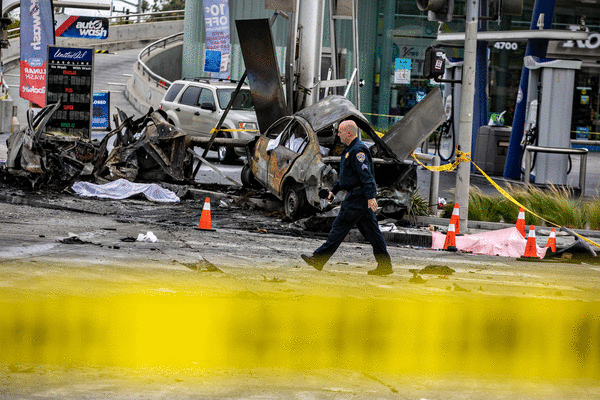
LOS ANGELES — If Nicole Linton had a seizure, then she can't be held responsible for what happened after her Mercedes flew into a South L.A. intersection at 131 mph in August 2022.
If she didn't, then she's going to prison for decades on six counts of murder.
After a three-week trial that focused more on Linton's mental and physical health than the crash itself, jurors must now decide whether the traveling nurse was suffering a medical crisis or driving recklessly and full of rage when she careened into the intersection of Slauson Boulevard and La Brea Avenue more than four years ago. The jury is expected to begin deliberating Friday morning.
Prosecutors charged Linton with six counts of murder in the deaths of Nathesia Lewis, 42, Lynette Noble, 38, Asherey Ryan, 23, her 11-month-old son, Alonzo, and her boyfriend, Reynold Lester, 23. Ryan was more than eight months pregnant at the time, and Linton is also charged with killing her fetus.
Video from the scene shows Linton's vehicle flying into the intersection like a missile, causing a fiery multi-car collision that left burning car parts and streaks of blood as black smoke filled the sky. The force of the collision ripped Ryan's fetus from her womb and launched Alonzo's car seat through the air, prosecutors have said.
On the day of the crash, Linton was headed home from her job at Kaiser Permanente hospital in West L.A, according to prosecutors. They said she was furious at co-workers, planning to quit her job and channeling that rage into her driving.
Linton's defense has centered on expert testimony from a neurologist and a psychiatrist who say Linton had a seizure before the crash. While Linton has not been diagnosed with an underlying seizure disorder, such as epilepsy, defense attorney Jovan Blacknell said Linton suffered intermittent seizures during her life, including at the time of the wreck.
He has repeatedly told jurors that they need to look past the atrocious images prosecutors have continually displayed in court to assess the central issue of the case: whether his client was awake at the time of the crash.
"The results were catastrophic. The images are visceral. And the loss of life was horrendous," he said. "But as much as I do want to acknowledge what occurred, and acknowledge the people who were injured, the people who died, those images don't help you answer the question you are here to answer."
When she began her closing argument on Thursday morning, Deputy District Attorney Antonella Nistorescu displayed horrific video images of the crash with the word "preventable" plastered across the screen in red letters.
Linton had been diagnosed with bi-polar disorder and prosecutors pointed to previous instances where she harmed herself or others when off her medication. In one previous mental health episode highlighted by Nistorescu, Linton allegedly struck another woman then drove through red lights at 100 miles per hour.
At the time of the wreck, Linton was not properly medicated and had not slept for days, prosecutors said.
"They didn't lose their lives. They were killed. In a completely preventable act. The only person who could have prevented this is Nicole Linton," Nistorescu said. "The only person who knew that when she got behind the wheel of her Mercedes that she was under the same stressors, exhibiting the same symptoms that had led her, before, to engage in violent aggressive actions that brought harm to others."
Blacknell contended that four different medical professionals treated Linton after the crash and none of them concluded the wreck was tied to a bi-polar episode.
Prosecutors charged Linton under an "implied malice" theory, meaning Linton is guilty if she knew her actions were dangerous to human life but undertook them anyway. Jurors do not have to find Linton had a specific intent to kill any of the victims, as they would under a first degree murder filing.
Linton did not testify at trial. She has sat impassively and quiet through most of the proceedings.
Blacknell said prosecutors are trying to punish his client for a tragic accident. At trial, a neurological expert testified that Linton had a seizure in the lead up to the collision, and a psychiatrist said Linton displayed psychotic symptoms weeks after the crash that were consistent with the aftermath of a seizure. During a videotaped electroenchephalogram to test Linton for possible epileptic episodes, Linton also jerked and twitched on six different occasions.
Prosecutors have said Linton was pretending to seize during the tests, noting the scan itself did not show brain activity consistent with an epileptic episode during the moments when she was physically reacting.
Pointing to a journal entry Linton authored years before the wreck titled "Bitter F—ing Nurse," Nistorescu said she had a history of lying to protect herself.
"You will see that I especially lie to avoid the consequences of my actions," Linton wrote in 2020.
Blacknell and psychiatrist William Darby said Nistorescu was making an enormous leap in logic to suggest a journal entry that Linton wrote in 2020 signaled that she would fake seizures in a medical test following the crash. In his closing argument Thursday, Blacknell also noted that no medical professional made a finding that Linton was "malingering," essentially faking an illness, during the neurological tests.
Nistorescu also said accident reconstruction evidence and data from the Mercedes itself show Linton managed to keep the vehicle in the center lane and floored the gas pedal to 100% acceleration in the seconds before the crash, reaching a top speed of 131 miles per hour at the time of the wreck.
"If she is conscious, if she is aware, heading into this intersection ... maintaining a straight trajectory so as to aim directly through and cut through a crowded intersection, there is no question that she's guilty," Nistorescu said. "Because she would know the danger. Would know, not only is this dangerous to human life … but if Nicole Linton is headed into that intersection filled with cars, she knows people are going to end up dying."
Dr. David Millett, a neurologist who examined Linton, suggested an evolving seizure could account for those details. Linton's episode began as what's known as a "focal seizure," meaning it is localized in one part of the brain, then evolved into a "tonic-clonic" seizure, which can cause a person's entire body to stiffen up as they lose consciousness. Millett testified that the acceleration could have been caused by Linton's leg going stiff.
"She did not know she was going to have a seizure. She did not wish to have a seizure ... but that occurred," Blacknell said Thursday. "That's not murder. And that is the only question before you. Is it murder?"
_____
©2026 Los Angeles Times. Visit latimes.com. Distributed by Tribune Content Agency, LLC.





Comments