Iran officials pessimistic about US deal before midterms
Published in News & Features
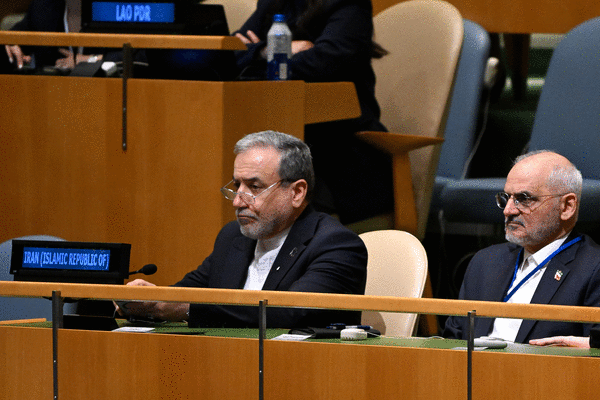
Iranian officials have privately expressed pessimism about reaching a deal to end hostilities with Washington and reopen the Strait of Hormuz before U.S. midterm elections in November, according to people familiar with the matter.
Iran and the U.S. made little progress during talks in New York on the sidelines of the United Nations General Assembly last week and the Islamic Republic believes there’s a high chance of the conflict escalating after the Nov. 3 vote, according to the people, some of whom were briefed by Iranian officials. They asked not to be named discussing sensitive matters.
Iran’s officials have consistently said they are willing to pursue diplomacy but do not trust the administration of U.S. President Donald Trump to abide by the terms of any agreement. The White House has similar feelings of distrust toward Tehran and Trump has said he doubts a deal can be reached before the midterms.
There will not be a pact with Iran unless issues regarding the country’s nuclear program are addressed, according to one U.S. official, who asked not to be identified. Trump is willing to give Iran sanctions relief and release frozen funds in exchange for concrete progress on atomic issues, the official said.
“We’re going to win,” the president told reporters on Monday, when asked about talks with Iran. “As far as I’m concerned, it’s going to be one way or the other. It’s going to go pretty quickly.”
Iran’s Foreign Minister Abbas Araghchi, who met Trump’s envoys Jared Kushner and Steve Witkoff last week, remained in the U.S. for more discussions conducted via mediators for the warring sides.
An Iranian delegation and a Qatari mediator met in New York on Monday. They talked about “how to pave the way to fulfill Iran’s conditions,” Araghchi was cited as saying by the state-run Islamic Republic News Agency. “They had ideas, and we had a discussion that they will raise again with the American side. Following that, the American side’s final response will be conveyed to us, which I hope will happen” by Tuesday.
The main mediators are seeking something different from the so-called Memorandum of Understanding signed by Iran and the U.S. in mid-June. That led to a ceasefire and more maritime traffic flowing through Hormuz but collapsed within about a fortnight, before the sides made substantive progress on a permanent peace deal.
Pakistan and Qatar have been the most prominent interlocutors in the on-off talks.
The MOU was widely criticized among U.S. politicians as ceding too much to Iran financially, especially in the form of sanctions relief. Iran also continued to restrict shipping in the strait and volumes remained far below pre-war levels.
The U.S. government has told mediators it wants Iran to make firm commitments on reopening the strait this time around, as well as to make concessions on its nuclear program, two of the people said.
A spokesman for Iran’s Ministry of Foreign Affairs didn’t immediately respond to a request for comment.
The Wall Street Journal earlier reported that negotiators are pressing Iran to compromise on its nuclear activities to revive the peace talks and placate Trump on an issue he has made a priority.
In his address to the U.N. General Assembly last week, Iranian President Masoud Pezeshkian said the country isn’t seeking to build an atomic weapon but won’t give up the right to develop nuclear technology for economic purposes.
Tehran says it has made an offer to reopen the Hormuz strait within seven days if Washington makes certain moves. Its leaders have previously said the U.S. must lift a naval blockade and oil sanctions for there to be any progress on allowing more ships through the vital waterway. Trump said Saturday he had rejected the proposal.
Oil prices have jumped this week with expectations of a agreement on Hormuz in near-term fading. Brent crude is up around 2.5% to $107 a barrel.
The surge in energy prices since the U.S. and Israel started the war in late February has hurt Trump and his Republican Party ahead of the midterm elections, in which the Democratic Party is widely expected to make gains.
—With assistance from Golnar Motevalli, Kate Sullivan and Jennifer A. Dlouhy.
©2026 Bloomberg L.P. Visit bloomberg.com. Distributed by Tribune Content Agency, LLC.



Comments