Chicago Public Schools enrollment falls by 11,500 students, continuing decades-long decline
Published in News & Features
CHICAGO — Chicago Public Schools enrollment dropped 11,537 students this year, continuing a decades-long decline amid a shrinking number of school-aged children.
CPS CEO Macquline King said Thursday that the district’s 20th day enrollment — which represents the official count for the school year — was 304,687, a decline of 3.7% since last fall. Still, the district appears to have restored its position as the nation’s third-largest school district, behind New York City and Los Angeles.
Since 2010, overall enrollment in CPS has declined 24%, or nearly 100,000 students.
CPS was the nation’s third-largest school district for decades before falling behind Miami-Dade County Public Schools in Floriday in 2022. But that district’s enrollment dropped by 19,000 students this August, leaving its total enrollment at about 300,000 — just behind CPS.
Public school enrollment has plunged across the country, mostly due to declining birth rates. U.S. fertility rates last peaked in 2007, prior to the Great Recession. As those cohorts of children grow up, fewer young students replace them. In Chicago, births declined 37% between 2010 and 2023, according to Illinois Department of Public Health data.
CPS saw modest enrollment gains in 2023 and 2024, fueled by thousands of migrants arriving in Chicago. After a year of intensified immigration enforcement, however, Latino enrollment fell by 7,800 this fall, or about 5.3%. The district’s makeup has remained relatively unchanged compared, with Black students representing about a third of the student body and Latino students representing 47%.
The enrollment decline comes as Chicago officials debate whether — and how — to address a growing number of underenrolled schools. The district’s school closure moratorium will expire next summer, after a fully-elected school board takes office.
Chicago has slightly reversed its recent population loss, gaining 5,253 residents in the year leading up to July 2025. But the city has still lost 16,748 people since 2020, according to Census data. Experts cite rising costs and a lack of affordable housing. For Black families — who have left Chicago in droves over the past decade — chronic disinvestment on the South and West Sides has also driven population shifts.
Public schools also face more competition than ever, including homeschooling, private schools and online schooling options. A January report from advocacy group Kids First Chicago found that CPS served only 71% of the city’s school-aged population in 2023, down from 75% in 2018.
The district’s shrinking roster hasn’t been felt evenly across the city, according to CPS. The Lower West Side experienced a nearly 53% decline this year, the largest of any community area, followed by South Lawndale at 42%. Avondale, Brighton Park, Gage Park and McKinley Park — all predominantly Latino neighborhoods — also saw significant drops, ranging from 35% to 40%.
A handful of neighborhoods saw growth: The O’Hare community area on the Far Northwest Side experienced a 29% jump in enrollment. Student enrollment also rose 28% in the Loop and 19% in Lincoln Park.
Meanwhile, the number of students with Individualized Education Plans — legal documents that outline specialized instruction and services for students with disabilities — has grown by nearly 5% since last year, even as overall enrollment has declined. More than 18% of students now have IEPs, mirroring a national surge.
The district reported decreases in the number of students who are low-income, English language learners or in temporary living situations. But officials said those figures are expected to increase as staff continue updating students’ records.
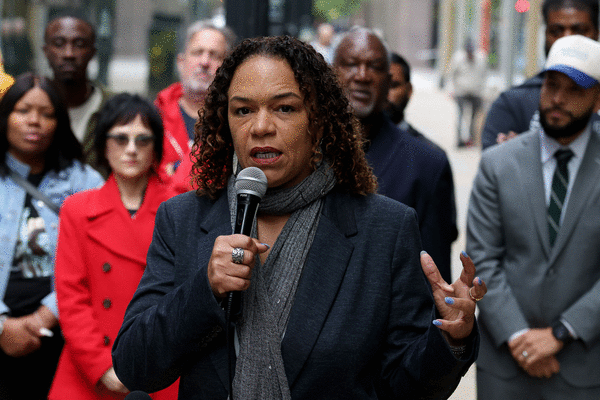
Ahead of Thursday’s school board meeting, a group of community leaders rallied outside CPS headquarters, demanding that the district extend its school closure moratorium indefinitely. School closures have been a political third rail in Chicago since officials shuttered 50 schools in 2013, a move that prompted widespread outcry across the city. Those campuses were almost entirely on the South and West Sides and disproportionately impacted Black students.
Research has found that closures disrupt students’ academic progress, while generating little short-term savings for districts. Some of the school buildings closed in 2013 still sit empty, raising safety concerns and lowering property values.
Wilma Pittman, a longtime organizer with North Side Action for Justice, said any closures would be “catastrophic” to students of color.
“Our children are not numbers on a spreadsheet, and our neighborhoods are not dispensable,” Pittman said. “I’m appealing to humanity, and I do mean humanity. If you have some, please do not close another school in Chicago.”
Others argue that the district’s tiniest campuses are unable to offer the full breadth of academic courses and extracurricular activities. CPS also spends significantly more per pupil to operate many of its smallest schools because fixed operating and staffing costs are spread across fewer students.
The issue has become a hot-button campaign debate ahead of November’s school board election. Only board president candidate Hilario Dominguez has pledged not to close schools. Candidates Jessica Biggs, Victor Henderson and Sendhil Revuluri have left the door open, but all have said they don’t agree with City Hall’s top-down approach in 2013.
____
©2026 Chicago Tribune. Visit at chicagotribune.com. Distributed by Tribune Content Agency, LLC.






Comments