Harvey Weinstein sentenced to 15 years for violent sexual assault
Published in News & Features
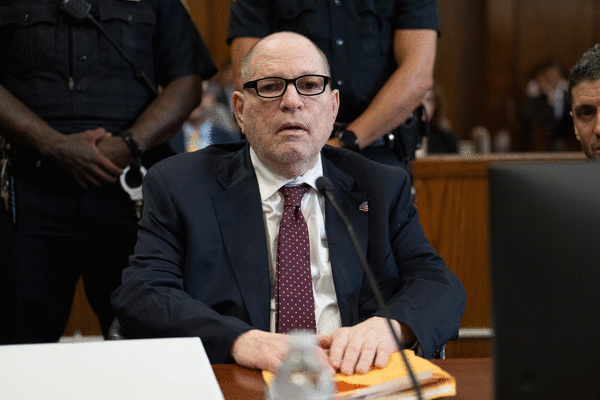
NEW YORK — Miramax founder Harvey Weinstein was sentenced to another 15 years in prison Wednesday for sexually assaulting a production assistant in the heyday of his Hollywood career, the latest conviction for the disgraced mogul.
The term handed down by Manhattan Supreme Court Justice Curtis Farber followed a yearslong legal saga for the victim in this case, former “Project Runway” assistant Miriam Haley, as well as for other women whose allegations against the disgraced film producer led to his precipitous fall from grace.
The revelations about Weinstein, which first surfaced in late 2017, catapulted the #MeToo movement against workplace sexual harassment and abuse onto the global stage. Since 2020, Weinstein has gone on trial three times in Manhattan and once in Los Angeles.
Directly addressing Weinstein, Farber said that when women refused his sexual advances, “You took what you wanted by force.”
“You had it all,” the judge said in his remarks. “Your legacy could have been cemented as one of greatness, but you threw it all away when you assaulted Miriam Haley.”
Describing the fallen filmmaker as a “sexual predator, the literal face of the Me Too movement,” the judge said a significant sentence was warranted given the nature of Weinstein’s crimes and his refusal to accept responsibility for the attacks he was convicted of on both coasts.
Farber, who also imposed five years’ post-release supervision, said the term may run consecutive to the sentence Weinstein must serve for his 2022 rape and sexual assault conviction in California, depending on the judge’s decision at his pending resentencing ordered by an appeals court that upheld the guilty verdict.
In her victim impact statement, Haley broke down into tears, telling the court that her self-esteem had been shattered by the assault and having to relive it repeatedly.
“Having been sexually assaulted by Harvey Weinstein has had a devastating effect on my life and sense of self that may never go away,” she said.
The jury that last summer found Weinstein guilty of violently assaulting Haley inside his SoHo loft in 2006 reached the same conclusion as the initial set of jurors who heard allegations against him at his landmark #MeToo trial in 2020.
Haley had to take the stand again last year after the 2020 conviction was overturned in 2024 by New York’s highest court based on trial testimony unrelated to her allegations or those of another woman whom he was found guilty of raping, Jessica Mann. It was retried twice by Manhattan District Attorney Alvin Bragg, who attended Wednesday’s hearing.
Haley described the entire process as formidable and said she had often considered giving up.
“It’s quite a serious undertaking to stand in the way of a powerful and dangerous man’s freedom,” Haley said. “I certainly didn’t think I’d be standing here again, six years after the initial conviction and 20 years after he assaulted me.”
Speaking to reporters after the hearing, Bragg, who had sought a 20-year prison term, commended Haley and all of the women who came forward against Weinstein, several of whom attended the hearing.
“I’m moved, as we should all be moved, by their courage and their steadfastness through what has obviously been a challenging process,” the DA said.
In urging Farber to impose the same 20 years Weinstein received for the attack on Haley almost seven years ago, Assistant District Attorney Nicole Blumberg detailed a campaign of harassment and intimidation Weinstein waged against Haley and other women from his cell on Rikers Island.
“The defendant doesn’t deserve a day less than his original sentence,” the prosecutor said, later adding, “The people of the state of New York should have confidence that justice in 2026 is the same as it was in 2020.”
In his lengthy statement to the court, Weinstein insisted he was sorry and that he did feel remorse. He said his youngest children were growing up without a father and had been severely bullied in school because of his notorious reputation as a sexual predator.
Once considered among the most influential people in Hollywood, Weinstein said he spends 23 hours a day in a cell on Rikers, “shut off from companionship, sunlight.”
“You’re treated as an animal — you’re actually less than an animal because you’re treated as nothing,” he said.
The judge heard arguments from lawyers for Weinstein, who said the ailing moviemaker, incarcerated since February 2020 and having undergone heart surgery and cancer treatment, deserved leniency.
Defense attorney Marc Agnifilo asked the judge to disregard the mass of sexual abuse allegations Weinstein has faced in various criminal and civil cases, describing it as noise. He emphasized Weinstein had been criminally convicted of abusing just two women. Weinstein is expected to appeal the sentencing.
Outside the courthouse, women’s rights attorney Gloria Allred, who represents Haley, spoke to the many instances of sexual abuse committed by men in positions of power that never make it before a jury.
“It does not only manifest itself in criminal trials,” Allred said. “Countless women enter confidential settlements.”
In graphic accounts of the assault given at both trials, Haley, a Swedish native, described how Weinstein, then 54, forcibly performed oral sex on her inside his loft, disregarding her protests and the fact that she was menstruating.
The jury in 2025 was unable to come to a unanimous decision on Mann’s allegations of a 2013 rape inside a Midtown hotel, resulting in a partial mistrial and another do-over this March.
The former actress, who wept during Wednesday’s sentencing, spent several days on the stand at the third Manhattan trial describing a yearslong, psychologically manipulative relationship with Weinstein punctuated by rape and sexual abuse. Weinstein denies the allegations.
Jurors at this year’s retrial on Mann’s allegations heard only vague reference to the scores of women who have accused Weinstein of abuse, in part due to the appeals court decision that overturned his first conviction.
The third New York jury was also unable to agree on a verdict, and the case ended in another mistrial. Bragg’s office in June said it would not retry the case, citing an “extraordinarily taxing ordeal” for Mann, who testified in front of two grand juries and three trial juries over the course of eight years.
_____
©2026 New York Daily News. Visit at nydailynews.com. Distributed by Tribune Content Agency, LLC.






Comments