Why haven't state officials revealed more about Pennsylvania's measles deaths?
Published in News & Features
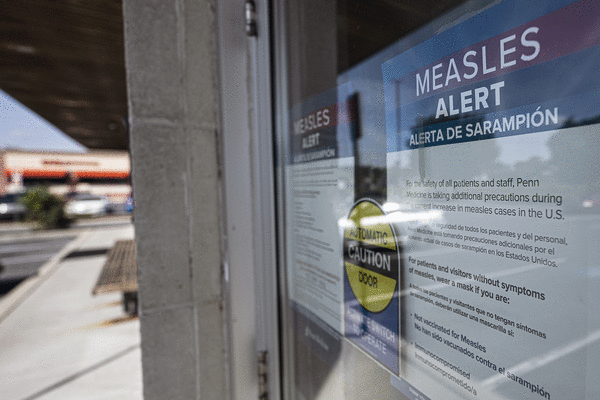
PHILADELPHIA – In the last month, Pennsylvania health officials have announced four measles-associated deaths but have been tight-lipped about almost every detail, beyond sharing their county of residence and that all were unvaccinated.
Most of what the public knows about the four deaths linked to the outbreak — ranging in age from a newborn to a 40-year-old — has come from local coroners in Jefferson, Mifflin, and Lancaster Counties. In one case, a family also spoke to the media.
Pennsylvania’s health department has cited state privacy laws that they say prohibit them from releasing more information. Legal and public health experts acknowledge the state faces legal restrictions, but some argue that the state should do whatever it can to ensure more information about the deaths is made public.
More details about a death, they say, help the public to understand the risks of measles and the benefits of vaccination to prevent the spread of the highly contagious disease.
Transparency around how the state defines measles-associated deaths and unvaccinated people can also head off misinformation, they said, in a highly politically charged environment.
The spreading outbreak has sickened 767 people — now the largest outbreak in the United States — and hospitalized 150 people as of Friday. The deaths reported by the state mark Pennsylvania’s first in 35 years, and the most seen nationally from measles in three decades.
Here’s what to know about Pennsylvania’s privacy laws and how officials communicate in infectious disease outbreaks.
What is known about the measles-associated deaths in Pennsylvania?
State officials announced two “measles-associated” deaths in Lancaster County late last month, though they did not define the term in an initial news release on the cases. They did not provide any additional information, beyond saying both victims were unvaccinated and residents of Lancaster County.
Lancaster County’s coroner subsequently shared that he had investigated one of the deaths, involving an infant who contracted measles in utero and died shortly after birth. The baby tested positive for measles, but, the coroner said, died from a ruptured spleen. Physicians have pointed out that measles can damage a person’s spleen, putting it at higher risk for rupture.
The state has continued to characterize the Lancaster County infant’s death as “measles-associated,” meaning it occurred within 30 days of symptom onset in a person with clinical evidence of infection and a positive laboratory test for measles, and who did not die of another unrelated cause, like a car crash.
Lancaster’s coroner said a second death, in a 6-week-old Lancaster County baby, was caused by measles. The child also had Amish lethal microcephaly, a fatal genetic disorder that makes it especially risky to contract a respiratory illness like measles.
State officials confirmed two more measles-associated deaths last week.
Jefferson County’s coroner said measles led to the death of a 40-year-old unvaccinated woman with severe respiratory conditions. A postmortem test showed the woman had an active measles infection, and she had also been exposed to a person with a lab-confirmed measles case.
Mifflin County’s coroner also confirmed that an unvaccinated 18-year-old died of a rare neurological complication of measles.
Why are state and federal officials clashing over the deaths?
Starting with the initial news conference to announce the first two deaths, Democratic Gov. Josh Shapiro has traded barbs with President Donald Trump’s Health and Human Services secretary, Robert F. Kennedy, Jr., over the outbreak.
Shapiro has accused Kennedy, a longtime anti-vaccine activist, of spreading misinformation contributing to a decline in vaccination rates. Kennedy said in a social media post that Shapiro’s staff may have “fabricated” the deaths, after the Lancaster County coroner’s comments, though Kennedy later acknowledged one infant’s death was caused by measles.
Federal officials said Tuesday they were aware of the third and fourth deaths reported in Pennsylvania but have not updated the federal website tracking measles cases to reflect any of the deaths reported by Pennsylvania. They have said they will record measles-related deaths when the National Center for Health Statistics “identifies measles as the underlying cause based on death record information submitted by the states.”
Democrats and public health experts have harshly criticized the decision, saying it’s a departure from established procedures for recording infectious disease deaths.
State health officials said they have discussed the details of each case with CDC professional staff, “at length.”
“At no point did CDC staff express any concern or issue with the data we provided,” they wrote in a statement.
Why is the health department not releasing more information on measles-associated deaths? Why can coroners give out more information?
Pennsylvania health officials have cited two state laws: one prohibiting public access to death records and another that requires the state to keep records of diseases confidential, except when it’s necessary to inform the public of the risk of communicable disease.
But coroners and medical examiners are county officials who operate by different rules, the state said in a frequently-asked-questions document posted online last week. Laws governing coroners’ duties and the state’s right-to-know statute allow them to provide the public with identifying details like a person’s cause and manner of death, the state says.
“Releasing additional details beyond what we did could have led to the unnecessary identification of individuals and their families. Further, the specific details of a single case do not change the important message that measles is a highly contagious virus that can cause severe illness and complications, and the MMR vaccine is the best protection against it,” state health officials said in a statement.
Legal experts say decision-making around what to reveal about a death during a measles outbreak is difficult, and privacy laws do apply to health departments.
Robert Field, a professor emeritus at Drexel University’s Thomas R. Kline School of Law, said health departments typically release aggregate data about disease outbreaks, not individual deaths.
“Confidentiality and privacy are major issues for any health department, which is why the regulations are stricter,” he said. With just a few measles-associated deaths reported, he said, releasing further details about the deaths could risk identifying families.
“A newborn dying with a ruptured spleen — there aren’t a lot of those,” he said, referencing one case in Lancaster County. “In terms of additional information, further details that would ID the patients — that would be off-limits.”
Why are some experts criticizing state officials over their communications strategy?
Releasing less information about a death risks creating an “information vacuum,” especially in a highly politically charged environment, said Amesh Adalja, an infectious disease physician at the University of Pittsburgh Medical Center.
Unlike the first two deaths, announced by the state last month without further detail, the public immediately knew more about the two disclosed last week, he noted, crediting coroners in Jefferson and Mifflin Counties who have been forthcoming with information about the deaths.
“Coroners talking in detail about cases they’ve been handling, as well as the parents of the neonate that died” provided “really important information that helped bring a lot of clarity to an information vacuum,” said Adalja, who is also a senior scholar at the Johns Hopkins Center for Health Security.
Adalja has said the state should have been clearer from the onset about how it defines measles-associated deaths, and could have provided information about the victims’ general age ranges — for example, whether they were adults or children. And the state could involve other officials who are not restricted by the same privacy laws, he said.
“If they assess they are bound by Pennsylvania state law in a way that county coroners are not, include coroners in the press conferences,” Adalja said.
He added that Shapiro and Kennedy’s political fight over the nature of the deaths risks overshadowing a serious measles outbreak that has sickened hundreds.
“The anti-vaccine movement has really made inroads here — people are calling this a hoax,” he said. “It’s obviously not a hoax. And there are real actions that need to be taken. It’s much harder to do that work when you [are] engulfed in some political problem.”
Arthur Caplan, a New York University professor emeritus, wrote in an Inquirer op-ed Thursday that the state should provide “maximum information” about the deaths “in order to prevent further harm.”
He sharply criticized Kennedy, accusing the nation’s top health official of spreading misinformation about vaccine safety and the threat of measles: “[Nothing] the federal government has to say about measles is trustworthy,” he wrote.
In an interview, he said state should weigh privacy obligations with the need to inform the public about whether victims had exposed others to measles.
“In the middle of an epidemic, those laws need to be pushed as far as you can,” he said.
Drexel’s Field said the state could also have emphasized that “unvaccinated” does not necessarily mean that a person chose not to take a measles, mumps, and rubella vaccine. Some people, like newborns, pregnant women, and people with weakened immune systems, are unable to be vaccinated.
“People should know that if they choose not to be vaccinated and contribute to the spread, it could affect people who did not decline vaccination by choice but are in such fragile health that there is no choice,” he said.
State officials have said that even revealing that someone was too young to be vaccinated would be enough to identify the deceased in small communities.
It’s imperative that health officials balance the need to inform the public and maintain trust amid the growing outbreak, Field said, especially as vaccination rates drop.
“If the credibility of the state health department is questioned by the public, then I think we’re in big trouble. And that would be a very unfortunate outcome of this,” he said.
©2026 The Philadelphia Inquirer, LLC. Visit at inquirer.com. Distributed by Tribune Content Agency, LLC.





Comments