AI can supercharge Putin's goals, not his great-power ambitions
Published in News & Features
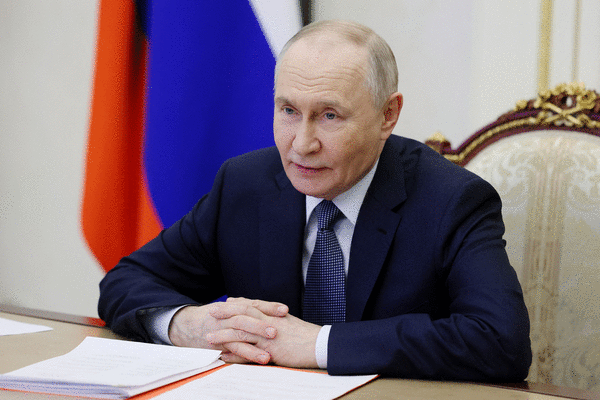
When President Vladimir Putin imposed harsh censorship laws in the wake of his 2022 invasion of Ukraine, a major Russian publishing house took drastic action.
Faced with trawling through the thousands of volumes it had published over the previous twenty years in light of the new restrictive criteria, the Eksmo-AST group trained an AI agent to highlight books and passages that risked falling foul of the law so they could be removed from bookshelves.
The publisher conducted some 20,000 checks, and 600 volumes were handed over to external experts for additional reviews, Oleg Novikov, the group’s president, told Russian state television. “We’re here on the frontier of technological progress,” he said.
However overblown the claim, the use of artificial intelligence in Russia is widespread. It lags in the race to develop cutting edge models — a contest dominated by the U.S. and China — but Moscow has become adept at co-opting AI for real-life situations.
More often than not, Putin’s regime is the chief beneficiary.
AI-powered drones are increasingly used to bomb Ukraine, bots create fake social-media profiles to disseminate the Kremlin narrative abroad, while at home facial-recognition surveillance networks keep track of citizens. It’s a source of pride for the president, who frequently mentions AI in his speeches and comments to officials.
“Russia is probably one of only a handful of countries — perhaps one of just three — that both have the opportunity and are actively developing their own sovereign AI capabilities,” Putin boasted recently.
Russia is developing applied, narrow AI for many spheres of life, including state services, improvements in industrial production, and healthcare. As in the U.S. and the U.K., it’s been using AI to develop individual vaccines for cancer, for example.
It can boast at least two major large-language models: Alice, developed by Russia’s equivalent to Google, Yandex; and Gigachat from Sberbank, the biggest Russian lender.
Sberbank’s AI is about six months behind China and a year behind the most advanced U.S. models, according to Chief Executive Officer Herman Gref, a long-time Putin ally.
Yet the clearest sign that these models aren’t competitive is that hardly anyone outside of Russia uses them.
It’s indicative of how Putin’s ambitious goal to build world-class AI is falling short. The war in Ukraine, sanctions, hardware constraints and the ideology of his regime focused on self-isolation all cloud the chances of realizing his aim, according to people familiar with Russia’s AI capabilities. All asked not to be named discussing sensitive matters of government priority.
Starved of high-end AI accelerators made by the likes of Nvidia Corp., with investment increasingly geared toward the war economy instead of technology, and lacking access to non-Russian data-sets, the country has turned to Chinese and even western open-weight models for some military applications.
“You won’t need the world’s best AI to coordinate a swarm of bots or drones. Where you do need frontier AI is to build the next generation of AI models and stay ahead of everyone else,” said Sergei Guriev, the dean of London Business School and a long-standing critic of the Russian president. “I do not think Putin will have that capability.”
For a power that went head-to-head with the U.S. throughout the Cold War in nuclear weapons and the space race, that risks ultimately diminishing Russia as a leading geopolitical player.
As Putin himself said: “In essence, major countries — true civilizations — face a historic choice: Either they create their own platform and technological ecosystems, or they become a digital periphery.”
For now, though, Russia’s AI capabilities are likely sufficient for the state’s needs.
Long before the full-scale invasion of Ukraine, the Kremlin played with automated assistants to create powerful bot farms that flooded social networks. Now it’s working on building AI-driven drone swarms, said one of the people with direct knowledge of the efforts. A few Chinese open-weight models are more than enough to help in this line of work, the person said.
Last week, Anthropic PBC said that users in Russia it determined were not linked to the state tried to use its Claude model to develop kamikaze drone swarms.
There is evidence of more systemic efforts to produce tactical AI applications and systems.
In February, OpenAI banned a cluster of ChatGPT accounts that were linked to Russian pro-war Telegram channel Rybar and its network for disseminating pro-Kremlin disinformation. European countries meanwhile expect cyber threats from Russia to intensify as more advanced artificial intelligence tools spread.
Commercially available AI models can be adapted and redeveloped for military use.
Many of China’s most capable models allow users to download them and use them independently on their own servers, which means the developers don’t retain technical control over the copies, according to one of the people. These models are good enough for the tasks drone makers need them for, said another.
This hybrid approach allows Russia to mitigate sanctions and accelerate AI adoption without building foundational models from scratch, according to Kateryna Bondar, a senior fellow with the Wadhwani AI Center at the Washington-based Center for Strategic and International Studies.
“State-linked organizations use GigaChat and YandexGPT, while developers continue building on open-weight models, now mostly Chinese,” she said.
When Putin first expressed interest in AI, it was about supporting the economy and facilitating the everyday lives of Russians. Now it’s principally about national security and Russian sovereignty.
Sberbank’s Gref is one of two Putin allies trying to educate the president about the technology. The other is former Finance Minister Alexei Kudrin, who also advises Yandex. Putin’s daughter, Katerina Tikhonova, has an interest in the subject and is seen as another channel for explaining the technological limits of isolation to Putin.
Putin often relies on assessments of AI capabilities provided by security agencies which favor tighter controls, two of the people said. While there are still plenty of public calls to develop AI, security officials repeatedly focus on the threats, espionage and restrictions, so this filters out many of the tools, technologies and international links needed to develop it effectively, they said.
At meetings in the Kremlin and in government, the dominant voice in determining Russia’s approach to AI is that of the Federal Security Service, the people said.
Battlefield data
Russia and Ukraine have gathered an unprecedented amount of battlefield data from cameras attached to the millions of drones they deploy annually. Both Russia and NATO members are testing attritional drones, electronic warfare, missiles and command software in Ukraine.
Kyiv has offered a vast dataset to international partners to train neural networks to identify targets using real data. The Russian Defense Ministry has recently opened its own archive to trusted domestic developers for training AI models, including hundreds of terabytes of high-quality video from fiber-optic and radio-controlled strike drones.
Russia is learning and adapting fast, according to Bondar at CSIS, who cited the transfer of self-targeting technology to long-range strike weapons as having “materialized within months.” The main constraint, she said, “is not talent or ambition, but compute and components.”
AI development requires access to huge sets of data, energy resources and the highest-end electronic components available, not to mention the best brains. While Putin claims he has it all, there are limits to what Russia can do — even if China has proved it can achieve near parity with U.S. capabilities at a fraction of the cost.
AI is all about scale and the balance here is clearly not in Russia’s favor, according to Ekaterina Vlasova, Russia economist with Bloomberg Economics. She contrasted Russia’s potential investment with spending by U.S. Big Tech companies of more than $700 billion this year alone, arguing that Moscow can’t compete “on computing scale or capital intensity.”
“The government may push for sovereign AI, but the more plausible path is the gradual adoption of Chinese technologies — potentially re-branded as ‘domestic’ solutions,” she said.
Sberbank’s Gref claims that his AI is the only “fundamental model fully developed by a Russian company.”
“Yandex today is just fine-tuning Qwen,” Gref said July 17. “It is based on a Chinese model.”
Yandex categorically denied Gref’s claim. The company says its Alice AI is the fastest-growing Russian neural network and remains the country’s most popular AI service.
Special commission
This year, the Kremlin formed a special commission led by Putin’s economic aide Maxim Oreshkin and Deputy Prime Minister Dmitry Grigorenko to oversee “key technology transforming all sectors of the economy.”
Russia adopted its first comprehensive AI law, effective Sept. 1, creating two categories of approved models. A “sovereign” model must be developed and controlled in Russia, while a “national” one may use foreign or open-source components but must remain under Russian control and operate on Russian infrastructure.
Demand for AI is meanwhile on the rise in Russian society. Alexey Zakharov, the founder of recruitment platform SuperJob, has increasingly turned to AI consulting, advising clients in the defense and education sectors how to deploy the technology and launching popular Telegram channels devoted to AI.
Still, Zakharov is doubtful about Russia’s chances to be able to develop frontier foundation models, saying “there are simply no chips.”
To be sure, Russia doesn’t need the latest AI to continue to pose a geopolitical threat.
AI can easily enhance Putin’s abilities as global disruptor and a domestic autocrat, according to Fiona Hill, who served as the top Russia adviser on the U.S. National Security Council in President Donald Trump’s first term and is now a senior fellow at the Brookings Institution.
“Putin doesn’t need a frontier model to supercharge with AI his military, surveillance or propaganda capabilities,” she said. “There are enough available tools and applications to do that at much lower cost for now.”
—With assistance from Julius Domoney.
©2026 Bloomberg L.P. Visit bloomberg.com. Distributed by Tribune Content Agency, LLC.






Comments